

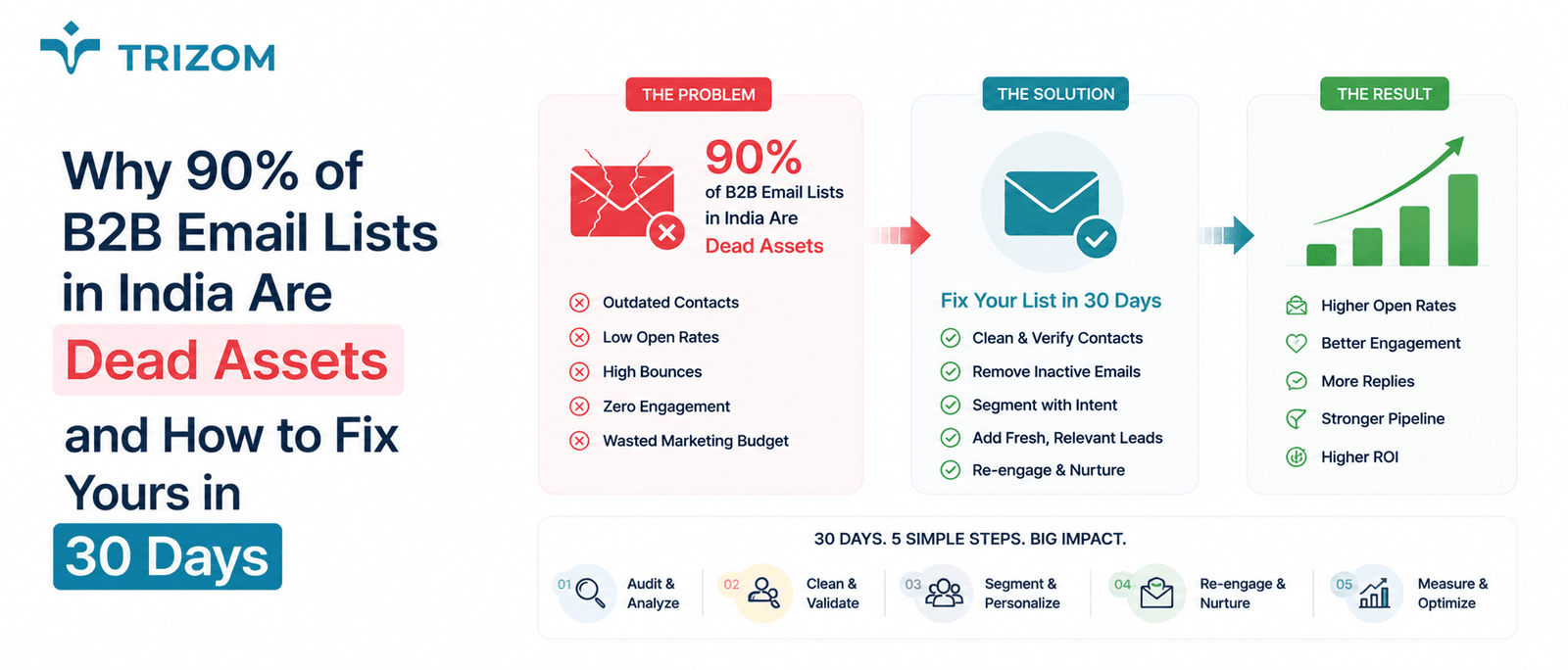
Somewhere in your CRM right now sits a database of hundreds, possibly thousands, of contacts your sales team spent years collecting. Referrals, event attendees, webinar registrants, past enquiries, cold outreach responses. Every one of them was a live opportunity at some point.
Most of them have not heard from you in months.
That database is not an asset anymore. It is a graveyard. And email marketing for B2B in India is the only tool that can bring it back to life, but only if you stop treating every contact the same way and start treating your B2B email list in India like the segmented, behaviour-driven pipeline it was always meant to be.
Here is exactly what killed your list and how to fix it in 30 days.
Why B2B Email Lists Die in Indian Companies
The death of a B2B email list in India rarely happens overnight. It happens gradually, through a pattern of well-intentioned but strategically misaligned email habits that erode engagement one send at a time.
Here is the pattern that plays out in almost every sales and marketing team we have worked with.
The list grows through multiple channels with no consistent qualification process. Everyone gets added to the same master list regardless of where they came from, what they expressed interest in, or where they are in the buying journey. Every contact receives the same newsletter, the same product update, the same festival greeting email.
Over time, open rates drop. Nobody investigates why. The team sends more frequently to compensate. Unsubscribes climb. Gmail and Outlook begin routing the domain to spam. The list that took three years to build now delivers a 4% open rate and a 0.2% click rate.
That is not an email problem. That is an email segmentation for B2B problem dressed up as a deliverability problem.
The 30-Day Fix: What to Do and When
Week 1: Audit and Segment Before You Send Another Email
Stop all outgoing email immediately. Sending more emails to a disengaged list makes your deliverability problem permanently worse.
Spend the first week doing one thing: segment your B2B email list in India based on the data you already have.
Divide your contacts into at minimum four buckets. Active engaged contacts who opened or clicked within the last 90 days. Warm contacts who engaged between 90 and 180 days ago. Cold contacts with no engagement in over 180 days. And completely unresponsive contacts who have never opened a single email.
Each bucket needs a completely different strategy. Treating them the same is what created the problem in the first place.
Email segmentation for B2B at this level does not require sophisticated technology. It requires honest interrogation of the data you already have inside your CRM.
Week 2: Launch a Re-Engagement Campaign for Cold Contacts
Your cold and warm segments need a re-engagement email campaign before they receive any sales or nurturing content.
A re-engagement sequence for B2B email list recovery in India has one job: confirm whether the contact still wants to hear from you and give them a reason to say yes.
The sequence structure that works consistently for Indian B2B companies looks like this.
Email one goes out on day one with a subject line that acknowledges the silence directly. Something like “We have not spoken in a while. Is this still relevant to you?” performs significantly better than a promotional subject line for cold contacts because it creates pattern interruption in an inbox conditioned to ignore your domain.
Email two goes out on day four with a piece of genuinely useful content. Not a product pitch. A specific insight, a short case study, or a practical framework relevant to the contact’s industry and role. This is where email copywriting for B2B in India separates average campaigns from ones that actually rebuild engagement.
Email three goes out on day seven as a final check-in with a clear binary choice. Stay on the list or opt out. Contacts who do not respond to any of the three emails should be suppressed immediately. Keeping unresponsive contacts on your list damages your sender reputation and reduces deliverability for every email you send to the contacts who do want to hear from you.
Week 3: Build Drip Campaigns Around Subscriber Behaviour Triggers
Once your list is segmented and your re-engagement campaign is running, shift your focus to the engaged contacts.
Drip campaigns for B2B in India built around subscriber behaviour triggers outperform broadcast email campaigns by a significant margin because they respond to what a contact actually does rather than what you assume they want to receive.
Subscriber behaviour triggers that every Indian B2B company should be tracking include email opens without clicks, link clicks on specific content topics, website visits from email traffic, whitepaper or case study downloads, and pricing page visits.
Each of these signals tells you something specific about where the contact sits in their buying journey. A contact who clicks a link about implementation methodology is further along in evaluation than one who opened a thought leadership article. Your drip campaign for B2B in India should respond to that distinction with a different next email in the sequence.
Marketing automation in India through tools like HubSpot, Zoho, or Mailchimp makes this trigger-based approach implementable without manual intervention. The investment in setup pays back immediately in relevance, and relevance is what drives email open rate improvement in India sustainably.
Week 4: Integrate Your Email System With Your CRM
The final week of your 30-day fix addresses the root cause of why most Indian B2B email lists become disconnected from actual sales activity in the first place.
CRM email integration in India closes the loop between your marketing email activity and your sales pipeline. When a salesperson can see that a prospect opened four emails, clicked a pricing link, and downloaded a case study in the last two weeks, their follow-up call has context. That context changes the entire quality of the conversation.
Without CRM email integration, your marketing team and sales team are operating with different information about the same prospect. Marketing thinks the lead is cold because they have not responded to emails. Sales thinks the lead is uninterested because they have not returned calls. The prospect is actually mid-evaluation, consuming your content quietly, and waiting for someone to reach out with something relevant.
Lead nurturing email strategy in India connected to CRM data ensures that the handoff from marketing nurture to sales outreach happens at the right moment, triggered by the right behaviour signal, rather than based on an arbitrary follow-up schedule.
What Your B2B Newsletter Strategy Should Actually Look Like
A B2B newsletter strategy in India is not a monthly update about what your company has been doing. Nobody reads those. Nobody forwards those. Nobody books a meeting because of those.
A B2B newsletter that drives email campaign ROI in India delivers one specific, actionable insight relevant to the reader’s role and industry in every send. It is short enough to read in under three minutes. It has one clear CTA that serves the reader’s interest, not just yours. And it arrives consistently on the same day and time each week, so subscribers develop an expectation of its arrival.
The companies generating measurable pipeline from their newsletters in India are the ones that have made their newsletter genuinely useful to their specific audience. Not useful-in-general. Useful-to-their-exact-buyer-persona-on-a-Tuesday-morning useful.
That level of specificity is what transforms a B2B newsletter strategy from a vanity metric exercise into a cold email-to-warm-lead pipeline that your sales team can actually work with.
How Trizom Revives Dead B2B Email Lists
At Trizom, our email marketing for B2B process in India starts with your existing list, not a blank slate. We audit your current database, segment contacts by engagement level and buying stage, build re-engagement sequences for cold contacts, and design trigger-based drip campaigns for B2B in India that respond to real behaviour rather than assumed intent.
We set up CRM email integration so your sales team has full visibility into prospect engagement, and we build a B2B newsletter strategy in India that your subscribers look forward to receiving because it consistently delivers something worth their attention.
Your email list is not dead. It is dormant. And the difference between those two things is a structured 30-day strategy that treats your contacts as individuals with specific needs rather than names on a spreadsheet waiting for your next broadcast.
Conclusion
A neglected B2B email list in India is one of the most recoverable assets a sales and marketing team possesses, but only if the recovery strategy addresses the root causes rather than just sending more emails to a disengaged database. Proper email segmentation for B2B, trigger-based drip campaigns, a genuine re-engagement email campaign, and tight CRM email integration transform a dormant list into a consistent source of warm, pre-nurtured leads. Email marketing for B2B in India done correctly in 2026 is not about volume. It is about relevance delivered at exactly the right moment to exactly the right person.
Is your B2B email list generating pipeline or collecting dust?
Let Trizom Build Your Email Strategy
Frequently Asked Questions

How do drip campaigns help B2B companies in India convert cold contacts into leads?
Drip campaigns for B2B in India convert cold contacts into warm leads by delivering a pre-planned sequence of relevant, value-led emails over a defined period, gradually building familiarity, trust, and purchase intent without requiring manual intervention at every touchpoint. Unlike broadcast emails that treat every contact identically, a well-structured drip sequence responds to subscriber behaviour triggers such as email opens, link clicks, and website visits, automatically advancing the contact to the next stage of the sequence based on their actual engagement. This approach to lead nurturing email strategy in India consistently outperforms cold outreach because it warms the prospect through demonstrated expertise before any sales conversation begins.
What is email segmentation and why is it critical for B2B email marketing in India?
Email segmentation for B2B is the process of dividing your contact database into distinct groups based on shared characteristics such as industry, job title, buying stage, past engagement behaviour, and content interests, and then sending each group emails specifically relevant to their situation. For Indian B2B companies with diverse contact databases built across multiple channels over several years, segmentation is the single most impactful improvement available to email open rate improvement in India. A financial services firm receiving an email written for a manufacturing company will not engage, regardless of how well written the email is. Segmentation ensures relevance, and relevance is what drives open rates, click rates, and ultimately email campaign ROI in India.
How does CRM email integration improve B2B email marketing performance in India?
CRM email integration in India connects your email marketing platform to your sales CRM so that every email open, click, download, and website visit is visible to your sales team alongside the contact's full relationship history. This integration eliminates the information gap between marketing and sales that causes perfectly warm prospects to be ignored because neither team has a complete picture of the contact's engagement level. When marketing automation in India is connected to CRM data, trigger-based emails can fire automatically when a prospect performs a high-intent action such as visiting your pricing page or downloading a case study, creating a seamless cold email to warm lead pathway that requires minimal manual intervention from your sales team.
How do you improve email open rates for B2B email campaigns in India?
Sustainable email open rate improvement in India for B2B campaigns comes from four interconnected improvements. First, list hygiene through removal of unresponsive contacts and a structured re-engagement email campaign for dormant subscribers improves your sender reputation and deliverability. Second, email segmentation for B2B ensures that each contact receives content relevant to their specific role and buying stage, making every send worth opening. Third, subject line testing that focuses on specificity, curiosity, and direct relevance to the recipient's actual problem consistently outperforms generic subject lines. Fourth, sending cadence optimisation through subscriber behaviour triggers rather than arbitrary broadcast schedules means contacts receive emails when their engagement signals indicate readiness, not just when your content calendar dictates the next send.
