

Festive Season Meta Ads for D2C Brands: High ROAS, Hidden Losses

If you run a D2C skincare, fashion, food or wellness brand in India, you already know the festive season is supposed to be your biggest quarter. Yet, after a September of strong ROAS, October often brings a sinking feeling: revenue up, profits down. The culprit? Festive season Meta ads for D2C brands can quietly drain your margins if you ignore the warning signs.

We see it every year. CPMs spike, discounts eat into contribution margin, COD RTO balloons and even your best creatives burn out faster than you can refresh them. Suddenly, your campaign looks great on the dashboard but your Shopify payout tells a different story.

This post breaks down why this happens, and what you can do about it. If you want to come out of Diwali with money in the bank, not just more orders, read on.

TL;DR

  • D2C brands see profit drops during festive season Meta ads due to CPM spikes, discounting and high return rates.
  • Revenue often rises but contribution margin falls, especially with short-term sales thinking.
  • COD RTO and creative fatigue can quietly wipe out gains from increased traffic.
  • Start planning Meta ads early and focus on campaign structure, creative refresh and margin control to win Diwali profitably.

Why do D2C brands in India lose money on festive season Meta ads despite increased revenue?

D2C brands lose money on festive season Meta ads in India because CPMs spike, discounts cut into margins, COD RTO increases and ad creatives fatigue quickly. This means that even as sales revenue goes up, costs and returns rise faster, leading to profit loss.

Understanding CPM spikes and their impact on ad costs

CPM, or cost per thousand impressions, shoots up during the festive season. Every D2C founder notices it: ads that cost Rs 70 CPM in September suddenly cost Rs 120+ as Diwali nears. This is not just inflation, it’s a direct result of every brand fighting for the same eyeballs, causing auction prices to soar.

What causes festive CPM spikes?

Meta’s auction-based model means that when every D2C and retail brand increases budgets for Diwali, competition increases. More bidders, higher CPM. On top of that, platforms detect intent and seasonal demand, further raising costs for sale-related campaigns.

How rising CPMs hit your performance marketing

When CPM increases but your conversion rate stays flat, or even drops due to creative fatigue or poor targeting, you pay more for each sale. For D2C performance marketing in India, this can mean your Meta ads ROAS drop even if your top-line revenue grows. Suddenly, your CAC (customer acquisition cost) is out of sync with your contribution margin.

Festive Ad Cost Impact September October (Festive)
CPM (Rs) 70 120+
ROAS High Drops

To avoid this, you need to stagger budgets and build up your audience early, not just pour money in the last 7 days before Diwali.

How discount-led sales erode margins despite revenue growth

Discounts work to drive volume, but most D2C brands in India run into a trap: the more aggressive the offer, the thinner the margin. During festive sale periods, contribution margin often shrinks so much that even a spike in orders can’t save your bottom line.

Why discounts aren’t always your friend

Sure, your revenue dashboard looks strong. But if your offer is 40% off plus free shipping, and CPMs are up, what is left over? Many Shopify brands in India see revenue double but profit halve in festive sales. The maths rarely works out unless you rigorously model your margin scenarios before setting sale prices.

Framework for protecting contribution margin

  • Calculate break-even CAC for every product group.
  • Model 3 scenarios: no discount, 20% off, 40% off, with real CPM projections.
  • Factor in expected RTO and returns on COD orders.
  • Set a maximum discount cap; do not cross it even if competitors go lower.
  • Push bundles, value packs or limited editions to lift AOV (average order value) without shrinking margin.

This approach keeps you from falling into the trap of chasing revenue at the cost of actual profit.

The rising challenge of COD RTO and its effect on profitability

COD RTO (Cash on Delivery, Return to Origin) is the silent killer of D2C festive sales. When you run high-traffic campaigns, especially with new audiences, expect a sharp rise in RTO rates on COD orders. This is especially true in India, where prepaid penetration is still catching up.

How COD RTO eats into your profit

Every undelivered COD parcel costs you shipping both ways, blocked inventory, and sometimes even damages. During Diwali, COD RTO can spike as impulse buyers place orders they never intend to receive. This wipes out gains from any Meta ads ROAS drop you were trying to manage.

Actionable steps for D2C brands

  • Segment audiences by past prepaid behaviour and prioritise them in retargeting.
  • Show COD options only to users with a history of successful orders.
  • Deploy WhatsApp or IVR confirmations for high-value COD orders.
  • Factor RTO into your contribution margin planning, not after the fact.

Return rate management is as important as ad optimisation for Indian D2C brands during festive season sales.

Creative fatigue: Why ad performance drops fast and how to combat it

Ad creative fatigue means your audience has seen the same festive sale banners too many times. On Meta, this can set in within days during high-budget periods. Engagement drops, CTR falls and your CPM rises further as Meta’s algorithm deprioritises your stale ads.

Why creative fatigue is worse during Diwali

Volume is not the only problem. Every D2C brand is pushing similar offers. If you use generic creative assets, your campaign gets lost in a sea of sameness. By week two, even your best-performing visuals lose their edge.

How to keep creative fresh and effective

  • Prepare at least 4-6 festive-specific creative sets before the sale begins.
  • Mix formats (video, carousel, static, reels) and messaging (offer-led, storytelling, UGC).
  • Plan a mid-sale creative refresh, not just at launch.
  • Test copy angles specific to each region or cohort.
  • Use dynamic product ads with fresh overlays for high SKU brands.

Creative variety and timely refresh are your best defence against fatigue-induced ROAS drops.

Strategic campaign planning: Moving beyond the 7-day sale

Most D2C brands treat festive sales as a 7-day sprint. The brands seeing real profit treat it as a 90-day campaign. This is a non-obvious shift, but it is where most of your competition gets it wrong.

Why long-term planning wins

Meta’s algorithm learns over time. If you only start ramping up in the final week before Diwali, you pay the highest CPMs, your audiences are cold, and your retargeting pools are undercooked. Early starters use September and early October for awareness and warm-up, then scale sales in the final push with already engaged users.

How to build a 90-day festive campaign calendar

  • Phase 1 (60-45 days before): Run awareness and engagement campaigns to build pixel and video custom audiences.
  • Phase 2 (45-15 days before): Launch early bird and waitlist offers, collecting leads and warming up potential buyers.
  • Phase 3 (last 15 days): Open main sale, heavy on retargeting and lookalikes built from earlier phases.
  • Post-sale: Run win-back and review campaigns to maximise LTV (lifetime value).

This structure gives you more stable CPMs, better creative performance and a higher share of profit from festive sale marketing in India.

For a look at how long-term campaign thinking pays off in another high-competition category, our festive real estate lead generation guide shows similar patterns outside D2C.

Leveraging Meta Advantage+ shopping campaigns for efficiency

Meta Advantage+ shopping campaigns use machine learning to optimise delivery and budget allocation across your product catalogue. For D2C brands in India, these campaigns can help you reach new buyers while controlling cost spikes during the festive season.

When to use Advantage+ shopping campaigns

If you have a large SKU count and a sizeable catalogue, Meta’s automation can help you identify winning products and creatives in real time. This is especially helpful when manual optimisation is too slow to react to rapid festive market changes.

Best practices for D2C brands

  • Feed clean product data and high-quality images.
  • Start with a test budget early, then scale winners during the peak sale period.
  • Monitor for overlap with manual campaigns; avoid cannibalisation.
  • Layer in retargeting for high-margin SKUs.

These campaigns are not a set-and-forget solution, but they can save time and improve ROAS efficiency when competition peaks. For more on automation, see our AI marketing automation services page.

Balancing CAC payback and contribution margin during festive sales

Too many D2C brands focus on top-line revenue and ROAS, ignoring the lag between customer acquisition cost (CAC) and payback period. Festive sale buyers are often less loyal and less likely to repeat unless you have a plan for LTV.

What is CAC payback?

CAC payback is the time it takes for a new customer to generate enough gross profit to cover the cost of acquiring them. If you acquire at a loss during Diwali but make it up in later months, that’s fine, if you have a working retention strategy.

How to manage CAC and contribution margin

  • Tag festive buyers and set up tailored post-purchase flows (email, WhatsApp, remarketing).
  • Push for prepaid and subscription where possible to lock in future value.
  • Re-invest a fixed share of festive profits into retention, not just acquisition.
  • Review contribution margin weekly, not just after the sale ends.

This is where D2C retargeting campaigns matter: not just to convert, but to keep new customers coming back. For more on closing the loop between acquisition and retention, our content marketing services page explains nurturing strategies that fit D2C brands.

Case studies or examples of successful festive Meta ads in India

While we cannot share confidential client data, here are anonymised takeaways from D2C brands that protected profit during festive Meta ad campaigns:

  • One skincare brand started awareness campaigns 45 days before Diwali and saw stable CPMs, higher retargeting ROAS and 22% lower COD RTO than the previous year.
  • A fashion label ran six creative sets, refreshing every 5 days, keeping CTR above 2.5% throughout the sale.
  • A food D2C brand capped discounts at 20% and focused on bundles, maintaining 18% contribution margin even as sales volume doubled.

The common link: long-term planning, creative discipline and margin control at every step.

Key takeaways

  • CPM spikes and discounting kill margin even as sales rise during festive season Meta ads for D2C brands.
  • COD RTO and creative fatigue are silent threats to profitability in Indian festive sales.
  • Long-term campaign planning (60-90 days) outperforms last-minute 7-day blitzes.
  • Use Meta Advantage+ shopping campaigns for catalogue efficiency but monitor overlap.
  • Focus on CAC payback and contribution margin, not just revenue or ROAS.
  • Refresh creatives and layer retargeting for both acquisition and retention.

Frequently asked questions

Why do CPMs spike during the festive season for Meta ads?

CPMs spike during the festive season because every brand increases their ad spend to compete for the same audience. This competition in Meta’s auction-based system drives up the cost per impression, especially in India during Diwali sales.

How can D2C brands reduce losses caused by discount-led sales?

To reduce losses, D2C brands should cap discounts, focus on bundles or higher-margin products, and model margin scenarios before launching sales. Avoid unsustainable offers and always account for increased ad costs and returns when planning festive discounts.

What is COD RTO and how does it affect D2C profitability?

COD RTO means Cash on Delivery Return to Origin, when a customer refuses or cannot receive a parcel. This increases shipping and handling costs, blocks inventory, and reduces profit. Festive periods see higher RTO rates in India, directly hurting D2C margins.

How to prevent creative fatigue in festive season ad campaigns?

Prevent creative fatigue by preparing multiple festive-specific creatives, refreshing them mid-sale, and mixing formats and messaging. Monitor frequency and engagement metrics, and be ready to test new ideas quickly during the busy period.

What is the ideal duration for festive season Meta ad campaigns?

The ideal duration is 60 to 90 days, starting with awareness and engagement campaigns, then gradually shifting to sales and retargeting as Diwali approaches. Short 7-day blitzes miss out on audience warm-up and efficient spend.

How do Advantage+ shopping campaigns help during high-competition periods?

Advantage+ shopping campaigns use automation to optimise ad delivery and budget allocation, identifying winning products and creatives. This helps D2C brands manage costs and improve ROAS during periods of high competition like Diwali.

Get your Meta ad account festive-ready

If you want to avoid hidden losses this Diwali and run festive season Meta ads for D2C brands that truly protect your bottom line, our team can help. Book a free festive ad account audit before Diwali and get tailored feedback for your brand. Let us help you turn festive revenue into real profit this year.

Published by

Trizom Private Limited

A full-service digital marketing company in Jaipur helping businesses in India, the UAE, Singapore and Australia turn search, ads and content into qualified leads.


Our services  |  Talk to our team

Solar Installer Lead Generation India: Winning Leads Beyond Price Wars

If you’re a residential rooftop solar installer or empanelled vendor in India, you know the pain of the solar installer lead generation India grind. PM Surya Ghar has opened the floodgates: more than 29,000 active vendors, all fighting for attention from the same pool of homeowners. You buy the same shared leads, compete on the same portal and it’s turned into a race to the lowest price. Margins are thinner, conversion is tougher, and it’s hard to stand out.

We see you. You’re not just selling panels, you’re building a business in an overcrowded market. It’s tempting to undercut the competition, but that path leads to stress, unsustainable profits and a reputation as “the cheap guy”. There’s a smarter way to win quality leads, by using digital marketing, building trust, and showing real value beyond just cost.

This guide gives you practical, India-specific tactics to escape the price war. We’ll show how to leverage the unique PM Surya Ghar ecosystem, use the right digital channels, and turn customer trust into your biggest sales asset.

TL;DR

  • Vendor saturation under PM Surya Ghar has made lead generation a price-driven battleground, eroding profits for solar installers.
  • You can win quality leads without undercutting by using digital marketing, Google Business Profile reviews, and leveraging subsidy and compliance knowledge.
  • Integrating Google Ads and Meta ads with trust-building tactics helps you target ready-to-buy homeowners, not just price-shoppers.
  • We offer a free solar lead funnel audit to help you break out of the price war and build a sustainable residential solar business.

What is the vendor saturation challenge under PM Surya Ghar?

Vendor saturation under PM Surya Ghar means more than 29,000 active rooftop solar installers competing for the same leads, making it harder to win business without dropping prices. This leads to shared leads, lower conversion rates and squeezed margins for everyone.

India’s PM Surya Ghar scheme has changed the residential solar game. With over 29,469 active vendors and more than 50 lakh homes expected to be covered by August 2026, the opportunities are huge. But so is the competition. Every vendor is empanelled and listed on the same portal. Homeowners can compare prices instantly, and most vendors end up chasing the same leads, often sold multiple times by lead marketplaces.

For the typical installer, this means:

  • Lead prices keep rising while conversion rates fall.
  • Buyers expect instant quotes and lowest prices.
  • Trust is low, customers see vendors as interchangeable.
  • Margins are squeezed, especially for smaller companies.

This is not just a marketing problem, it’s a survival issue for solar businesses. You need to rethink your approach to solar installer lead generation India or risk getting lost in the crowd.

Understanding the PM Surya Ghar ecosystem and vendor statistics

PM Surya Ghar is India’s flagship rooftop solar push, aiming to power over 50 lakh homes by August 2026. The scheme’s design has led to 34,219 registered vendors, with 29,469 currently active according to MNRE data.

Here’s a snapshot of the ecosystem:

PM Surya Ghar Ecosystem (2024) Details
Registered vendors 34,219
Active vendors 29,469
Target homes by Aug 2026 50 lakh+
Empanelled vendor portal Single nationwide

Every installer is on the same platform. Homeowners pick from a sea of nearly 30,000 active vendors in their city or region. Most vendors are buying shared leads from the same sources, such as marketplaces, Google or Meta ads, and solar lead generation companies. The result: a commoditised market where price is the default differentiator.

But there’s a flip side. The sheer size of the opportunity means that if you can stand out on trust, quality and value, you don’t have to win every lead, you just have to win the right ones. The best lead generation for solar installers in India is about being chosen, not just being seen.

Why price wars hurt solar installers and how to avoid them

Price wars destroy profits, erode trust, and burn out teams. For residential solar, the margin for error is small: undercutting may win you jobs today but leaves you exposed to risk and reputation damage tomorrow.

Here’s what we’ve seen with Indian solar EPCs and vendors:

  • Competing only on price makes you a commodity, not a trusted partner.
  • Low pricing attracts price-sensitive buyers who are less loyal and more likely to churn.
  • It’s hard to deliver quality service and after-sales support on razor-thin margins.

To break free from the price trap, you need:

  1. A clear positioning: Highlight what makes you different (e.g. expertise with ALMM/DCR compliance, record on timely subsidy processing, quality of after-sales support).
  2. Trust signals: Google reviews, local references, and visible certifications.
  3. Customer education: Explain the value of net metering, quality panels, and the true benefits of the ₹78,000 rooftop solar subsidy.
  4. Smart digital targeting: Use Google and Meta ads to reach buyers with intent, not just price-shoppers.

It’s not about being the lowest, it’s about being the best fit for the homeowner’s needs. When you show value, you win the leads that matter and preserve your margins.

What are the proven lead generation channels for rooftop solar in India?

The best solar installer lead generation India strategies combine digital channels, local presence and trust-building. The most effective channels for Indian installers include:

  • Google My Business (Business Profile): Local homeowners search “solar company near me”, having a complete, review-rich profile is essential.
  • IndiaMart and other B2B marketplaces: These platforms offer access to serious buyers, but you must qualify leads quickly to avoid wasting time.
  • WhatsApp RWA groups: Hyperlocal, word-of-mouth-driven leads from Resident Welfare Associations are highly qualified and often convert faster.
  • Lead generation companies: Firms like Sambhav Pro and Solar Connect offer verified leads, with some using AI to match installers with ready buyers.
  • Google Ads and Meta ads: Target intent-driven and interest-based audiences for scalable lead flow (see next section).

For most new solar EPCs, a mix of Google Business Profile, marketplaces, and digital ads is the fastest way to get your first 50 leads, as explained in this practical guide.

Here’s a quick channel comparison:

Channel Lead Quality Conversion Speed
Google Business Profile High Medium
Marketplaces (IndiaMart, etc.) Medium Fast
WhatsApp RWA Groups Very High Fast
Lead Generation Companies High (if verified) Medium
Google & Meta Ads High (with good targeting) Fast

It’s about blending channels, then qualifying and nurturing prospects with strong follow-up. Consistency is key: the more visible and trusted you are, the less you have to compete on price.

How to leverage digital marketing: Google Ads and Meta ads for solar leads

Digital marketing is the fastest way to scale rooftop solar marketing without getting into a price war. Google Ads and Meta ads (Facebook and Instagram) let you reach high-intent buyers and educate prospects, before they get to the crowded vendor portal.

Here’s how to use these platforms for solar lead generation in India:

Google Ads for solar company targeting

Google Ads lets you capture buyers searching “solar panels for home”, “PM Surya Ghar subsidy installer”, or “solar company near me”. The key is:

  • Focus on tight geographic targeting (your city or district).
  • Use ad copy that highlights your empanelled vendor status, net metering knowledge and subsidy support.
  • Point clicks to a landing page that explains your process, showcases reviews, and offers a quick callback.

We see better lead quality when campaigns highlight compliance with ALMM/DCR modules and show you understand MNRE requirements. To get the most from your ad spend, read our advice on preventing wasted Google Ads spend.

Solar leads from Meta ads

Meta ads (Facebook and Instagram) are ideal for building local awareness and retargeting visitors. Successful solar companies use:

  • Video testimonials from local customers.
  • Carousel ads explaining the ₹78,000 subsidy and how to apply.
  • Lead forms with pre-qualification questions (roof size, electricity bill, city).

Combining Google and Meta ads with a proper funnel (ad, landing page, callback) can double your conversion rates compared to buying generic shared leads. If you’re looking for an expert partner, see our Google & Meta Ads management service for solar companies.

How to build trust with customers: Google Business Profile and reviews

Trust is your most powerful weapon in a price-driven market. Homeowners want proof you’re reliable, not just cheap. Your Google Business Profile and reviews provide social proof that turns interest into action.

Why Google reviews matter for solar installers

When a homeowner searches “solar company near me”, results with strong reviews and complete profiles stand out. This is your chance to:

  • Showcase successful installations with photos and client feedback.
  • Highlight your response to reviews (especially negative ones, show professionalism).
  • Display certifications, empanelled status and experience with PM Surya Ghar applications.

Checklist for a high-converting Google Business Profile

  • Use your real business name and address.
  • Add photos of recent rooftop solar projects (with permission).
  • Ask every happy customer for a review and reply to all reviews.
  • List your empanelled vendor ID and mention ALMM/DCR compliance in your description.

Consistent, positive Google reviews will help you win leads even when your price is not the lowest. For more on reputation management, see our online reputation management guide.

How to add value: Navigating subsidies, net metering, and compliance

Solar buyers don’t just want the lowest price, they want the most value. You can stand out by being the installer who explains and manages these key benefits:

₹78,000 rooftop solar subsidy

Many homeowners are confused about the process and eligibility for the PM Surya Ghar subsidy. By clearly explaining how to claim the ₹78,000 benefit, and helping with the paperwork, you become a trusted advisor, not just another vendor.

Net metering and ALMM/DCR modules

Net metering lets customers sell excess power back to the grid, reducing payback time. ALMM and DCR compliance ensures customers get MNRE-approved, quality modules. Use this knowledge in your sales pitch and marketing material to reassure buyers.

Practical steps:

  • Include a subsidy and net metering FAQ on your website and landing pages.
  • Mention ALMM and DCR compliance in ads and proposals.
  • Offer to handle the full paperwork process for your clients.

This educational, value-first approach attracts quality leads who care about long-term savings and compliance, not just price.

Case example: Winning solar leads without racing to the lowest price

Let’s say you’re an empanelled vendor in Jaipur. You notice most leads from the PM Surya Ghar portal ask for your “best price” and then ghost you after you send a quote. Instead of joining the price war, you:

  • Run Google Ads targeting “rooftop solar subsidy Jaipur” and “net metering installer near me”.
  • Optimise your Google Business Profile with 35+ positive reviews mentioning timely subsidy processing and after-sales support.
  • Partner with a local RWA to give a rooftop solar demo and collect WhatsApp leads.
  • On every call, you walk the homeowner through the subsidy application and offer to handle the net metering paperwork.

The result? You win fewer, but more qualified leads who value trust, service and compliance over the absolute lowest price. Your margins improve and your business reputation grows. This is the sustainable way to scale as an Indian solar installer.

Key takeaways

  • Vendor saturation under PM Surya Ghar has made lead generation highly competitive and price-focused.
  • Standing out requires trust, digital marketing, and value education, not just discounts.
  • Google Ads, Meta ads and Google Business Profile reviews are the fastest way to reach quality leads.
  • Explain subsidy, net metering and compliance benefits to attract serious buyers.
  • Avoiding price wars protects your margins and builds long-term business health.

Frequently asked questions

How can rooftop solar installers generate quality leads in India?

Focus on a mix of digital marketing (Google Ads, Meta ads), a strong Google Business Profile with reviews, participation in RWA groups, and lead generation companies offering verified leads. Qualify leads quickly and build trust through education about subsidies and compliance.

What is the impact of vendor saturation under PM Surya Ghar on lead generation?

Vendor saturation means thousands of installers compete for the same leads, leading to price wars, shared lead buying, reduced trust, and lower conversion rates. This environment makes it critical to differentiate your business on value, not price alone.

How do Google Ads and Meta ads help solar companies get leads?

Google Ads target ready-to-buy customers searching for rooftop solar, while Meta ads build awareness and retarget interested prospects. Both platforms allow precise location and intent targeting, helping you reach high-quality leads before they land on crowded vendor portals.

What role do Google Business Profile reviews play for solar installers?

Reviews build trust and help your business stand out in local searches. Positive Google reviews show real customer satisfaction, boost click-through rates and are proven to increase conversion, especially when paired with photos and detailed responses.

How does the ₹78,000 subsidy affect customer buying decisions?

The subsidy makes rooftop solar more affordable, but many homeowners need guidance on eligibility and application. Installers who educate customers and manage the process often win more trust and close more deals, even if their prices are slightly higher.

What are ALMM and DCR modules, and why are they important?

ALMM stands for Approved List of Models and Manufacturers, and DCR is Domestic Content Requirement. Using ALMM and DCR-compliant modules is needed for subsidy eligibility and assures customers of panel quality and MNRE approval.

Ready to break free from the price war?

If you’re tired of racing to the bottom and want a sustainable, high-quality solar installer lead generation India strategy, we’re here to help. Book your free solar lead funnel audit with our team and see what your business is missing. Let’s build a solar brand that wins on trust, not just price.

Published by

Trizom Private Limited

A full-service digital marketing company in Jaipur helping businesses in India, the UAE, Singapore and Australia turn search, ads and content into qualified leads.
Our services  |  Talk to our team

Real Estate Lead Generation for Builders India: Festive Wins

If you’re a mid-size residential developer in India, you know the pain every festive season brings: real estate lead generation for builders India becomes a race against rising CPL, junk Meta leads, and vanishing site visits. You’re pouring budget into campaigns, but half your leads never show up, and many slip through the cracks between your sales team and channel partners.

Navratri to Dhanteras should be your golden window for bookings. Instead, it’s often a scramble to justify ad spends, chase no-shows, and plug leaks in your follow-up process. We see it every season. But with the right digital marketing, CRM, and team coordination, you can turn festive site visits into confirmed bookings, without burning your ad budget.

TL;DR

  • Festive season raises demand but also spikes CPL and junk leads from Meta ads.
  • Filtering, CRM, and WhatsApp follow-up are key to converting site visits into bookings.
  • Display your RERA number and use localised campaigns for trust and compliance.
  • Audit your funnel and try a free lead quality audit for your current campaigns now.

How can builders reduce festive season CPL and boost lead quality?

To cut cost per lead and improve quality during Navratri-Dhanteras, filter Meta leads early, use AI forms, coordinate site visit bookings via CRM and WhatsApp, and verify RERA compliance in all ads. This approach stops lead leakage and turns festive traffic into bookings efficiently.

Understanding the festive season lead generation landscape in Indian real estate

The period from Navratri to Dhanteras is the busiest for residential real estate in India. Developers across Tier 1 and Tier 2 cities see a surge in enquiries and site visits. But competition for buyer attention is at its peak, and CPL from Google and Meta ads can double in these weeks. Most marketers lean heavily on Meta and Google, but without the right filtering, the quality of leads drops, and sales teams are buried under junk data.

Why festive leads matter, but why they’re harder to convert

Buyers are primed to book during these festivals, but they’re also overwhelmed with options. Your campaign reach goes up, but so does the volume of half-interested, duplicate, or uncontactable leads. Real estate lead generation is about more than just capturing interest; it’s about managing and qualifying those leads quickly.

Key channels and festive season dynamics

  • Meta ads (Facebook, Instagram): High reach, but quality fluctuates.
  • Google Ads: Stronger intent but more expensive during festive weeks.
  • SEO, YouTube, hyper-local campaigns: Good for brand recall and nurturing long-term prospects.

Site visits increase, but so do no-shows and duplicate bookings. The challenge is not getting leads, but getting the right ones and moving them swiftly to booking.

What are the real challenges: Rising CPL, junk leads, and lead leakage?

During Navratri and Dhanteras, cost per lead real estate jumps, especially on Meta platforms. Developers often see a spike in leads, but 40-60% can be junk, unresponsive, or duplicates. Meanwhile, leads handed off to channel partners or sales teams often get lost, with no clear follow-up or accountability.

Why CPL and junk leads are so high during festive campaigns

Meta’s targeting may widen during high-demand periods, pulling in less qualified traffic. AI filters and qualification forms are underused, and most teams don’t review lead quality daily. On-ground teams get overwhelmed, skipping follow-up or double-calling the same prospect.

Lead leakage between sales and channel partners

  • No central CRM or tracking means leads are dropped or called too late.
  • Channel partners sometimes compete for the same prospect, causing confusion and poor experience.
  • WhatsApp follow-ups are manual, inconsistent, and often missed.

Even with high enquiry volumes, bookings stall if your funnel leaks at every handoff.

How can Meta ads be optimised for real estate developers during festivals?

Start with intent filters. Use AI forms that auto-qualify with questions around budget, timeline, and preference. Avoid generic “Get Details” CTAs. Instead, offer a specific festive benefit or site visit slot. Every Meta campaign should integrate with your real estate CRM India to avoid duplicate or missed leads.

Meta ad tactics to lower CPL and weed out junk leads

  • Run separate campaigns for remarketing, new launches, and site visit bookings.
  • Use custom questions in forms to pre-qualify (eg: “Are you looking to book during Dhanteras?”).
  • Exclude recent lead data from your audience to stop junk leads Facebook ads from re-entering your funnel.
  • Sync Meta leads with WhatsApp for instant follow-up and confirmation.

Platforms like NS Ventures use automated filtering and AI forms to deliver higher quality, conversion-ready leads for Indian developers.

Sample Meta ad campaign structure

Campaign Type Goal Key Filters
Site Visit Booking Booked appointments AI forms, WhatsApp integration
New Launch Project awareness Remarketing, dynamic CTAs
Festive Offer Immediate conversions Urgency messaging, limited slots

Our Google & Meta Ads management service is built to filter, qualify and instantly route leads for follow-up, reducing waste and improving conversion rates during the festive spike.

What makes site visit booking campaigns work during Navratri to Dhanteras?

To convert festive demand into bookings, your site visit campaigns must do three things: pre-qualify intent, automate follow-up, and keep every stakeholder in the loop. Sending a generic SMS or email isn’t enough. Real-time WhatsApp confirmation, calendar blocks, and on-ground reminders are essential.

Checklist: High-converting site visit booking flow

  • Lead fills form with preferred site visit date and time.
  • Instant WhatsApp message with confirmation and map link.
  • CRM creates a task for on-ground sales to call and confirm attendance.
  • Automated reminder on the morning of the visit.
  • Sales team updates attendance status in CRM.

This workflow stops site visit no-shows and ensures every visit is logged, followed up, and nudged toward booking.

On-ground and channel partner coordination tips

  • Give channel partners CRM access for real-time lead status.
  • Assign leads to the right team based on source, location, and language preference.
  • Track and incentivise conversions, not just visits.

For more on optimising your sales process, see our insights on CRM development for Indian businesses.

How can real estate CRM and WhatsApp boost festive conversion rates?

A real estate CRM India is the backbone of leak-free festive campaigns. It tracks every lead, automates reminders, and gives you a single view of all follow-ups, even when channel partners are involved. WhatsApp integration lets you reach buyers where they actually respond.

Must-have CRM features for Indian builders

  • Auto-assign leads based on source (Meta, Google, channel partner).
  • WhatsApp and SMS drip campaigns for nurturing.
  • Daily follow-up task lists for every sales executive.
  • Source and status tagging to prevent duplicate calls.
  • Booking and site visit tracking, not just enquiry logging.

Drip campaigns and instant WhatsApp follow-up mean no lead gets cold, and every site visit is converted into a booking opportunity. For developers needing a tailored solution, our custom CRM development is designed around Indian sales workflows.

WhatsApp lead follow-up: Practical tips

  • Send a festive greeting and site visit confirmation in the buyer’s language.
  • Share Google Maps location and RERA number for trust.
  • Use quick reply buttons for “Confirm”, “Reschedule”, or “Need more info”.

Combine this with your CRM for a seamless, trackable experience.

Why must you display your RERA number in property ads?

Displaying your RERA number in property ads is essential for compliance and trust. It reassures buyers that your project is registered and credible, reducing hesitation and improving conversion rates. Regulators require RERA disclosure in all property marketing, so always confirm your local guidelines.

Having RERA information visible in Meta, Google, and offline creatives sets your project apart from less transparent competitors and reduces friction with buyers who are increasingly wary of non-compliant ads.

How do you create high-converting new launch landing pages for festive campaigns?

Your new launch landing page is where festive ad traffic either falls flat or converts. For Indian buyers, clarity, trust signals, and instant action matter most. Avoid clutter. Use clear festive offers, project USPs, and a prominent RERA number. Embed a WhatsApp chat widget for real-time queries and use AI-powered forms to qualify leads before they reach your sales team.

Checklist for a festive-ready landing page

  • Festive offer banner (eg: “Book during Navratri & get free modular kitchen”)
  • Project highlights and gallery
  • Visible RERA number and compliance statement
  • Simple, mobile-first enquiry form with WhatsApp connect
  • Trust badges (eg: “Trusted by 100+ families in [City]”)

For more on landing page optimisation, consider our website design and development services.

Key takeaways

  • Festive season raises demand, but also spikes cost per lead real estate and junk leads, filter early and often.
  • Meta ads for real estate developers must use AI forms and WhatsApp integration for higher quality.
  • Site visit booking campaigns work best with automated reminders and CRM tracking.
  • Display your RERA number in all property ads for compliance and trust.
  • Custom real estate CRM India with WhatsApp follow-up stops lead leakage and boosts conversions.
  • Audit your funnel now to stop wasted spend and turn festive traffic into bookings.

Frequently asked questions

What are the best digital marketing channels for real estate lead generation in India?

The most effective channels are Google Ads for high-intent buyers, Meta ads (Facebook and Instagram) for reach, SEO blogs for long-term leads, and WhatsApp chat widgets for instant engagement. Combining these with remarketing and YouTube walkthroughs improves both quality and conversion rates.

How can builders reduce junk leads from Meta ads?

Builders should use AI-powered lead forms, custom questions to pre-qualify prospects, exclude recent leads from re-targeting, and instantly route all Meta leads to a CRM or WhatsApp for immediate follow-up. This filters out unqualified or duplicate submissions early.

What is the role of RERA numbers in property advertising?

RERA numbers in property ads show buyers that your project is registered and compliant with regulations. This builds trust and reduces hesitation in booking, while also ensuring you meet legal marketing requirements in India.

How to improve site visit turnout during festive seasons?

Automate site visit booking confirmations via WhatsApp, send reminders on the day of the visit, and track every lead in a central CRM. Real-time follow-up and clear directions help reduce no-shows and increase actual footfall.

What features should a real estate CRM have for Indian developers?

Key CRM features include lead auto-assignment by source, WhatsApp and SMS drip campaigns, daily follow-up task lists, status tagging, and site visit tracking. Integration with Meta and Google ad platforms is also important for centralising data.

How can WhatsApp be used effectively for lead follow-up?

Send instant confirmations, share directions and festive offers, use quick reply buttons for rescheduling, and automate reminders. WhatsApp ensures rapid, two-way communication that buyers prefer, improving follow-up rates and conversions.

Ready to stop lead leakage and boost festive bookings?

If you’re done watching festive campaign budgets disappear with little to show, it’s time for a change. Let us run a free lead quality audit of your current property campaigns. We’ll show you exactly where leaks, junk leads, and missed bookings are costing you. Book your free audit here and turn this festive season into your best yet.

Published by

Trizom Private Limited

A full-service digital marketing company in Jaipur helping businesses in India, the UAE, Singapore and Australia turn search, ads and content into qualified leads.

Our services  |  Talk to our team

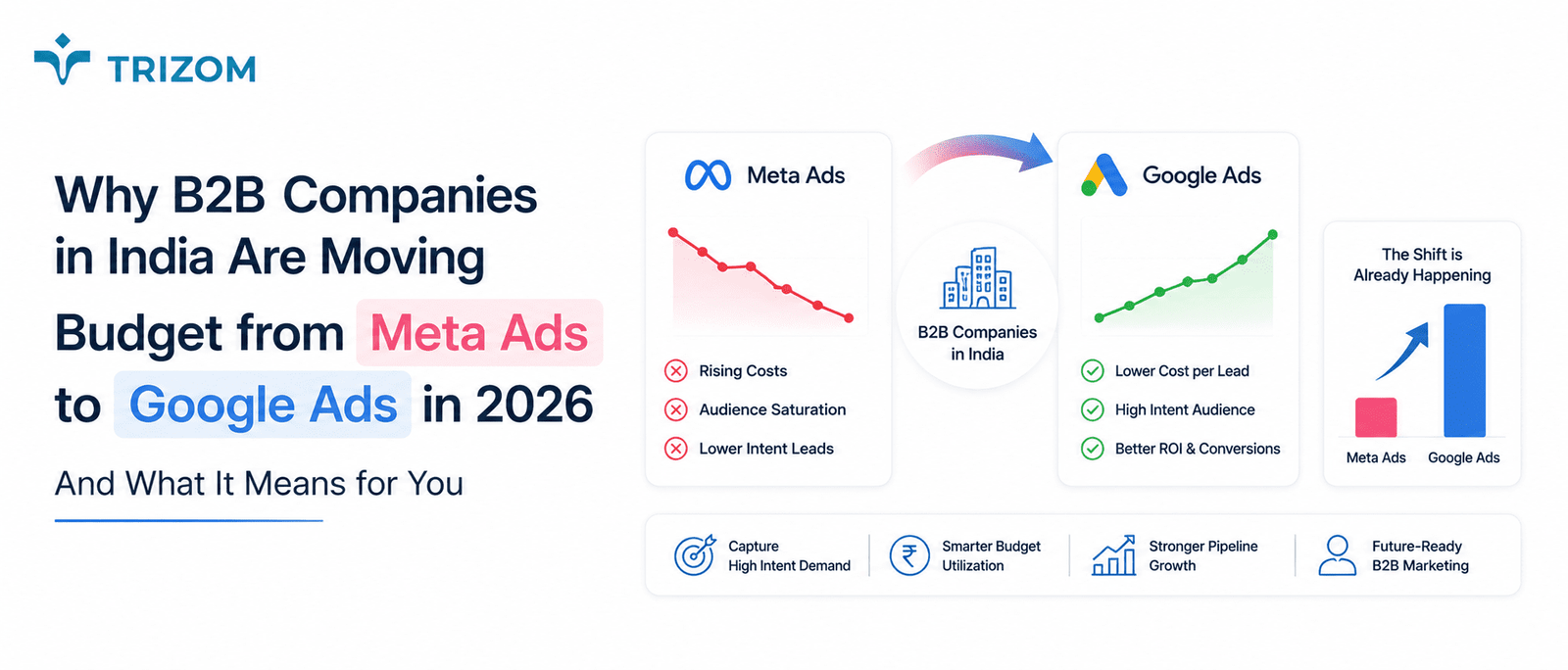
Why B2B Companies in India Are Moving Budget from Meta Ads to Google Ads in 2026 And What It Means for You

Meta Ads vs Google Ads for B2B in India is no longer a theoretical debate happening in marketing forums. It is a live budget reallocation decision being made by CMOs and performance marketing managers across Indian B2B companies right now, and the direction of that shift is becoming increasingly clear.

The question is not which platform is better in absolute terms. The question is which platform is better for your specific buyer, your specific sales cycle, and your specific revenue goal in 2026. And the answer to that question has changed significantly over the last eighteen months.

Here is what is driving the shift and what it means for how you allocate your paid advertising strategy for B2B in India going forward.

The Fundamental Problem with Meta Ads for B2B in India

Meta Ads, encompassing Facebook and Instagram, were built for consumer behaviour. The platform architecture, the algorithm, and the ad formats are all optimised for impulse-driven decisions made by individuals scrolling through personal content feeds.

Facebook Ads for B2B in India ask you to interrupt a decision maker who is looking at their cousin’s wedding photos and convince them in three seconds to care about your enterprise software, logistics solution, or professional service.

That is not impossible. But it is inefficient, and in 2026 the inefficiency is showing up clearly in Google Ads vs Meta Ads ROI comparisons across B2B accounts in India.

The core issue is intent. Meta captures passive audiences. Google captures active intent. And in B2B purchasing, intent is everything.

Why Google Ads Is Winning the B2B Budget Conversation in India

High Intent at the Moment That Matters Most

When a procurement manager in Mumbai types “cloud infrastructure management company India” into Google, they are not browsing. They are evaluating. That search represents a buyer who has already identified a problem, decided they need an external solution, and is now comparing vendors.

Lead generation ads in India in 2026 that appear at this moment of active intent convert at a fundamentally different rate than ads that interrupt passive scrolling behaviour on Meta.

For B2B companies with high-value contracts and long sales cycles, capturing a buyer at peak intent is worth far more than reaching ten times as many passive scrollers on Facebook.

Campaign Structure Built for B2B Buying Committees

A critical advantage of Google Ads for B2B is the ability to build campaign structure for B2B buying behaviour, where multiple stakeholders search for different aspects of the same solution at different stages of the evaluation process.

A technical director searches for implementation complexity. A CFO searches for pricing and ROI benchmarks. A CEO searches for vendor reputation and case studies. A well-structured Google Ads campaign can reach each of these decision-makers with a relevant message at their specific point of research, something B2B paid social advertising on India’s Meta platforms struggles to replicate with the same precision.

Where Meta Ads Still Earn Their Place in a B2B Paid Media Strategy

Before you reallocate your entire budget to Google, understand where B2B paid social advertising in India through Meta still delivers genuine value.

Top of Funnel Awareness at Scale

Meta Ads for B2B in India remain one of the most cost-effective ways to build broad brand awareness among a defined professional demographic. If your target audience includes startup founders, SME owners, or younger business decision-makers who spend significant time on Instagram and Facebook, Meta can introduce your brand at a lower CPM than almost any other digital channel.

The key is not to expect Meta to close deals. Expect it to start conversations and build familiarity.

Retargeting Campaigns That Recapture Intent

Retargeting for B2B in India is where Meta genuinely earns its allocation in a mature paid media strategy. Once a prospect has visited your website through a Google search or organic channel, Meta retargeting keeps your brand visible as they continue their evaluation process across their personal social feeds.

ROAS optimisation in India for B2B campaigns consistently shows that retargeting audiences on Meta convert at significantly higher rates than cold audiences, because the intent signal has already been established through another channel.

This is the correct role for Meta in a B2B paid media strategy in 2026. Not primary acquisition. Persistent re-engagement.

The Smarter Paid Advertising Strategy for B2B India in 2026

The B2B companies generating the strongest pipeline from paid media in India right now are not choosing between Google and Meta. They are sequencing them intelligently.

Google Ads captures high-intent buyers at the moment of active search. It fills the top of your qualified pipeline with prospects who are already in evaluation mode.

Meta Ads retarget those same prospects across their social feeds, reinforcing your brand message, sharing proof points, and keeping you front of mind during the weeks or months between their initial search and their final vendor decision.

This sequenced paid media strategy in India requires tight conversion tracking in India across both platforms, clear audience targeting segmentation between cold and warm audiences, and disciplined ad creative strategy for B2B that serves different messages at different stages of the buyer journey.

ROAS Optimisation Across Both Platforms

ROAS optimisation in India for B2B paid campaigns requires a unified view of the customer journey rather than optimising each platform in isolation. A prospect who clicked a Google Ad, visited your pricing page, saw three Meta retargeting ads, and then converted through a direct website visit should not be attributed to the last touchpoint alone.

Multi-touch attribution, even at a basic level, reveals that the cost per acquisition for B2B is almost always lower when Google and Meta work together as a sequenced strategy than when either platform operates in isolation.

How Trizom Builds Paid Media Strategies That Convert B2B Buyers

At Trizom, our paid advertising strategy for B2B in India is built around one principle: budget should follow buyer intent, not platform familiarity.

We audit your current Google and Meta Ads performance, identify where budget is being allocated versus where it is actually generating qualified pipeline, and rebuild your campaign architecture around a sequenced strategy that uses each platform for what it does best.

From campaign structure for B2B buying committees to ROAS optimisation across platforms and full conversion tracking setup in India, we manage every layer of your paid media ecosystem so your budget generates pipeline rather than just impressions.

Conclusion

Meta Ads vs Google Ads for B2B in India is not a winner-takes-all decision in 2026. It is a sequencing and allocation decision. Google Ads wins on intent capture and direct lead generation for high-value B2B buyers. Meta Ads wins on brand awareness and retargeting for prospects already in your funnel. The Indian B2B companies generating the strongest returns from their paid advertising strategy are the ones running both platforms with clear roles, tight conversion tracking, and a unified view of the buyer journey from first search to signed contract. The shift happening in 2026 is not away from Meta entirely. It is toward smarter allocation that respects how B2B buyers actually make decisions.

Is your paid media budget allocated where your buyers actually convert?
Get a Free Paid Media Audit from Trizom

Frequently Asked Questions

Loader image

Facebook Ads for B2B in India underperform Google Ads on direct lead generation because Meta is a passive discovery platform where users are not actively searching for business solutions. B2B buying decisions involve multiple stakeholders, long evaluation cycles, and high purchase values, all of which require intent-based targeting that Google's search network delivers far more effectively. B2B paid social advertising in India through Meta works best as a retargeting and brand awareness tool rather than a primary lead generation channel, which is why the Google Ads vs Meta Ads ROI comparison consistently favours Google for direct B2B pipeline impact.

The most effective paid media strategy for B2B India in 2026 combines Google Search Ads for high-intent acquisition with Meta retargeting for prospect re-engagement, supported by strong conversion tracking in India that gives you a unified view of the buyer journey across both platforms. Within Google, a well-structured campaign structure for B2B targets different buyer roles and search intents at different stages of the evaluation process. Within Meta, retargeting for B2B in India focuses exclusively on warm audiences who have already engaged with your brand through search or organic channels, significantly improving cost per acquisition for B2B across your overall paid investment.

Retargeting for B2B in India involves showing paid ads specifically to people who have previously visited your website, engaged with your content, or interacted with your brand through another channel. On Meta, retargeting uses the Facebook Pixel to identify website visitors and serve them relevant ads across Facebook and Instagram feeds during their ongoing evaluation period. On Google, retargeting through Display and YouTube reaches the same prospects across millions of websites. For B2B companies, retargeting consistently delivers the lowest cost per acquisition in the paid media mix because you are re-engaging buyers who have already demonstrated intent rather than trying to generate interest from a cold audience.

Measuring ROAS optimisation in India for B2B campaigns requires a different approach than B2C because B2B conversions are rarely immediate transactions. Effective ROAS measurement for B2B paid advertising tracks lead quality metrics alongside volume metrics, assigns pipeline value to each lead source based on historical close rates and average deal sizes, and uses multi-touch attribution to distribute revenue credit across Google Ads, Meta retargeting, and other paid touchpoints that contributed to a conversion. Proper conversion tracking in India across both Google and Meta platforms, integrated with your CRM, is the foundation of meaningful ROAS optimisation for any B2B paid social advertising strategy in India.