

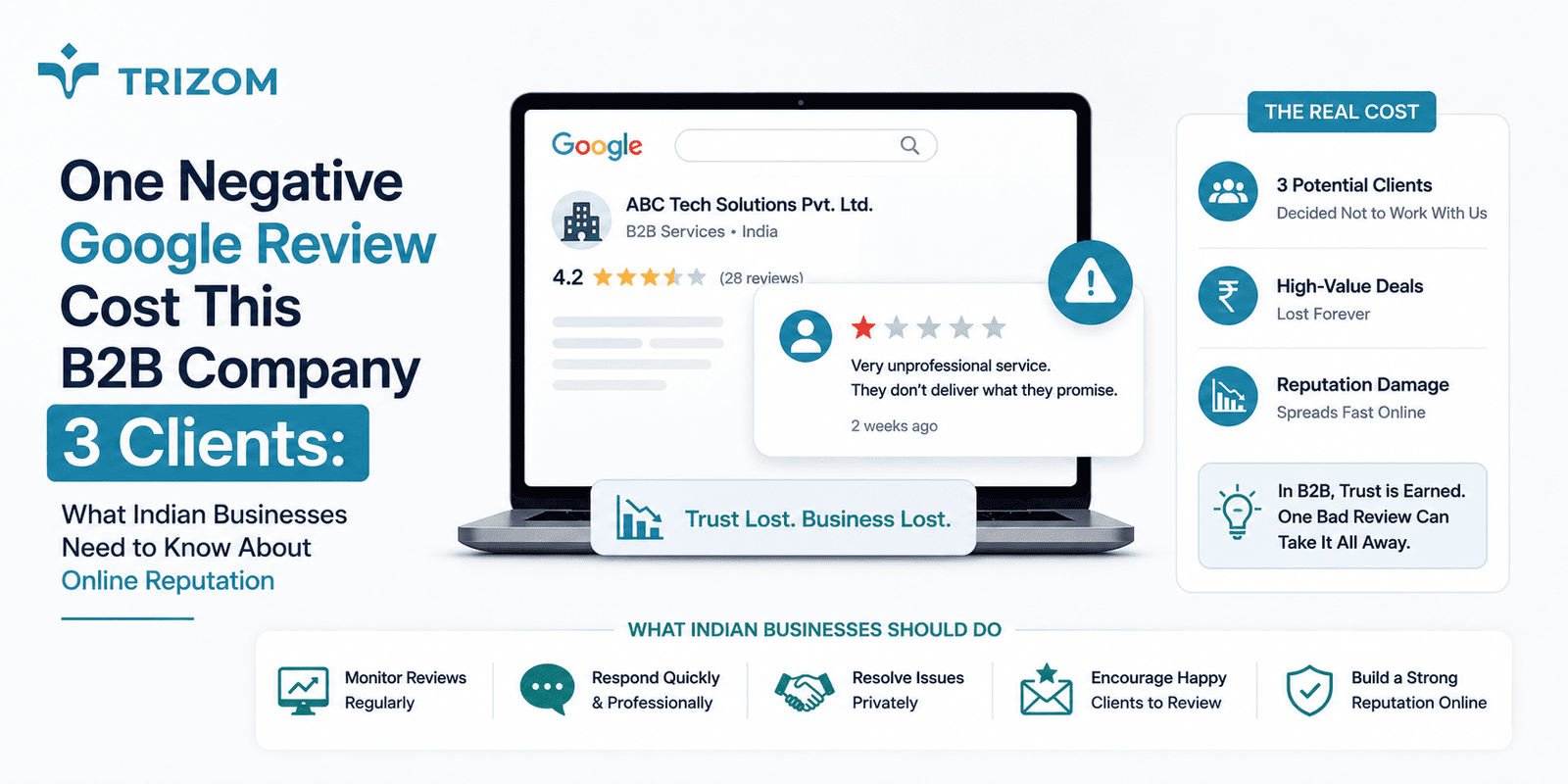
Picture this. A procurement head in Bengaluru shortlists your company after a referral from a mutual contact. Before sending your proposal to their leadership team, they do what every serious B2B buyer does in 2026. They Google your company name.
The first thing they find is a one-star review from eighteen months ago. No response from your side. No context. Just a damaging statement sitting at the top of your search results, completely unchallenged.
Your proposal never gets discussed in that boardroom.
This is not a hypothetical. It is the reality for hundreds of Indian B2B companies that have invested years building service quality and client relationships while leaving their online reputation management for B2B in India entirely unattended. And the cost of that neglect is measured not in lost reviews but in lost revenue.
Why Online Reputation Hits B2B Companies Harder Than B2C
B2C companies can absorb negative reviews because purchase decisions are individual, low-stakes, and often impulsive. A restaurant with a few bad reviews still fills tables because one hungry customer’s risk tolerance is completely different from a procurement committee evaluating a ₹20 lakh annual contract.
B2B buying decisions involve multiple stakeholders, extended evaluation periods, and significant financial commitment. Every person in that buying committee independently researches your company before signing off. A CFO, a COO, and a department head all Google your name at different points in their evaluation.
What they find in those searches determines whether your sales conversation continues or quietly stalls.
Google reviews management in India for B2B companies is therefore not a customer service function. It is a revenue protection function. And most Indian B2B companies are treating it like neither.
The Four Ways a Damaged Online Reputation Kills B2B Pipeline
-
Unanswered Negative Reviews Signal Indifference
A negative review without a response does not just show one unhappy client. It shows every prospect that your company does not care enough to address public criticism.
Your review response strategy in India communicates your company’s character more powerfully than any marketing material you produce. A professional, empathetic, solution-focused response to a critical review can actually strengthen buyer confidence rather than diminish it.
Buyers understand that problems occur in business relationships. What they are evaluating is how your company responds when they do. Silence fails that test every single time.
-
Negative SERP Results Appear Before Your Website Does
SERP reputation management for B2B in India is about controlling what appears when someone searches your company name, not just your website ranking.
When a negative news article, a critical forum post, or a damaging third-party review outranks your own website in search results, your brand narrative is being written by someone else. Prospects form their first impression from whatever appears at the top of the page, and in most cases that impression forms before they ever visit your official website.
Negative content suppression in India through deliberate creation and promotion of authoritative positive content is the only sustainable way to reclaim your SERP narrative. It requires consistency, strategic content placement, and a long-term view of SERP results management that most companies only adopt after damage has already been done.
-
Your Google My Business Profile Is Working Against You
Most B2B companies in India set up their Google My Business profile once and never return to it.
Meanwhile, reviews accumulate without responses. Outdated information sits uncorrected. Photos from three years ago misrepresent your current team size and office environment. Questions from potential clients go unanswered for weeks.
Google My Business reputation management in India requires active, weekly attention. Your GMB profile appears in branded searches, map searches, and knowledge panels. It is often the first structured information a prospect encounters about your company, and a neglected profile communicates operational carelessness before the relationship even begins.
-
A Single Crisis Can Undo Years of Brand Trust Building
Crisis management for Indian businesses in the digital age moves at a speed that most traditional B2B companies are completely unprepared for.
A disgruntled ex-employee posts publicly on LinkedIn. A client dispute spills into a public forum. A negative article appears in an industry publication. Within 48 hours, that content can rank for your brand name and be seen by every prospect currently evaluating your company.
Brand trust building for B2B takes years of consistent delivery and careful reputation management. It can be significantly damaged in 48 hours by a single piece of unaddressed negative content. The companies that recover fastest are the ones with a crisis response protocol already in place before the crisis arrives, not the ones scrambling to figure out their response after the damage is visible.
What Proactive ORM Actually Looks Like for Indian B2B Companies
Most Indian B2B companies’ approach to ORM services for companies in India reactively. They Google themselves after losing a deal they should have won and discover the reputation problem that cost them the contract.
Proactive brand reputation management in India operates on a completely different timeline. It involves monitoring your brand mentions across search, social media, review platforms, and news sources continuously, so you identify emerging reputation risks before they escalate into visible damage.
Brand monitoring tools in India range from Google Alerts at the basic end to enterprise platforms that track sentiment across thousands of sources simultaneously. The right tool depends on your company size, industry, and the volume of online conversation around your brand.
Regardless of the tool, the discipline is the same. Monitor daily. Respond to every review, positive or negative, within 48 hours. Suppress emerging negative content proactively through consistent publication of authoritative positive content. And build your digital PR for B2B in India through thought leadership, industry contributions, and earned media that creates a body of positive search results strong enough to withstand occasional negative content without losing its dominance.
The Role of Digital PR in B2B Reputation Management
Digital PR for B2B in India is one of the most underutilised reputation tools available to Indian companies, particularly those operating in professional services, technology, and consulting.
Earned media placements in respected industry publications, expert commentary in business news outlets, and contributed articles in niche trade platforms all create authoritative positive content that ranks well for your brand name and builds the kind of third-party credibility that no amount of self-published content can replicate.
When a prospect Googles your company and finds a Forbes India feature, an Economic Times quote from your founder, and a detailed case study on an industry platform alongside your website and a perfectly managed GMB profile, the narrative they form about your company is completely different from the one they form when they find an unanswered negative review.
Brand perception management in India at the highest level is essentially content strategy applied to your reputation. It requires the same discipline, consistency, and long-term thinking that any serious marketing investment demands.
How Trizom Protects and Rebuilds B2B Reputations in India
At Trizom, our online reputation management for B2B in India combines continuous brand monitoring, strategic negative content suppression, Google My Business management, review response strategy, and digital PR for B2B into a unified reputation programme that protects your brand narrative across every touchpoint a prospect encounters.
We do not wait for your reputation to become a problem before we start working on it. We build the positive digital infrastructure that makes reputation damage significantly harder to inflict and significantly faster to recover from when it does occur.
Your B2B pipeline depends on trust. And trust, in 2026, is built and broken on the first page of Google.
Conclusion
Online reputation management for B2B in India is not a defensive exercise for companies already in crisis. It is a proactive revenue protection strategy for any company where client trust, referrals, and professional credibility drive pipeline. A single unaddressed negative review, an unanswered GMB comment, or a damaging search result appearing above your website can silently cost you multiple deals before your sales team even knows the prospect was evaluating you. Google reviews management in India combined with strategic negative content suppression, consistent digital PR for B2B, and a structured crisis response protocol is what separates Indian B2B companies that control their narrative from those that let the internet write it for them.
Is your online reputation protecting your pipeline or putting it at risk?
Request a Free ORM Audit from TRIZOM
Frequently Asked Questions

Can negative Google reviews be removed for B2B companies in India?
Negative review removal in India is possible in specific circumstances where the review violates Google's review policies, such as reviews containing fake information, spam, off-topic content, or content from someone who was never actually a client. Legitimate negative reviews from real clients cannot be removed but can be effectively managed through a professional review response strategy in India that demonstrates accountability and resolution commitment to every future prospect who reads the exchange. For negative reviews that cannot be removed, negative content suppression in India through consistent publication of authoritative positive content gradually pushes damaging results down in SERP results management, reducing their visibility to prospects researching your brand.
How quickly can a negative online reputation damage a B2B company's pipeline in India?
The damage from a negative online reputation to a B2B pipeline in India can begin within days of damaging content becoming visible in search results. B2B sales cycles in India typically involve a research phase where multiple stakeholders independently evaluate vendors over several weeks. If negative content appears during that window, it influences shortlisting decisions that your sales team never gets visibility into. The prospect simply stops responding without explaining why. Crisis management for Indian businesses that moves within 24 to 48 hours of negative content appearing can significantly limit the pipeline damage. Companies without a monitoring and response protocol in place typically discover the problem weeks or months after it begins affecting their conversion rates.
What is SERP reputation management and why does it matter for B2B companies in India?
SERP reputation management for B2B in India is the practice of actively managing what appears in search engine results pages when someone searches your company name, founder names, or brand-related terms. For B2B companies in India, the first page of branded search results functions as a digital due diligence report for every prospect evaluating your company. SERP results management involves building a body of positive, authoritative content across your own website, industry publications, social platforms, and review sites that collectively dominates the first page of your branded search results. When your SERP is filled with positive, credible content, negative reviews or damaging content is pushed to page two or beyond, where the vast majority of prospects never look.
How much does online reputation management cost for B2B companies in India?
ORM services for companies in India vary in cost based on the current state of the reputation, the competitiveness of branded search results, and the scope of ongoing monitoring and management required. For B2B companies with a relatively clean reputation seeking proactive protection, monthly brand reputation management programmes in India typically range from ₹15,000 to ₹40,000 per month, covering Google My Business reputation management, review monitoring and response, brand mention tracking through brand monitoring tools, and basic digital PR for B2B, for companies requiring active negative content suppression or crisis management, the scope and investment required are determined after a thorough audit of the current SERP landscape and the nature of the content requiring suppression.
