
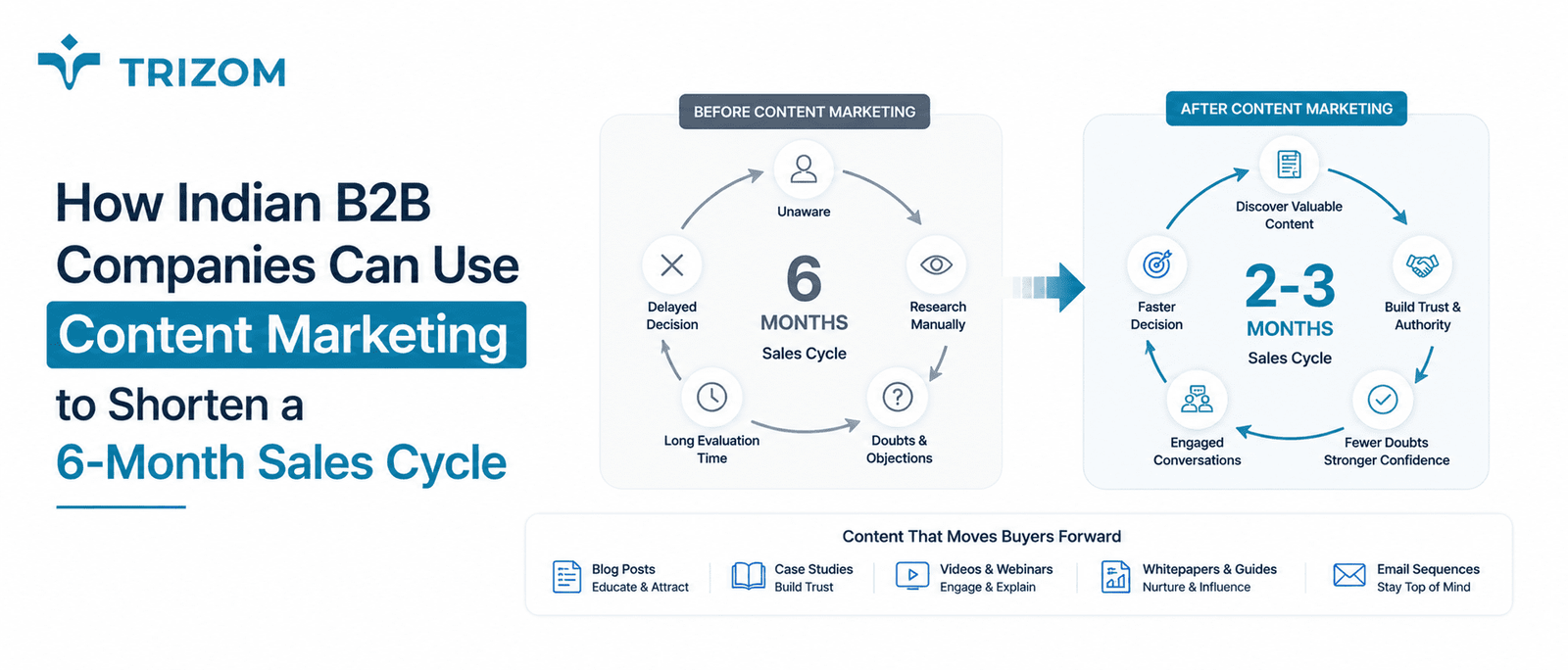
The average Indian B2B sales cycle does not fail because of bad salespeople. It fails because prospects spend months in silence, evaluating vendors through content they find on their own, and most companies have nothing useful waiting for them when they look.
That silence is where B2B content marketing in India either wins the deal or hands it to a competitor who published the right article three months ago.
If your sales team is chasing the same prospects for six months with follow-up calls that go unanswered, the problem is not persistence. It is the absence of a content strategy for B2B companies in India that does the nurturing between those calls.
Why Long B2B Sales Cycles Exist in the First Place
A six-month sales cycle is not irrational buyer behaviour. It is a rational response to high-stakes purchasing decisions.
B2B buyers in India typically involve four to seven stakeholders before signing a contract. Each stakeholder has different concerns, different objections, and different information needs. While your sales team is speaking to one of them, the others are quietly researching on their own.
What they find during that independent research determines whether your brand stays on the shortlist or quietly disappears from it.
This is the exact problem that a structured content strategy for B2B companies in India solves. Not by replacing your sales process, but by running parallel to it and doing the heavy lifting of trust-building between touchpoints.
Mapping Content to the Buyer Journey: Where Most Companies Get It Wrong
Most Indian B2B companies that invest in content create awareness-stage material almost exclusively. Blog posts explaining what their service is. LinkedIn posts announcing new hires. Website copy describing their process.
None of this helps a buyer who already knows what they need and is now evaluating whether your company specifically can deliver it.
Buyer journey content mapping requires a fundamentally different approach. Every piece of content must serve a specific stage of the decision process for a specific stakeholder within the buying committee.
Here is how that looks in practice.
Stage 1 – Awareness: Make Them Find You Before They Are Ready to Buy
At this stage, your buyer has identified a problem but has not yet defined what kind of solution they need.
Blog writing for B2B in India at the awareness stage should address the symptoms of the problem your service solves, not the service itself. A B2B logistics company does not write about their fleet size at this stage. They write about why growing e-commerce brands in India consistently underestimate last-mile delivery costs.
That specificity is what builds topical authority with both search engines and human readers. Google rewards depth of expertise. Buyers reward relevance to their actual situation.
SEO content for B2B in India in 2026 at the awareness stage targets informational keywords with meaningful search volume, pulling prospects into your content ecosystem before any competitor has a chance to introduce themselves.
Stage 2 – Consideration: Give Them the Ammunition to Shortlist You
This is where most B2B sales cycles stall and where the right content can dramatically accelerate momentum.
A prospect in the consideration stage is comparing three to five vendors. They are looking for reasons to trust one and eliminate the others. They are not reading your homepage. They are reading your case studies, your long-form guides, and your thought leadership content to assess whether your team genuinely understands their problem.
B2B whitepaper content in India at the consideration stage demonstrates depth of expertise on a specific problem your buyer is facing. A well-constructed whitepaper does three things simultaneously: it answers the questions your prospect is asking independently, it surfaces objections your sales team has not addressed yet, and it positions your company as the most informed voice in the room before the formal evaluation even begins.
Case study content for B2B in India is arguably the highest-converting content format at this stage. Specific, outcome-focused case studies written around the buyer’s industry and problem type shorten the evaluation period because they eliminate the prospect’s biggest remaining doubt: has this company solved a problem like mine before?
The answer needs to be visible, specific, and credible. Not buried in a PDF nobody downloads.
Stage 3 – Decision: Remove the Last Obstacle Between Interest and Action
Your prospect has shortlisted you. They are now building an internal business case to get sign-off from their leadership team.
At this stage, thought leadership content in India from your founders and senior team carries enormous weight. A detailed LinkedIn post from your CEO addressing a specific challenge in the buyer’s industry does more for final-stage conversion than any brochure your design team produces.
Long-form content for B2B in India at the decision stage includes detailed implementation guides, ROI frameworks, comparison content, and responses to the most common objections your sales team encounters. This content gives your internal champion the language and evidence they need to sell your solution upward within their own organisation.
You are not just convincing the buyer anymore. You are equipping them to convince everyone else.
Distribution: The Half of Content Marketing Nobody Invests In
Creating content without a content distribution strategy is the single most common reason content marketing ROI in India disappoints.
Publishing a blog post and sharing it once on LinkedIn is not distribution. Distribution means your content reaches your target buyer across multiple touchpoints, through organic search, LinkedIn organic and paid amplification, email nurturing sequences, WhatsApp follow-ups from your sales team, and republication in relevant industry communities.
AEO content strategy in India adds another dimension to distribution in 2026. Structuring your content to appear in AI-generated search summaries, Google’s featured snippets, and People Also Ask sections means your answers reach buyers even when they are not actively searching for your brand.
Topical authority building through interconnected content clusters, where pillar pages link to spoke articles covering every sub-topic in depth, signals to Google that your website is the definitive resource on your subject matter. That signal translates directly into higher organic rankings and greater visibility throughout the buyer’s research journey.
How Trizom Builds Content Strategies That Actually Shorten Sales Cycles
At Trizom, our B2B content marketing approach in India starts with your sales data, not a content calendar template.
We interview your sales team to understand exactly where deals stall, what objections arise most frequently, and which competitor comparisons come up most often. We then build a content strategy for B2B companies that places the right answer at every stalling point in your buyer journey.
From blog writing for B2B, whitepapers, and case studies to LinkedIn thought leadership and AEO-optimised FAQ content, every piece we produce has a defined role in moving a specific buyer persona from awareness to decision.
Content marketing for lead generation in India done this way does not just generate traffic. It generates trust at scale, and trust is what converts a six-month sales cycle into a two-month one.
Conclusion
The length of your B2B sales cycle is not fixed. It is directly proportional to how much useful, relevant content your prospects find when they research independently between your sales touchpoints. B2B content marketing in India that maps deliberately to every stage of the buyer journey, distributes content across every channel your prospect uses, and builds topical authority in your specific domain compresses evaluation timelines by answering objections before your sales team even knows they exist. A structured content strategy for B2B companies in India is not a marketing expense in 2026. It is your most scalable sales asset.
Want content that shortens your sales cycle and fills your pipeline?
Build Your Content Strategy with TRIZOM
Frequently Asked Questions

What type of content works best for B2B lead generation in India in 2026?
The highest-performing content formats for B2B content marketing in India in 2026 are specific case studies with quantified outcomes relevant to the buyer's industry, long-form educational guides that address the exact problems your buyers search for independently, thought leadership content in India from founders and senior practitioners that demonstrates genuine domain expertise, and B2B whitepaper content that gives buyers the evidence they need to build an internal business case. SEO content for B2B in India structured around buyer-stage keyword intent and optimised for AEO content strategy to appear in AI search summaries and featured snippets consistently outperforms generic blog content in both traffic quality and conversion rate.
How long does it take for B2B content marketing to generate results in India?
B2B content marketing in India operates on a compounding timeline rather than a linear one. Most companies begin seeing meaningful organic traffic growth within 3 to 4 months of consistent, strategically structured content publication. Lead generation from content typically becomes measurable between months 4 and 6 as topical authority building gains traction with search engines and target audiences. The compounding nature of content means that a piece published in month 2 continues generating leads in month 18 without additional investment. Unlike paid advertising which stops delivering the moment you stop spending, content marketing ROI in India grows over time and becomes an increasingly cost-efficient lead generation channel as your content library expands.
What is buyer journey content mapping and why does it matter for B2B companies in India?
Buyer journey content mapping is the process of deliberately creating content that addresses the specific questions, objections, and information needs of your target buyer at each stage of their decision process, from initial problem awareness through vendor evaluation to final purchase decision. For B2B companies in India with multiple stakeholders and long sales cycles, content that is not mapped to a specific buyer stage and persona either attracts the wrong audience or fails to move the right audience forward. A structured content strategy for B2B companies in India built on buyer journey mapping ensures that every piece of content serves a defined commercial purpose rather than simply generating traffic that never converts into pipeline.
How do you measure content marketing ROI for B2B companies in India?
Measuring content marketing ROI in India for B2B companies requires tracking metrics at multiple levels of the funnel simultaneously. At the top, track organic traffic growth, keyword ranking improvements, and content reach through content distribution strategy channels. In the middle, track time on page, return visitor rates, whitepaper downloads, and email list growth from content. At the bottom, track the number of leads that first engaged with your brand through content, the conversion rate of content-sourced leads versus other channels, and the average sales cycle length for prospects who consumed your content before making contact. Companies that track all three levels consistently find that B2B blog strategy in India and long-form content deliver a significantly lower cost per acquired client than any outbound channel over a 12-month horizon.