
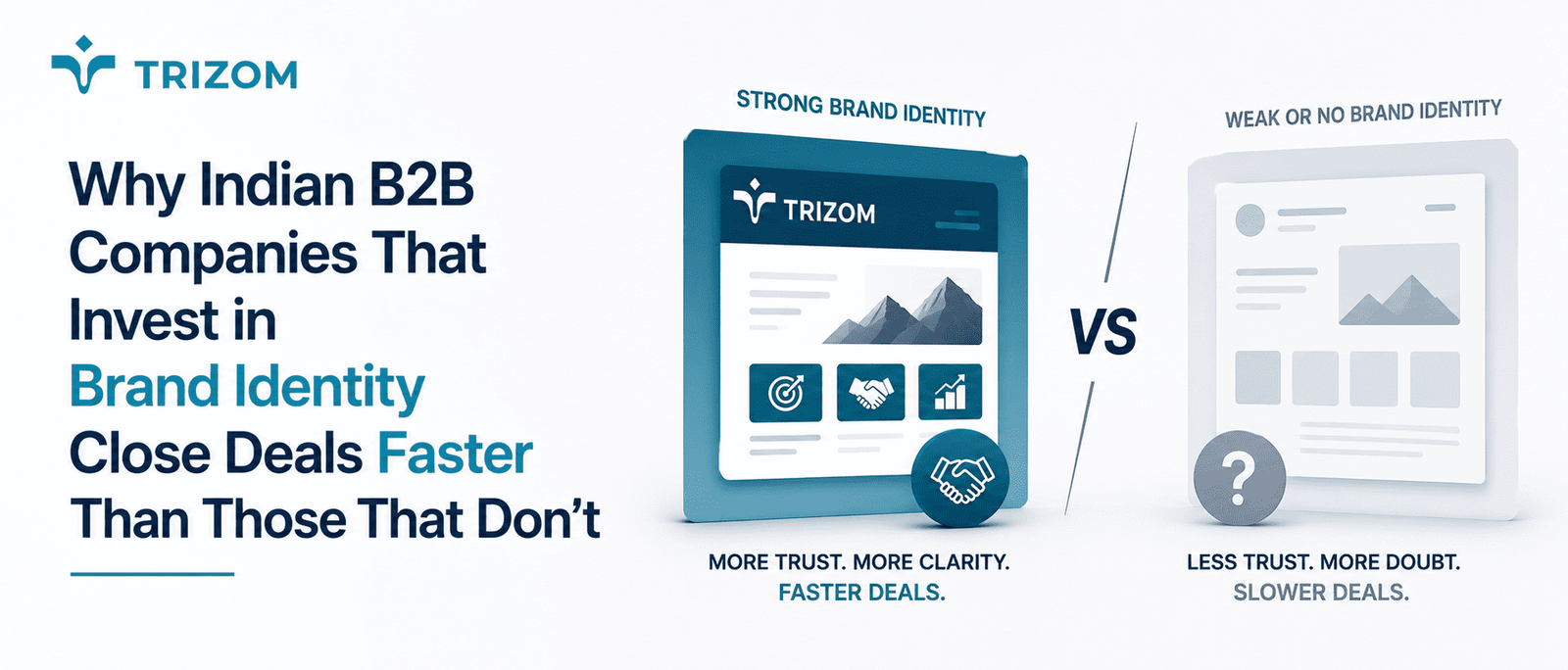
Nobody in a boardroom will tell you they chose a competitor because their logo looked more credible. But they did. They just called it something else. They said the other company “seemed more established.” They said they “felt more confident” in the other vendor. They said the competitor’s presentation “looked more professional.”
That is B2B branding in India doing its job invisibly, on the other side of the table.
Every Indian B2B founder who has lost a deal they should have won on merit alone needs to ask an uncomfortable question. Did your brand show up to that meeting as well as your team did? Because in 2026, the answer to that question is worth more to your pipeline than most sales training programmes your company will ever invest in.
The Boardroom Reality Nobody Talks About
B2B purchasing decisions are officially rational. They are justified with spreadsheets, vendor scorecards, and technical evaluations.
They are unofficially emotional. The committee members are human beings who experience doubt, uncertainty, and risk aversion. They are recommending a vendor to their leadership team and putting their professional judgment on the line with that recommendation.
Your brand is the thing that makes that recommendation feel safe or risky before a single commercial term is discussed.
Brand identity design for companies in India that communicates competence, stability, and professionalism reduces the perceived risk of choosing you. A weak, inconsistent, or visually dated brand amplifies it. And in a competitive shortlist where two vendors have comparable capabilities, the one whose brand communicates confidence more effectively wins the deal with far more consistency than the one relying on capability alone.
What B2B Branding Actually Is and What It Is Not
Most Indian B2B founders think of branding as logo design. A visual exercise completed once during company formation and revisited only when someone in leadership decides the current logo looks dated.
That misunderstanding is costing them deals every quarter.
B2B branding in India at its most functional level is the total of every impression your company creates across every touchpoint a prospect encounters before, during, and after a sales conversation. It is your website’s visual hierarchy. It is the quality of your proposal document. It is the consistency between your LinkedIn company page and your email signature and your pitch deck. It is the language your team uses to describe what you do and the visual system that makes every piece of communication instantly recognisable as yours.
Brand strategy in India for 2026 means treating your brand as a sales infrastructure investment, not a design expense. The companies that have internalised this distinction are closing deals at a different rate than those that have not.
The First Impression Problem in Indian B2B Sales
Research consistently shows that human beings form first impressions within milliseconds of encountering a new stimulus. In a B2B context, that stimulus is usually your website, your LinkedIn profile, your proposal, or your pitch deck.
First impression brand management in India is therefore not about aesthetics. It is about the cognitive signal your brand sends in the moment before a rational evaluation begins.
A prospect who encounters a professionally designed, visually consistent brand across every touchpoint they interact with enters the sales conversation with a baseline of confidence in your company. A prospect who encounters mismatched colours across your website and proposal, a pixelated logo on your email footer, and a pitch deck that looks like it was built in a hurry enters that same conversation with a baseline of doubt.
Both prospects hear the same pitch. The one who started with confidence is significantly more likely to end with a signed contract.
Brand trust building in India for B2B companies happens at the visual and communication level long before it happens at the relationship level. Your brand either builds that trust automatically or forces your sales team to overcome a deficit that should never have existed.
Brand Consistency Across Channels: Where Indian B2B Companies Lose the Plot
Walk through the typical Indian B2B company’s brand touchpoints, and the inconsistency is jarring.
The website uses one shade of blue. The proposal template uses a slightly different shade. The LinkedIn banner was designed by a freelancer two years ago and uses a completely different visual style. The pitch deck was built by a team member who used their own judgment about fonts and colours. The business cards are from the original printer who used the founding era logo before it was updated.
Every inconsistency is a micro-signal to the prospect that your company does not sweat the details. And in B2B sales, the prospect assumes that the way you manage your own brand is a reasonable proxy for how you will manage their project.
Brand consistency across channels requires brand guidelines in India that every team member, every freelancer, every vendor, and every partner works from as a non-negotiable standard. Not a mood board. Not a “we generally use this blue.” A documented, specific, enforced visual and communication standard that makes every piece of collateral your company produces instantly identifiable as yours.
How Rebranding Accelerates Growth for Indian B2B Companies
Rebranding for growth in India is not the admission that your original brand failed. It is the recognition that your company has outgrown the brand it launched with and needs a visual and strategic identity that matches where the business is going rather than where it started.
Mid-size Indian B2B companies approaching their first significant funding round, entering a new market segment, or repositioning their service offering consistently discover that their existing brand is actively working against the narrative they need to communicate to new stakeholders.
A manufacturing company that started as a small workshop and has grown into a 200-person precision engineering firm cannot walk into a conversation with a Tier-1 automotive OEM carrying brand materials that look like a local supplier. The credibility gap created by that brand mismatch is real, measurable, and entirely fixable.
Brand positioning for B2B in India as part of a rebrand defines not just how your company looks but how it is categorised in the mind of a prospect. Are you a vendor or a partner? Are you a commodity provider or a specialist? Are you a local option or a company capable of national or international delivery? Your brand communicates the answer to each of these questions before your sales team opens their mouth.
Pitch Deck Design: The Most Underinvested Brand Asset in Indian B2B Sales
Every Indian B2B company has a pitch deck. Very few have a pitch deck that actually sells.
Pitch deck design in India for B2B companies is where brand investment delivers its most immediate and measurable return. A pitch deck that is visually professional, narratively compelling, and brand-consistent does not just present your company. It demonstrates your company’s attention to detail, communication quality, and professional standard in the very act of being presented.
The quality of your pitch deck is the first piece of work a prospect evaluates from your team. If the document that is supposed to convince them to trust you with a significant contract looks like it was produced in an afternoon, the implicit message is that your actual deliverables will look the same way.
Marketing collateral design in India for B2B companies encompasses every document that leaves your building carrying your brand: proposals, case study documents, capability presentations, one-pagers, and leave-behinds. Every one of these is a brand touchpoint. Every one communicates something about your company’s standards. And every one either reinforces or undermines the pitch your sales team just delivered.
Logo Design Is the Start, Not the Finish
Logo design for B2B companies in India is where most founders think the branding conversation ends. A new logo, a refreshed colour palette, and an updated website header.
That is the beginning of a brand identity, not the completion of one.
Visual identity for Indian businesses at the level that actually influences commercial outcomes includes a complete brand system: primary and secondary colour palettes with specific hex codes and usage rules, typography hierarchy covering headings, body copy, and accent text across digital and print applications, iconography and illustration style guidelines, photography direction covering image style, composition, and colour treatment, and document templates for every category of business communication your company produces.
Without this complete system, every new piece of communication your team produces requires fresh decisions about how it should look. Those decisions introduce inconsistency. Inconsistency erodes the brand trust you are trying to build.
Professional branding in India for B2B companies is a system investment, not a design project. The distinction between those two framings determines whether the investment compounds in commercial value over time or gets repeated every two years when the last round of design work feels dated.
Creative Design for B2B Marketing: Making Content Work Harder
Creative design for B2B marketing in India extends brand investment into every piece of content your marketing team produces. LinkedIn carousel posts, case study graphics, email headers, event materials, social media templates, and digital ad creatives all need to operate within a consistent brand system to build the cumulative visual familiarity that makes your company recognisable at a glance.
B2B buyers in India encounter dozens of vendor touchpoints during their evaluation process. The companies they remember are the ones whose visual language they have seen enough times that it has become familiar. Familiarity reduces perceived risk. Reduced perceived risk accelerates the decision to engage.
Creative design for B2B marketing is therefore not about making beautiful content. It is about making consistent content that builds recognition at the frequency and across the channels where your buyers spend their professional attention.
How Trizom Builds Brand Identities That Close Deals
At Trizom, our B2B branding process in India begins with brand strategy before a single visual element is designed. We define your positioning, your competitive differentiation, your brand voice, and the specific impression you need to create at every stage of your prospect’s journey.
We then build a complete brand identity design system covering logo design, visual identity, brand guidelines, marketing collateral design, and pitch deck design that gives your sales team a brand they can be proud to put in front of any prospect at any deal size.
Creative design for B2B marketing in India done at Trizom is not a style exercise. It is a commercial strategy expressed visually, built to make every prospect interaction start with confidence rather than doubt.
Conclusion
B2B branding in India is not what companies invest in after they have achieved success. It is one of the reasons some companies achieve success faster than others. A complete brand identity design for companies in India that communicates professionalism, consistency, and expertise at every touchpoint reduces the friction between your first impression and your signed contract. Indian B2B founders who treat branding as a design expense will keep losing deals on intangibles they cannot name. Those who treat it as a sales infrastructure investment will keep wondering why their pipeline moves faster than their competitors’ despite pitching the same capabilities in the same market.
Is your brand winning deals before your team gets on the call?
Build a Brand That Closes with TRIZOM
Frequently Asked Questions

What is included in a professional B2B branding project in India?
A complete professional branding project in India for a B2B company includes brand strategy development covering positioning, differentiation, and target audience definition, logo design for B2B companies, full visual identity for Indian businesses covering colour palette, typography, and iconography, comprehensive brand guidelines in India documenting every usage rule for every application, marketing collateral design covering proposal templates, case study documents, and capability presentations, pitch deck design aligned with the brand system, and social media and digital templates ensuring brand consistency across channels. The output is not a collection of design files. It is a complete brand system your entire team and all external partners work from as a non-negotiable standard.
When should an Indian B2B company consider rebranding for growth?
Rebranding for growth in India becomes strategically necessary when your current brand no longer accurately represents the scale, capability, or market positioning of your business. Specific triggers include approaching a significant funding round where investor perception of your company's maturity matters, entering a new market segment or geography where your existing brand carries no recognition or credibility, repositioning your service offering to target a higher-value client segment, or merging with or acquiring another business that requires a unified brand identity. Brand positioning for B2B in India as part of a rebrand defines not just how your company looks but how it is categorised in the minds of the specific decision-makers you are trying to reach in your next phase of growth.
How do brand guidelines help B2B companies in India maintain consistency across all channels?
Brand guidelines in India for B2B companies are a documented, specific set of rules governing every visual and communication element your company produces, covering logo usage rules, colour specifications with exact hex and Pantone codes, typography hierarchy for every application, photography and imagery style direction, iconography standards, tone of voice guidelines, and templates for every category of business document. Without enforced brand guidelines, every team member and external vendor makes independent design decisions that introduce inconsistency across touchpoints. Brand consistency across channels built from a comprehensive guidelines document ensures that your website, proposal, LinkedIn presence, and pitch deck all communicate a single, coherent, professional identity to every prospect who encounters your brand during their evaluation process.
What is the ROI of investing in B2B branding and creative design in India?
The return on B2B branding in India is measured in commercial outcomes rather than design metrics. Companies that invest in complete brand identity design and professional branding consistently report improved shortlisting rates on competitive tenders, shorter evaluation periods due to stronger first impression brand impact, higher proposal acceptance rates attributed to professional pitch deck design and marketing collateral design, and stronger inbound lead quality as a more credible brand presence attracts higher-value prospects organically. Brand trust building in India compounds over time as consistent visual identity builds familiative familiarity with your target audience across repeated touchpoints, making each subsequent prospect interaction progressively easier to convert than the one before it.