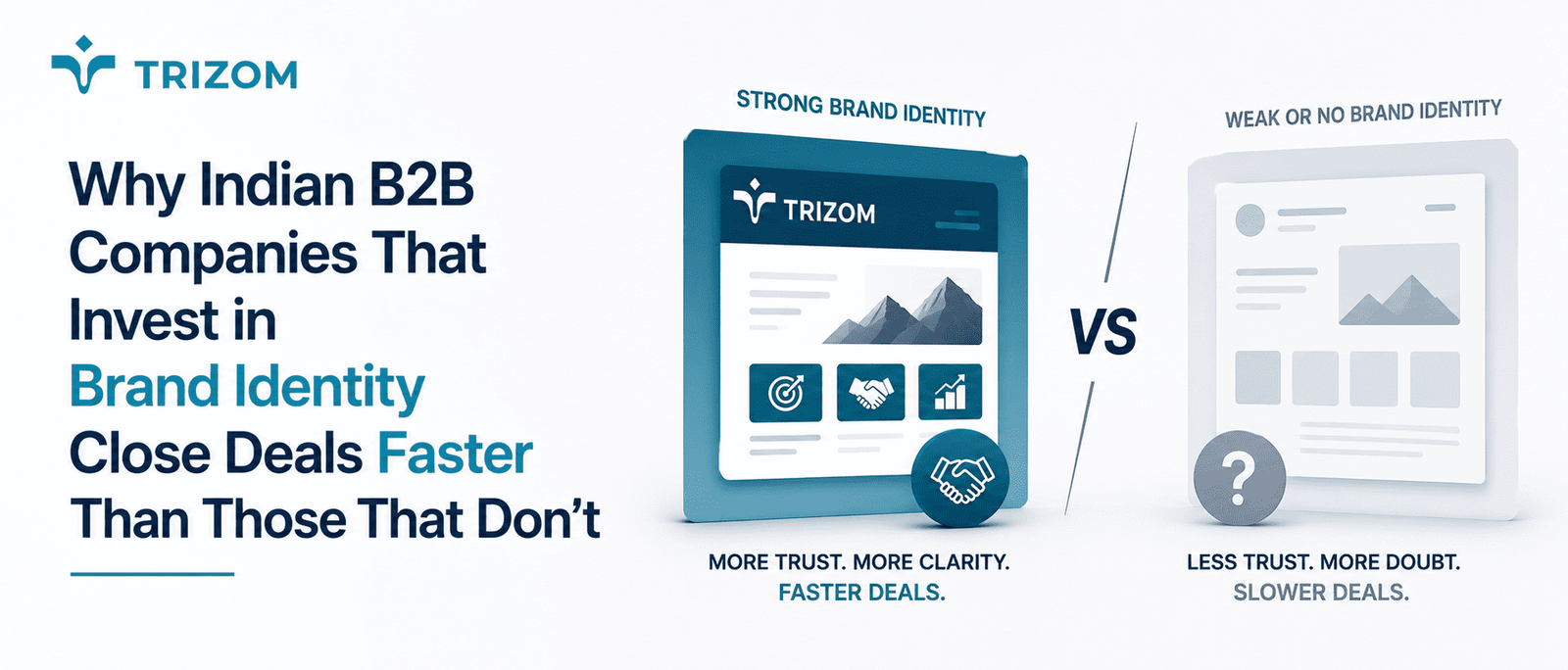
Why Indian B2B Companies That Invest in Brand Identity Close Deals Faster Than Those That Don’t

Nobody in a boardroom will tell you they chose a competitor because their logo looked more credible. But they did. They just called it something else. They said the other company “seemed more established.” They said they “felt more confident” in the other vendor. They said the competitor’s presentation “looked more professional.”

That is B2B branding in India doing its job invisibly, on the other side of the table.

Every Indian B2B founder who has lost a deal they should have won on merit alone needs to ask an uncomfortable question. Did your brand show up to that meeting as well as your team did? Because in 2026, the answer to that question is worth more to your pipeline than most sales training programmes your company will ever invest in.

The Boardroom Reality Nobody Talks About

B2B purchasing decisions are officially rational. They are justified with spreadsheets, vendor scorecards, and technical evaluations.

They are unofficially emotional. The committee members are human beings who experience doubt, uncertainty, and risk aversion. They are recommending a vendor to their leadership team and putting their professional judgment on the line with that recommendation.

Your brand is the thing that makes that recommendation feel safe or risky before a single commercial term is discussed.

Brand identity design for companies in India that communicates competence, stability, and professionalism reduces the perceived risk of choosing you. A weak, inconsistent, or visually dated brand amplifies it. And in a competitive shortlist where two vendors have comparable capabilities, the one whose brand communicates confidence more effectively wins the deal with far more consistency than the one relying on capability alone.

What B2B Branding Actually Is and What It Is Not

Most Indian B2B founders think of branding as logo design. A visual exercise completed once during company formation and revisited only when someone in leadership decides the current logo looks dated.

That misunderstanding is costing them deals every quarter.

B2B branding in India at its most functional level is the total of every impression your company creates across every touchpoint a prospect encounters before, during, and after a sales conversation. It is your website’s visual hierarchy. It is the quality of your proposal document. It is the consistency between your LinkedIn company page and your email signature and your pitch deck. It is the language your team uses to describe what you do and the visual system that makes every piece of communication instantly recognisable as yours.

Brand strategy in India for 2026 means treating your brand as a sales infrastructure investment, not a design expense. The companies that have internalised this distinction are closing deals at a different rate than those that have not.

The First Impression Problem in Indian B2B Sales

Research consistently shows that human beings form first impressions within milliseconds of encountering a new stimulus. In a B2B context, that stimulus is usually your website, your LinkedIn profile, your proposal, or your pitch deck.

First impression brand management in India is therefore not about aesthetics. It is about the cognitive signal your brand sends in the moment before a rational evaluation begins.

A prospect who encounters a professionally designed, visually consistent brand across every touchpoint they interact with enters the sales conversation with a baseline of confidence in your company. A prospect who encounters mismatched colours across your website and proposal, a pixelated logo on your email footer, and a pitch deck that looks like it was built in a hurry enters that same conversation with a baseline of doubt.

Both prospects hear the same pitch. The one who started with confidence is significantly more likely to end with a signed contract.

Brand trust building in India for B2B companies happens at the visual and communication level long before it happens at the relationship level. Your brand either builds that trust automatically or forces your sales team to overcome a deficit that should never have existed.

Brand Consistency Across Channels: Where Indian B2B Companies Lose the Plot

Walk through the typical Indian B2B company’s brand touchpoints, and the inconsistency is jarring.

The website uses one shade of blue. The proposal template uses a slightly different shade. The LinkedIn banner was designed by a freelancer two years ago and uses a completely different visual style. The pitch deck was built by a team member who used their own judgment about fonts and colours. The business cards are from the original printer who used the founding era logo before it was updated.

Every inconsistency is a micro-signal to the prospect that your company does not sweat the details. And in B2B sales, the prospect assumes that the way you manage your own brand is a reasonable proxy for how you will manage their project.

Brand consistency across channels requires brand guidelines in India that every team member, every freelancer, every vendor, and every partner works from as a non-negotiable standard. Not a mood board. Not a “we generally use this blue.” A documented, specific, enforced visual and communication standard that makes every piece of collateral your company produces instantly identifiable as yours.

How Rebranding Accelerates Growth for Indian B2B Companies

Rebranding for growth in India is not the admission that your original brand failed. It is the recognition that your company has outgrown the brand it launched with and needs a visual and strategic identity that matches where the business is going rather than where it started.

Mid-size Indian B2B companies approaching their first significant funding round, entering a new market segment, or repositioning their service offering consistently discover that their existing brand is actively working against the narrative they need to communicate to new stakeholders.

A manufacturing company that started as a small workshop and has grown into a 200-person precision engineering firm cannot walk into a conversation with a Tier-1 automotive OEM carrying brand materials that look like a local supplier. The credibility gap created by that brand mismatch is real, measurable, and entirely fixable.

Brand positioning for B2B in India as part of a rebrand defines not just how your company looks but how it is categorised in the mind of a prospect. Are you a vendor or a partner? Are you a commodity provider or a specialist? Are you a local option or a company capable of national or international delivery? Your brand communicates the answer to each of these questions before your sales team opens their mouth.

Pitch Deck Design: The Most Underinvested Brand Asset in Indian B2B Sales

Every Indian B2B company has a pitch deck. Very few have a pitch deck that actually sells.

Pitch deck design in India for B2B companies is where brand investment delivers its most immediate and measurable return. A pitch deck that is visually professional, narratively compelling, and brand-consistent does not just present your company. It demonstrates your company’s attention to detail, communication quality, and professional standard in the very act of being presented.

The quality of your pitch deck is the first piece of work a prospect evaluates from your team. If the document that is supposed to convince them to trust you with a significant contract looks like it was produced in an afternoon, the implicit message is that your actual deliverables will look the same way.

Marketing collateral design in India for B2B companies encompasses every document that leaves your building carrying your brand: proposals, case study documents, capability presentations, one-pagers, and leave-behinds. Every one of these is a brand touchpoint. Every one communicates something about your company’s standards. And every one either reinforces or undermines the pitch your sales team just delivered.

Logo Design Is the Start, Not the Finish

Logo design for B2B companies in India is where most founders think the branding conversation ends. A new logo, a refreshed colour palette, and an updated website header.

That is the beginning of a brand identity, not the completion of one.

Visual identity for Indian businesses at the level that actually influences commercial outcomes includes a complete brand system: primary and secondary colour palettes with specific hex codes and usage rules, typography hierarchy covering headings, body copy, and accent text across digital and print applications, iconography and illustration style guidelines, photography direction covering image style, composition, and colour treatment, and document templates for every category of business communication your company produces.

Without this complete system, every new piece of communication your team produces requires fresh decisions about how it should look. Those decisions introduce inconsistency. Inconsistency erodes the brand trust you are trying to build.

Professional branding in India for B2B companies is a system investment, not a design project. The distinction between those two framings determines whether the investment compounds in commercial value over time or gets repeated every two years when the last round of design work feels dated.

Creative Design for B2B Marketing: Making Content Work Harder

Creative design for B2B marketing in India extends brand investment into every piece of content your marketing team produces. LinkedIn carousel posts, case study graphics, email headers, event materials, social media templates, and digital ad creatives all need to operate within a consistent brand system to build the cumulative visual familiarity that makes your company recognisable at a glance.

B2B buyers in India encounter dozens of vendor touchpoints during their evaluation process. The companies they remember are the ones whose visual language they have seen enough times that it has become familiar. Familiarity reduces perceived risk. Reduced perceived risk accelerates the decision to engage.

Creative design for B2B marketing is therefore not about making beautiful content. It is about making consistent content that builds recognition at the frequency and across the channels where your buyers spend their professional attention.

How Trizom Builds Brand Identities That Close Deals

At Trizom, our B2B branding process in India begins with brand strategy before a single visual element is designed. We define your positioning, your competitive differentiation, your brand voice, and the specific impression you need to create at every stage of your prospect’s journey.

We then build a complete brand identity design system covering logo design, visual identity, brand guidelines, marketing collateral design, and pitch deck design that gives your sales team a brand they can be proud to put in front of any prospect at any deal size.

Creative design for B2B marketing in India done at Trizom is not a style exercise. It is a commercial strategy expressed visually, built to make every prospect interaction start with confidence rather than doubt.

Conclusion

B2B branding in India is not what companies invest in after they have achieved success. It is one of the reasons some companies achieve success faster than others. A complete brand identity design for companies in India that communicates professionalism, consistency, and expertise at every touchpoint reduces the friction between your first impression and your signed contract. Indian B2B founders who treat branding as a design expense will keep losing deals on intangibles they cannot name. Those who treat it as a sales infrastructure investment will keep wondering why their pipeline moves faster than their competitors’ despite pitching the same capabilities in the same market.

Is your brand winning deals before your team gets on the call?
Build a Brand That Closes with TRIZOM

Frequently Asked Questions

Loader image

A complete professional branding project in India for a B2B company includes brand strategy development covering positioning, differentiation, and target audience definition, logo design for B2B companies, full visual identity for Indian businesses covering colour palette, typography, and iconography, comprehensive brand guidelines in India documenting every usage rule for every application, marketing collateral design covering proposal templates, case study documents, and capability presentations, pitch deck design aligned with the brand system, and social media and digital templates ensuring brand consistency across channels. The output is not a collection of design files. It is a complete brand system your entire team and all external partners work from as a non-negotiable standard.

Rebranding for growth in India becomes strategically necessary when your current brand no longer accurately represents the scale, capability, or market positioning of your business. Specific triggers include approaching a significant funding round where investor perception of your company's maturity matters, entering a new market segment or geography where your existing brand carries no recognition or credibility, repositioning your service offering to target a higher-value client segment, or merging with or acquiring another business that requires a unified brand identity. Brand positioning for B2B in India as part of a rebrand defines not just how your company looks but how it is categorised in the minds of the specific decision-makers you are trying to reach in your next phase of growth.

Brand guidelines in India for B2B companies are a documented, specific set of rules governing every visual and communication element your company produces, covering logo usage rules, colour specifications with exact hex and Pantone codes, typography hierarchy for every application, photography and imagery style direction, iconography standards, tone of voice guidelines, and templates for every category of business document. Without enforced brand guidelines, every team member and external vendor makes independent design decisions that introduce inconsistency across touchpoints. Brand consistency across channels built from a comprehensive guidelines document ensures that your website, proposal, LinkedIn presence, and pitch deck all communicate a single, coherent, professional identity to every prospect who encounters your brand during their evaluation process.

The return on B2B branding in India is measured in commercial outcomes rather than design metrics. Companies that invest in complete brand identity design and professional branding consistently report improved shortlisting rates on competitive tenders, shorter evaluation periods due to stronger first impression brand impact, higher proposal acceptance rates attributed to professional pitch deck design and marketing collateral design, and stronger inbound lead quality as a more credible brand presence attracts higher-value prospects organically. Brand trust building in India compounds over time as consistent visual identity builds familiative familiarity with your target audience across repeated touchpoints, making each subsequent prospect interaction progressively easier to convert than the one before it.
Why Off-the-Shelf CRMs Like Salesforce and Zoho Are Failing Mid-Size Indian B2B Companies

Every mid-size Indian B2B company reaches the same inflection point eventually. The spreadsheets stopped working two years ago. The team adopted Zoho or Salesforce with genuine enthusiasm. The implementation consultant collected their fee and disappeared. Six months later, half the sales team is back to WhatsApp and Excel because the CRM “does not work the way we work.”

Sound familiar?

The problem is not your team’s discipline. It is not your change management process. It is that custom CRM development in India exists precisely because the way mid-size Indian B2B companies sell, follow up, and close deals is fundamentally different from the Western enterprise sales process that Salesforce and Zoho were designed to support.

You did not fail the CRM. The CRM failed you.

What Off-the-Shelf CRMs Were Actually Built For

Salesforce was built for large American enterprise sales teams with standardised processes, dedicated CRM administrators, and six-figure implementation budgets. Zoho was built to be affordable and broad, covering as many use cases as possible without going deep on any of them.

Neither was built for a 45-person B2B manufacturing company in Pune managing a hybrid inside-outside sales team, three regional distributors, a complex approval chain, and a product catalogue with 200 SKUs that require custom quotation logic every single time.

CRM software for Indian businesses at the mid-size level needs to accommodate the specific relationship dynamics, communication channels, approval hierarchies, and sales cycle structures that characterise how business actually gets done in India. Off-the-shelf platforms accommodate none of these out of the box, and the customisation required to make them fit costs more than building a purpose-specific solution from scratch.

The Specific Ways Generic CRMs Break Down for Indian B2B Companies

Your Sales Process Does Not Fit Their Pipeline Stages

Every sales pipeline management tool comes with default stages: Lead, Qualified, Proposal, Negotiation, Closed Won, Closed Lost.

That structure works beautifully for a SaaS company selling a standardised subscription. It works terribly for an Indian B2B company where a single deal might require a site visit, a technical specification review, three rounds of internal approvals, a commercial negotiation with procurement, a legal review, and a vendor registration process before a purchase order is raised.

Forcing your actual sales process into pre-built pipeline stages means your team stops trusting the data in the CRM because it never accurately reflects where a deal actually is. Adoption collapses. The CRM becomes a reporting tool that nobody believes rather than a sales management tool that everybody uses.

Custom CRM development in India solves this by building your pipeline stages around your actual sales process, not a template designed for a different industry in a different country.

WhatsApp and Regional Communication Channels Are Not Integrated

Indian B2B sales runs substantially on WhatsApp. Relationship conversations happen there. Quick approvals happen there. Document sharing happens there. Purchase intent signals emerge there before they ever appear in a formal channel.

Generic CRMs have no meaningful WhatsApp integration. Every conversation that happens outside the CRM is invisible to your pipeline management, your forecasting, and your management reporting.

CRM integration services in India that connect WhatsApp Business API, regional email providers, and the specific communication tools your team actually uses transform your customer relationship software from a parallel system your team tolerates into a central nervous system your team depends on.

Zoho vs Custom CRM: The Hidden Cost of Workarounds

The Zoho vs custom CRM debate in India almost always focuses on upfront cost. Zoho appears cheaper because the subscription fee is visible and the cost of workarounds is invisible.

Count how many hours per week your sales team spends exporting data to Excel because the CRM report does not show what they need. Count how many manual steps your operations team performs to bridge the gap between your CRM and your ERP. Count how many deals have fallen through the cracks because the CRM notification system did not match your follow-up workflow.

That invisible cost, measured in lost productivity, missed follow-ups, and deals lost to better-organised competitors, consistently exceeds the investment in custom CRM development in India within the first 18 months of honest accounting.

CRM for Manufacturing Companies in India Has Unique Requirements

CRM for manufacturing companies in India involves complexity that generic platforms genuinely cannot handle without expensive, brittle customisation.

Multi-level distributor management with different pricing tiers, margin structures, and communication protocols for each level. Technical specification management integrated into the quotation process. Inventory visibility connected to customer commitments. Production schedule integration with delivery promise management. After-sales service tracking connected to warranty terms and preventive maintenance schedules.

None of these requirements are exotic. They are standard operating realities for Indian manufacturing businesses. Yet every off-the-shelf CRM treats them as edge cases requiring premium add-ons, third-party integrations, or custom development on top of an already expensive platform subscription.

ERP CRM integration in India for manufacturing companies specifically requires a level of data architecture and process mapping that generic CRM vendors are structurally unable to provide because their product roadmap serves a global market, not your specific operational context.

Workflow Automation That Actually Matches Your Approval Chain

Workflow automation through CRM is the feature that every generic platform promises and almost none delivers for mid-size Indian B2B companies without significant additional investment.

Indian B2B approval chains are complex. A quotation above a certain value requires sign-off from three people in a specific sequence. A discount beyond a threshold triggers a separate approval process. A client from a specific geography requires a different contract template and payment terms. A product category requires technical team involvement before commercial terms are finalised.

CRM automation in India built into a custom system maps to these actual workflows rather than forcing your team to manually manage the exceptions that the generic platform cannot handle. Every manual exception in a CRM workflow is a potential deal that falls through the cracks because someone forgot a step that the system was supposed to catch.

Sales Process Optimisation Requires Data You Are Not Capturing

Sales process optimisation in India requires granular data about where deals slow down, which prospect types convert fastest, which sales rep behaviours correlate with higher win rates, and which follow-up cadences produce the best response rates in your specific market.

Generic CRMs capture the data they were designed to capture. They rarely capture the data that is specific to how your business wins and loses deals.

A custom CRM for B2B companies in India captures the data points that matter to your specific sales process and surfaces them in dashboards that answer the questions your leadership team actually asks, rather than the questions a product team in San Francisco assumed they would ask.

The CRM Migration Question: When Is the Right Time?

CRM migration in India from a generic platform to a custom solution is a decision most companies delay far longer than they should because the migration itself feels disruptive.

The honest assessment is straightforward. If your team’s CRM adoption rate is below 70%, your pipeline data is consistently inaccurate, your operations team maintains parallel systems to compensate for CRM gaps, and your management cannot trust the forecasting reports, you are already paying the cost of migration in productivity loss and missed revenue every single month.

The migration pain is a one-time investment. The productivity drain of the wrong CRM is a recurring cost with no end date.

CRM ROI in India for a properly built custom system becomes visible within the first quarter of full adoption, not because the technology is magic but because your team finally has a tool that works the way they work rather than a tool they work around.

How Trizom Builds Custom CRMs for Mid-Size Indian B2B Companies

At Trizom, our custom CRM development process in India begins with a structured discovery phase where we map your actual sales process, document your workflow approval chains, identify your integration requirements across WhatsApp, ERP, email, and accounting systems, and understand the specific data points your leadership team needs to manage pipeline and forecast revenue accurately.

We then build a lead management system and sales pipeline architecture that reflects how your business actually operates, with CRM automation built around your real workflows and CRM integration services connecting every tool your team currently uses.

The result is a customer relationship software solution your team adopts because it makes their job easier, not one they tolerate. After all, management mandated it.

Conclusion

Custom CRM development in India is not a luxury for large enterprises with unlimited technology budgets. It is the pragmatic choice for mid-size Indian B2B companies that have already discovered, often painfully, that generic platforms like Salesforce and Zoho were not designed for their sales process, their communication channels, their approval structures, or their operational complexity. The CRM for B2B companies in India that actually drives sales process optimisation, improves lead management, and delivers meaningful CRM ROI is one built around how your business wins deals, not one that asks your business to change how it wins deals to fit a template designed for someone else.

Is your CRM working for your team or against it?
Talk to Trizom About a Custom CRM Built for Your Business

Frequently Asked Questions

Loader image

The cost of custom CRM development in India for a mid-size B2B company depends on the complexity of the sales process, the number of users, the integrations required, and the degree of workflow automation needed. A foundational custom CRM with core lead management system functionality, basic CRM automation, and essential CRM integration services for a team of 10 to 25 users typically ranges from ₹3,00,000 to ₹8,00,000 as a one-time development investment. More complex builds involving ERP CRM integration in India, multi-level distributor management, or advanced analytics dashboards range higher. When evaluated against the combined cost of ongoing SaaS subscriptions, implementation fees, and productivity loss from workarounds, CRM ROI in India for custom development becomes positive within the first year for most mid-size companies.

Custom CRM development in India improves sales pipeline management by building pipeline stages that reflect your actual deal progression rather than forcing your process into generic templates. Every stage, trigger, approval requirement, and follow-up action in your pipeline is mapped to how your sales team actually works. CRM automation in India built into a custom system sends the right alerts to the right people at the right stage, ensures no deal falls through the cracks due to a missed manual step, and surfaces accurate pipeline data that your leadership team can actually use for forecasting. The result is a sales process optimisation outcome that generic platforms promise but rarely deliver for companies with complex, relationship-driven B2B sales cycles.

The most impactful CRM integration services in India for mid-size B2B companies include WhatsApp Business API integration for capturing relationship conversations within the CRM, ERP CRM integration for connecting sales commitments with inventory, production, and fulfilment data, accounting software integration for seamless quotation-to-invoice workflow, email platform integration for tracking all prospect communications, and marketing automation integration for connecting lead nurturing activity to sales pipeline visibility. CRM for manufacturing companies in India specifically benefits from integration with production scheduling systems so sales teams can make accurate delivery commitments based on real capacity data rather than estimates. Each integration eliminates a manual data transfer that currently costs your team time and introduces errors.

A CRM migration in India from a generic platform to a custom-built solution typically takes between 8 and 16 weeks depending on the volume of historical data being migrated, the complexity of the custom lead management system being built, and the number of CRM integration services required. The migration process at Trizom includes data audit and cleaning of your existing CRM data before migration, parallel running of old and new systems during a validation period, team training on the new customer relationship software, and a structured go-live process that minimises disruption to active deals in the pipeline. Most mid-size Indian B2B companies experience full team adoption of a well-built custom CRM within 4 to 6 weeks of go-live, compared to the 6 to 12 month adoption struggles that characterise most generic CRM implementations.

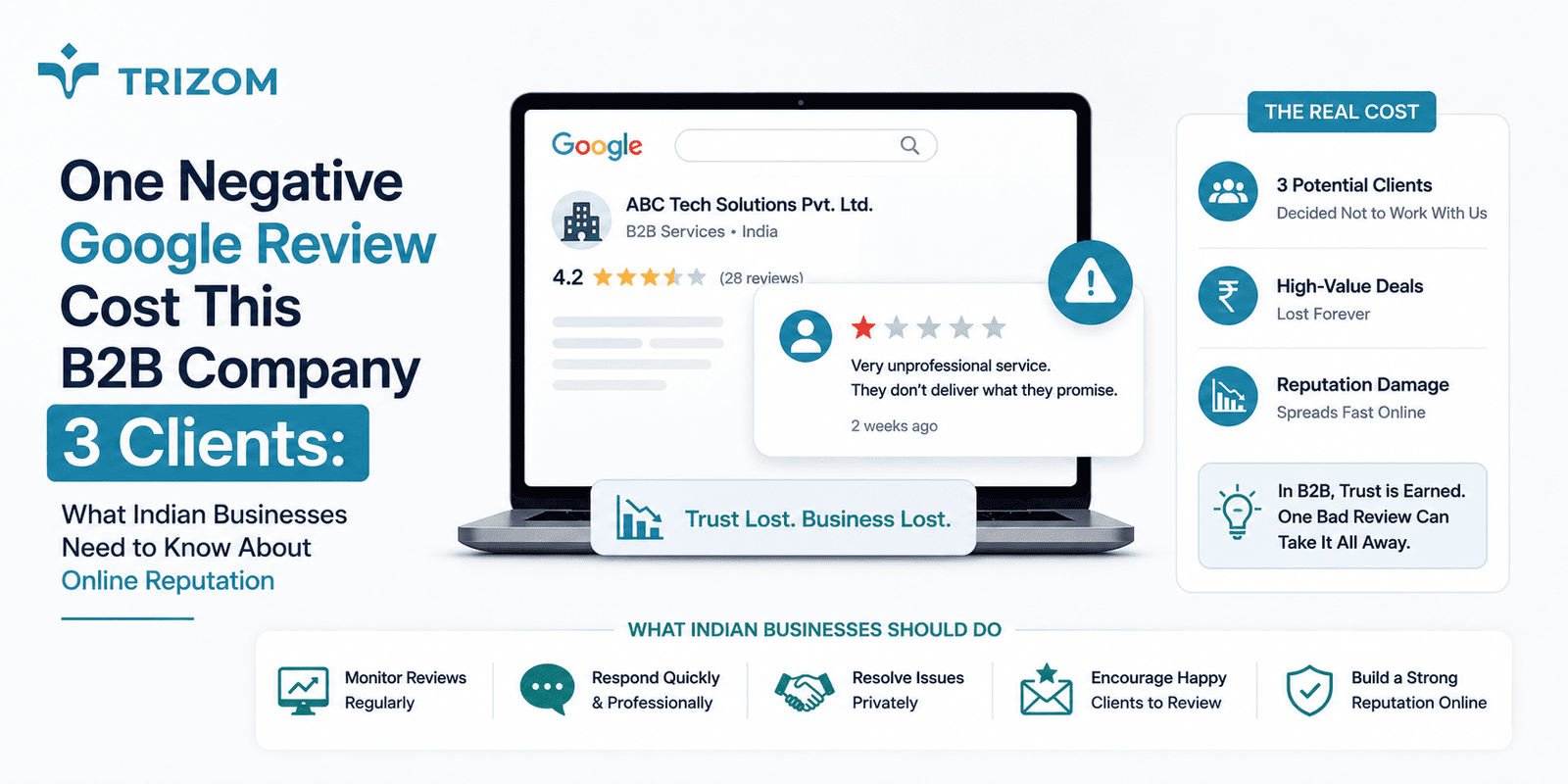
One Negative Google Review Cost This B2B Company 3 Clients: What Indian Businesses Need to Know About Online Reputation

Picture this. A procurement head in Bengaluru shortlists your company after a referral from a mutual contact. Before sending your proposal to their leadership team, they do what every serious B2B buyer does in 2026. They Google your company name.

The first thing they find is a one-star review from eighteen months ago. No response from your side. No context. Just a damaging statement sitting at the top of your search results, completely unchallenged.

Your proposal never gets discussed in that boardroom.

This is not a hypothetical. It is the reality for hundreds of Indian B2B companies that have invested years building service quality and client relationships while leaving their online reputation management for B2B in India entirely unattended. And the cost of that neglect is measured not in lost reviews but in lost revenue.

Why Online Reputation Hits B2B Companies Harder Than B2C

B2C companies can absorb negative reviews because purchase decisions are individual, low-stakes, and often impulsive. A restaurant with a few bad reviews still fills tables because one hungry customer’s risk tolerance is completely different from a procurement committee evaluating a ₹20 lakh annual contract.

B2B buying decisions involve multiple stakeholders, extended evaluation periods, and significant financial commitment. Every person in that buying committee independently researches your company before signing off. A CFO, a COO, and a department head all Google your name at different points in their evaluation.

What they find in those searches determines whether your sales conversation continues or quietly stalls.

Google reviews management in India for B2B companies is therefore not a customer service function. It is a revenue protection function. And most Indian B2B companies are treating it like neither.

The Four Ways a Damaged Online Reputation Kills B2B Pipeline

  1. Unanswered Negative Reviews Signal Indifference

A negative review without a response does not just show one unhappy client. It shows every prospect that your company does not care enough to address public criticism.

Your review response strategy in India communicates your company’s character more powerfully than any marketing material you produce. A professional, empathetic, solution-focused response to a critical review can actually strengthen buyer confidence rather than diminish it.

Buyers understand that problems occur in business relationships. What they are evaluating is how your company responds when they do. Silence fails that test every single time.

  1. Negative SERP Results Appear Before Your Website Does

SERP reputation management for B2B in India is about controlling what appears when someone searches your company name, not just your website ranking.

When a negative news article, a critical forum post, or a damaging third-party review outranks your own website in search results, your brand narrative is being written by someone else. Prospects form their first impression from whatever appears at the top of the page, and in most cases that impression forms before they ever visit your official website.

Negative content suppression in India through deliberate creation and promotion of authoritative positive content is the only sustainable way to reclaim your SERP narrative. It requires consistency, strategic content placement, and a long-term view of SERP results management that most companies only adopt after damage has already been done.

  1. Your Google My Business Profile Is Working Against You

Most B2B companies in India set up their Google My Business profile once and never return to it.

Meanwhile, reviews accumulate without responses. Outdated information sits uncorrected. Photos from three years ago misrepresent your current team size and office environment. Questions from potential clients go unanswered for weeks.

Google My Business reputation management in India requires active, weekly attention. Your GMB profile appears in branded searches, map searches, and knowledge panels. It is often the first structured information a prospect encounters about your company, and a neglected profile communicates operational carelessness before the relationship even begins.

  1. A Single Crisis Can Undo Years of Brand Trust Building

Crisis management for Indian businesses in the digital age moves at a speed that most traditional B2B companies are completely unprepared for.

A disgruntled ex-employee posts publicly on LinkedIn. A client dispute spills into a public forum. A negative article appears in an industry publication. Within 48 hours, that content can rank for your brand name and be seen by every prospect currently evaluating your company.

Brand trust building for B2B takes years of consistent delivery and careful reputation management. It can be significantly damaged in 48 hours by a single piece of unaddressed negative content. The companies that recover fastest are the ones with a crisis response protocol already in place before the crisis arrives, not the ones scrambling to figure out their response after the damage is visible.

What Proactive ORM Actually Looks Like for Indian B2B Companies

Most Indian B2B companies’ approach to ORM services for companies in India reactively. They Google themselves after losing a deal they should have won and discover the reputation problem that cost them the contract.

Proactive brand reputation management in India operates on a completely different timeline. It involves monitoring your brand mentions across search, social media, review platforms, and news sources continuously, so you identify emerging reputation risks before they escalate into visible damage.

Brand monitoring tools in India range from Google Alerts at the basic end to enterprise platforms that track sentiment across thousands of sources simultaneously. The right tool depends on your company size, industry, and the volume of online conversation around your brand.

Regardless of the tool, the discipline is the same. Monitor daily. Respond to every review, positive or negative, within 48 hours. Suppress emerging negative content proactively through consistent publication of authoritative positive content. And build your digital PR for B2B in India through thought leadership, industry contributions, and earned media that creates a body of positive search results strong enough to withstand occasional negative content without losing its dominance.

The Role of Digital PR in B2B Reputation Management

Digital PR for B2B in India is one of the most underutilised reputation tools available to Indian companies, particularly those operating in professional services, technology, and consulting.

Earned media placements in respected industry publications, expert commentary in business news outlets, and contributed articles in niche trade platforms all create authoritative positive content that ranks well for your brand name and builds the kind of third-party credibility that no amount of self-published content can replicate.

When a prospect Googles your company and finds a Forbes India feature, an Economic Times quote from your founder, and a detailed case study on an industry platform alongside your website and a perfectly managed GMB profile, the narrative they form about your company is completely different from the one they form when they find an unanswered negative review.

Brand perception management in India at the highest level is essentially content strategy applied to your reputation. It requires the same discipline, consistency, and long-term thinking that any serious marketing investment demands.

How Trizom Protects and Rebuilds B2B Reputations in India

At Trizom, our online reputation management for B2B in India combines continuous brand monitoring, strategic negative content suppression, Google My Business management, review response strategy, and digital PR for B2B into a unified reputation programme that protects your brand narrative across every touchpoint a prospect encounters.

We do not wait for your reputation to become a problem before we start working on it. We build the positive digital infrastructure that makes reputation damage significantly harder to inflict and significantly faster to recover from when it does occur.

Your B2B pipeline depends on trust. And trust, in 2026, is built and broken on the first page of Google.

Conclusion

Online reputation management for B2B in India is not a defensive exercise for companies already in crisis. It is a proactive revenue protection strategy for any company where client trust, referrals, and professional credibility drive pipeline. A single unaddressed negative review, an unanswered GMB comment, or a damaging search result appearing above your website can silently cost you multiple deals before your sales team even knows the prospect was evaluating you. Google reviews management in India combined with strategic negative content suppression, consistent digital PR for B2B, and a structured crisis response protocol is what separates Indian B2B companies that control their narrative from those that let the internet write it for them.

Is your online reputation protecting your pipeline or putting it at risk?
Request a Free ORM Audit from TRIZOM

Frequently Asked Questions

Loader image

Negative review removal in India is possible in specific circumstances where the review violates Google's review policies, such as reviews containing fake information, spam, off-topic content, or content from someone who was never actually a client. Legitimate negative reviews from real clients cannot be removed but can be effectively managed through a professional review response strategy in India that demonstrates accountability and resolution commitment to every future prospect who reads the exchange. For negative reviews that cannot be removed, negative content suppression in India through consistent publication of authoritative positive content gradually pushes damaging results down in SERP results management, reducing their visibility to prospects researching your brand.

The damage from a negative online reputation to a B2B pipeline in India can begin within days of damaging content becoming visible in search results. B2B sales cycles in India typically involve a research phase where multiple stakeholders independently evaluate vendors over several weeks. If negative content appears during that window, it influences shortlisting decisions that your sales team never gets visibility into. The prospect simply stops responding without explaining why. Crisis management for Indian businesses that moves within 24 to 48 hours of negative content appearing can significantly limit the pipeline damage. Companies without a monitoring and response protocol in place typically discover the problem weeks or months after it begins affecting their conversion rates.

SERP reputation management for B2B in India is the practice of actively managing what appears in search engine results pages when someone searches your company name, founder names, or brand-related terms. For B2B companies in India, the first page of branded search results functions as a digital due diligence report for every prospect evaluating your company. SERP results management involves building a body of positive, authoritative content across your own website, industry publications, social platforms, and review sites that collectively dominates the first page of your branded search results. When your SERP is filled with positive, credible content, negative reviews or damaging content is pushed to page two or beyond, where the vast majority of prospects never look.

ORM services for companies in India vary in cost based on the current state of the reputation, the competitiveness of branded search results, and the scope of ongoing monitoring and management required. For B2B companies with a relatively clean reputation seeking proactive protection, monthly brand reputation management programmes in India typically range from ₹15,000 to ₹40,000 per month, covering Google My Business reputation management, review monitoring and response, brand mention tracking through brand monitoring tools, and basic digital PR for B2B, for companies requiring active negative content suppression or crisis management, the scope and investment required are determined after a thorough audit of the current SERP landscape and the nature of the content requiring suppression.

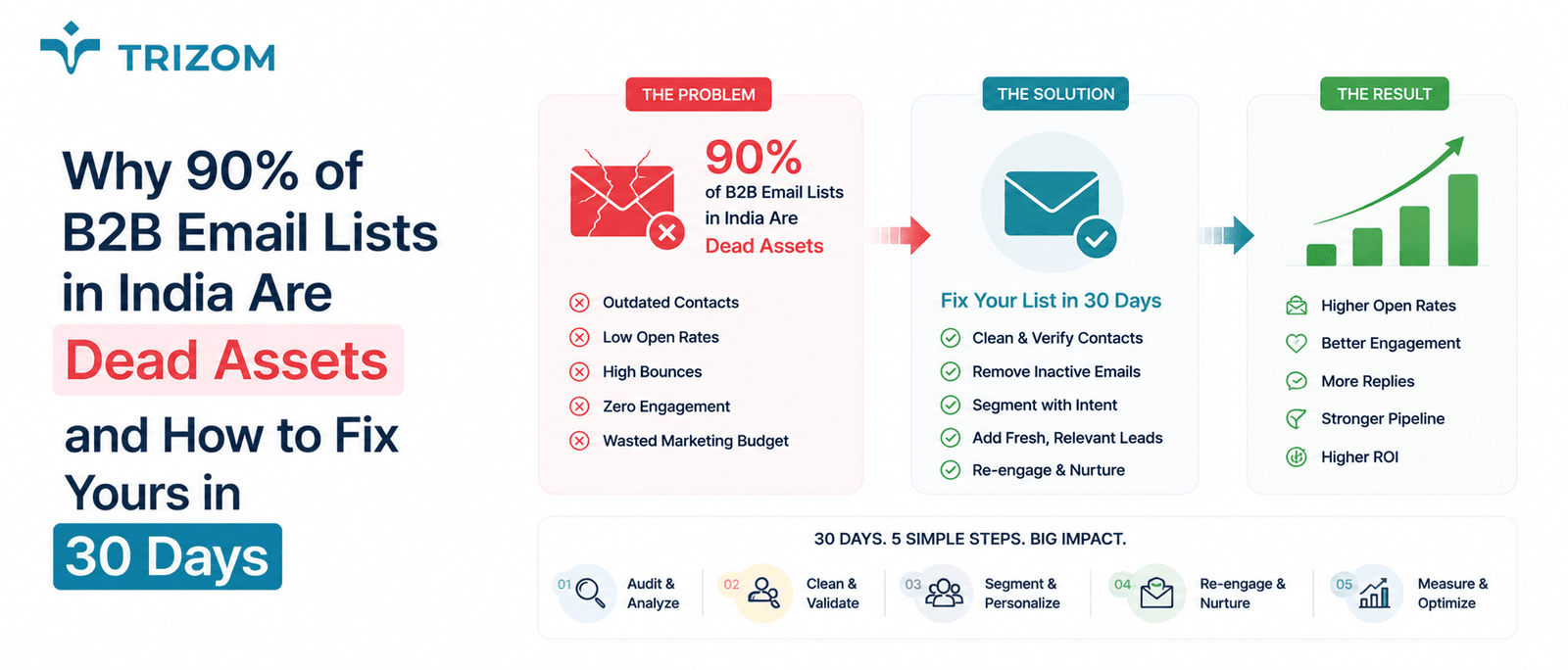
Why 90% of B2B Email Lists in India Are Dead Assets and How to Fix Yours in 30 Days

Somewhere in your CRM right now sits a database of hundreds, possibly thousands, of contacts your sales team spent years collecting. Referrals, event attendees, webinar registrants, past enquiries, cold outreach responses. Every one of them was a live opportunity at some point.

Most of them have not heard from you in months.

That database is not an asset anymore. It is a graveyard. And email marketing for B2B in India is the only tool that can bring it back to life, but only if you stop treating every contact the same way and start treating your B2B email list in India like the segmented, behaviour-driven pipeline it was always meant to be.

Here is exactly what killed your list and how to fix it in 30 days.

Why B2B Email Lists Die in Indian Companies

The death of a B2B email list in India rarely happens overnight. It happens gradually, through a pattern of well-intentioned but strategically misaligned email habits that erode engagement one send at a time.

Here is the pattern that plays out in almost every sales and marketing team we have worked with.

The list grows through multiple channels with no consistent qualification process. Everyone gets added to the same master list regardless of where they came from, what they expressed interest in, or where they are in the buying journey. Every contact receives the same newsletter, the same product update, the same festival greeting email.

Over time, open rates drop. Nobody investigates why. The team sends more frequently to compensate. Unsubscribes climb. Gmail and Outlook begin routing the domain to spam. The list that took three years to build now delivers a 4% open rate and a 0.2% click rate.

That is not an email problem. That is an email segmentation for B2B problem dressed up as a deliverability problem.

The 30-Day Fix: What to Do and When

Week 1: Audit and Segment Before You Send Another Email

Stop all outgoing email immediately. Sending more emails to a disengaged list makes your deliverability problem permanently worse.

Spend the first week doing one thing: segment your B2B email list in India based on the data you already have.

Divide your contacts into at minimum four buckets. Active engaged contacts who opened or clicked within the last 90 days. Warm contacts who engaged between 90 and 180 days ago. Cold contacts with no engagement in over 180 days. And completely unresponsive contacts who have never opened a single email.

Each bucket needs a completely different strategy. Treating them the same is what created the problem in the first place.

Email segmentation for B2B at this level does not require sophisticated technology. It requires honest interrogation of the data you already have inside your CRM.

Week 2: Launch a Re-Engagement Campaign for Cold Contacts

Your cold and warm segments need a re-engagement email campaign before they receive any sales or nurturing content.

A re-engagement sequence for B2B email list recovery in India has one job: confirm whether the contact still wants to hear from you and give them a reason to say yes.

The sequence structure that works consistently for Indian B2B companies looks like this.

Email one goes out on day one with a subject line that acknowledges the silence directly. Something like “We have not spoken in a while. Is this still relevant to you?” performs significantly better than a promotional subject line for cold contacts because it creates pattern interruption in an inbox conditioned to ignore your domain.

Email two goes out on day four with a piece of genuinely useful content. Not a product pitch. A specific insight, a short case study, or a practical framework relevant to the contact’s industry and role. This is where email copywriting for B2B in India separates average campaigns from ones that actually rebuild engagement.

Email three goes out on day seven as a final check-in with a clear binary choice. Stay on the list or opt out. Contacts who do not respond to any of the three emails should be suppressed immediately. Keeping unresponsive contacts on your list damages your sender reputation and reduces deliverability for every email you send to the contacts who do want to hear from you.

Week 3: Build Drip Campaigns Around Subscriber Behaviour Triggers

Once your list is segmented and your re-engagement campaign is running, shift your focus to the engaged contacts.

Drip campaigns for B2B in India built around subscriber behaviour triggers outperform broadcast email campaigns by a significant margin because they respond to what a contact actually does rather than what you assume they want to receive.

Subscriber behaviour triggers that every Indian B2B company should be tracking include email opens without clicks, link clicks on specific content topics, website visits from email traffic, whitepaper or case study downloads, and pricing page visits.

Each of these signals tells you something specific about where the contact sits in their buying journey. A contact who clicks a link about implementation methodology is further along in evaluation than one who opened a thought leadership article. Your drip campaign for B2B in India should respond to that distinction with a different next email in the sequence.

Marketing automation in India through tools like HubSpot, Zoho, or Mailchimp makes this trigger-based approach implementable without manual intervention. The investment in setup pays back immediately in relevance, and relevance is what drives email open rate improvement in India sustainably.

Week 4: Integrate Your Email System With Your CRM

The final week of your 30-day fix addresses the root cause of why most Indian B2B email lists become disconnected from actual sales activity in the first place.

CRM email integration in India closes the loop between your marketing email activity and your sales pipeline. When a salesperson can see that a prospect opened four emails, clicked a pricing link, and downloaded a case study in the last two weeks, their follow-up call has context. That context changes the entire quality of the conversation.

Without CRM email integration, your marketing team and sales team are operating with different information about the same prospect. Marketing thinks the lead is cold because they have not responded to emails. Sales thinks the lead is uninterested because they have not returned calls. The prospect is actually mid-evaluation, consuming your content quietly, and waiting for someone to reach out with something relevant.

Lead nurturing email strategy in India connected to CRM data ensures that the handoff from marketing nurture to sales outreach happens at the right moment, triggered by the right behaviour signal, rather than based on an arbitrary follow-up schedule.

What Your B2B Newsletter Strategy Should Actually Look Like

A B2B newsletter strategy in India is not a monthly update about what your company has been doing. Nobody reads those. Nobody forwards those. Nobody books a meeting because of those.

A B2B newsletter that drives email campaign ROI in India delivers one specific, actionable insight relevant to the reader’s role and industry in every send. It is short enough to read in under three minutes. It has one clear CTA that serves the reader’s interest, not just yours. And it arrives consistently on the same day and time each week, so subscribers develop an expectation of its arrival.

The companies generating measurable pipeline from their newsletters in India are the ones that have made their newsletter genuinely useful to their specific audience. Not useful-in-general. Useful-to-their-exact-buyer-persona-on-a-Tuesday-morning useful.

That level of specificity is what transforms a B2B newsletter strategy from a vanity metric exercise into a cold email-to-warm-lead pipeline that your sales team can actually work with.

How Trizom Revives Dead B2B Email Lists

At Trizom, our email marketing for B2B process in India starts with your existing list, not a blank slate. We audit your current database, segment contacts by engagement level and buying stage, build re-engagement sequences for cold contacts, and design trigger-based drip campaigns for B2B in India that respond to real behaviour rather than assumed intent.

We set up CRM email integration so your sales team has full visibility into prospect engagement, and we build a B2B newsletter strategy in India that your subscribers look forward to receiving because it consistently delivers something worth their attention.

Your email list is not dead. It is dormant. And the difference between those two things is a structured 30-day strategy that treats your contacts as individuals with specific needs rather than names on a spreadsheet waiting for your next broadcast.

Conclusion

A neglected B2B email list in India is one of the most recoverable assets a sales and marketing team possesses, but only if the recovery strategy addresses the root causes rather than just sending more emails to a disengaged database. Proper email segmentation for B2B, trigger-based drip campaigns, a genuine re-engagement email campaign, and tight CRM email integration transform a dormant list into a consistent source of warm, pre-nurtured leads. Email marketing for B2B in India done correctly in 2026 is not about volume. It is about relevance delivered at exactly the right moment to exactly the right person.

Is your B2B email list generating pipeline or collecting dust?
Let Trizom Build Your Email Strategy

Frequently Asked Questions

Loader image

Drip campaigns for B2B in India convert cold contacts into warm leads by delivering a pre-planned sequence of relevant, value-led emails over a defined period, gradually building familiarity, trust, and purchase intent without requiring manual intervention at every touchpoint. Unlike broadcast emails that treat every contact identically, a well-structured drip sequence responds to subscriber behaviour triggers such as email opens, link clicks, and website visits, automatically advancing the contact to the next stage of the sequence based on their actual engagement. This approach to lead nurturing email strategy in India consistently outperforms cold outreach because it warms the prospect through demonstrated expertise before any sales conversation begins.

Email segmentation for B2B is the process of dividing your contact database into distinct groups based on shared characteristics such as industry, job title, buying stage, past engagement behaviour, and content interests, and then sending each group emails specifically relevant to their situation. For Indian B2B companies with diverse contact databases built across multiple channels over several years, segmentation is the single most impactful improvement available to email open rate improvement in India. A financial services firm receiving an email written for a manufacturing company will not engage, regardless of how well written the email is. Segmentation ensures relevance, and relevance is what drives open rates, click rates, and ultimately email campaign ROI in India.

CRM email integration in India connects your email marketing platform to your sales CRM so that every email open, click, download, and website visit is visible to your sales team alongside the contact's full relationship history. This integration eliminates the information gap between marketing and sales that causes perfectly warm prospects to be ignored because neither team has a complete picture of the contact's engagement level. When marketing automation in India is connected to CRM data, trigger-based emails can fire automatically when a prospect performs a high-intent action such as visiting your pricing page or downloading a case study, creating a seamless cold email to warm lead pathway that requires minimal manual intervention from your sales team.

Sustainable email open rate improvement in India for B2B campaigns comes from four interconnected improvements. First, list hygiene through removal of unresponsive contacts and a structured re-engagement email campaign for dormant subscribers improves your sender reputation and deliverability. Second, email segmentation for B2B ensures that each contact receives content relevant to their specific role and buying stage, making every send worth opening. Third, subject line testing that focuses on specificity, curiosity, and direct relevance to the recipient's actual problem consistently outperforms generic subject lines. Fourth, sending cadence optimisation through subscriber behaviour triggers rather than arbitrary broadcast schedules means contacts receive emails when their engagement signals indicate readiness, not just when your content calendar dictates the next send.

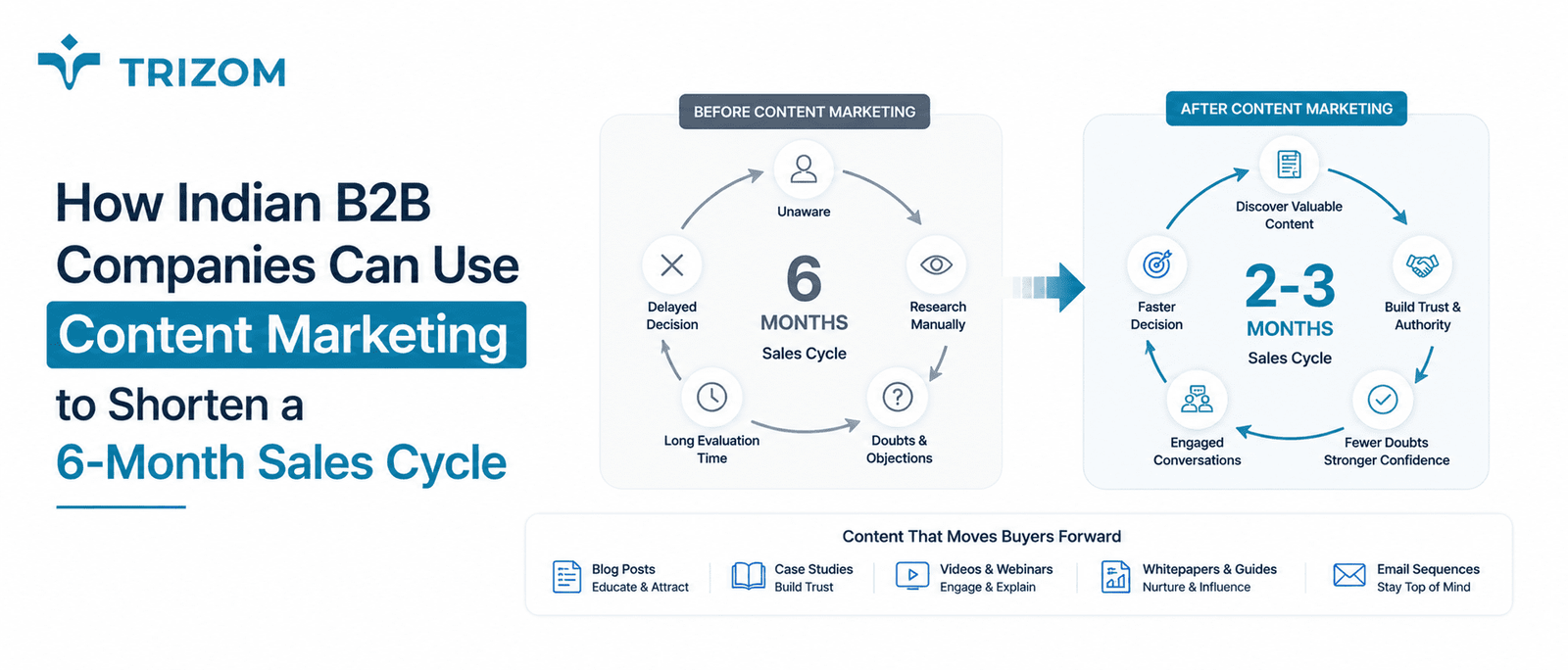
How Indian B2B Companies Can Use Content Marketing to Shorten a 6-Month Sales Cycle

The average Indian B2B sales cycle does not fail because of bad salespeople. It fails because prospects spend months in silence, evaluating vendors through content they find on their own, and most companies have nothing useful waiting for them when they look.

That silence is where B2B content marketing in India either wins the deal or hands it to a competitor who published the right article three months ago.

If your sales team is chasing the same prospects for six months with follow-up calls that go unanswered, the problem is not persistence. It is the absence of a content strategy for B2B companies in India that does the nurturing between those calls.

Why Long B2B Sales Cycles Exist in the First Place

A six-month sales cycle is not irrational buyer behaviour. It is a rational response to high-stakes purchasing decisions.

B2B buyers in India typically involve four to seven stakeholders before signing a contract. Each stakeholder has different concerns, different objections, and different information needs. While your sales team is speaking to one of them, the others are quietly researching on their own.

What they find during that independent research determines whether your brand stays on the shortlist or quietly disappears from it.

This is the exact problem that a structured content strategy for B2B companies in India solves. Not by replacing your sales process, but by running parallel to it and doing the heavy lifting of trust-building between touchpoints.

Mapping Content to the Buyer Journey: Where Most Companies Get It Wrong

Most Indian B2B companies that invest in content create awareness-stage material almost exclusively. Blog posts explaining what their service is. LinkedIn posts announcing new hires. Website copy describing their process.

None of this helps a buyer who already knows what they need and is now evaluating whether your company specifically can deliver it.

Buyer journey content mapping requires a fundamentally different approach. Every piece of content must serve a specific stage of the decision process for a specific stakeholder within the buying committee.

Here is how that looks in practice.

Stage 1 – Awareness: Make Them Find You Before They Are Ready to Buy

At this stage, your buyer has identified a problem but has not yet defined what kind of solution they need.

Blog writing for B2B in India at the awareness stage should address the symptoms of the problem your service solves, not the service itself. A B2B logistics company does not write about their fleet size at this stage. They write about why growing e-commerce brands in India consistently underestimate last-mile delivery costs.

That specificity is what builds topical authority with both search engines and human readers. Google rewards depth of expertise. Buyers reward relevance to their actual situation.

SEO content for B2B in India in 2026 at the awareness stage targets informational keywords with meaningful search volume, pulling prospects into your content ecosystem before any competitor has a chance to introduce themselves.

Stage 2 – Consideration: Give Them the Ammunition to Shortlist You

This is where most B2B sales cycles stall and where the right content can dramatically accelerate momentum.

A prospect in the consideration stage is comparing three to five vendors. They are looking for reasons to trust one and eliminate the others. They are not reading your homepage. They are reading your case studies, your long-form guides, and your thought leadership content to assess whether your team genuinely understands their problem.

B2B whitepaper content in India at the consideration stage demonstrates depth of expertise on a specific problem your buyer is facing. A well-constructed whitepaper does three things simultaneously: it answers the questions your prospect is asking independently, it surfaces objections your sales team has not addressed yet, and it positions your company as the most informed voice in the room before the formal evaluation even begins.

Case study content for B2B in India is arguably the highest-converting content format at this stage. Specific, outcome-focused case studies written around the buyer’s industry and problem type shorten the evaluation period because they eliminate the prospect’s biggest remaining doubt: has this company solved a problem like mine before?

The answer needs to be visible, specific, and credible. Not buried in a PDF nobody downloads.

Stage 3 – Decision: Remove the Last Obstacle Between Interest and Action

Your prospect has shortlisted you. They are now building an internal business case to get sign-off from their leadership team.

At this stage, thought leadership content in India from your founders and senior team carries enormous weight. A detailed LinkedIn post from your CEO addressing a specific challenge in the buyer’s industry does more for final-stage conversion than any brochure your design team produces.

Long-form content for B2B in India at the decision stage includes detailed implementation guides, ROI frameworks, comparison content, and responses to the most common objections your sales team encounters. This content gives your internal champion the language and evidence they need to sell your solution upward within their own organisation.

You are not just convincing the buyer anymore. You are equipping them to convince everyone else.

Distribution: The Half of Content Marketing Nobody Invests In

Creating content without a content distribution strategy is the single most common reason content marketing ROI in India disappoints.

Publishing a blog post and sharing it once on LinkedIn is not distribution. Distribution means your content reaches your target buyer across multiple touchpoints, through organic search, LinkedIn organic and paid amplification, email nurturing sequences, WhatsApp follow-ups from your sales team, and republication in relevant industry communities.

AEO content strategy in India adds another dimension to distribution in 2026. Structuring your content to appear in AI-generated search summaries, Google’s featured snippets, and People Also Ask sections means your answers reach buyers even when they are not actively searching for your brand.

Topical authority building through interconnected content clusters, where pillar pages link to spoke articles covering every sub-topic in depth, signals to Google that your website is the definitive resource on your subject matter. That signal translates directly into higher organic rankings and greater visibility throughout the buyer’s research journey.

How Trizom Builds Content Strategies That Actually Shorten Sales Cycles

At Trizom, our B2B content marketing approach in India starts with your sales data, not a content calendar template.

We interview your sales team to understand exactly where deals stall, what objections arise most frequently, and which competitor comparisons come up most often. We then build a content strategy for B2B companies that places the right answer at every stalling point in your buyer journey.

From blog writing for B2B, whitepapers, and case studies to LinkedIn thought leadership and AEO-optimised FAQ content, every piece we produce has a defined role in moving a specific buyer persona from awareness to decision.

Content marketing for lead generation in India done this way does not just generate traffic. It generates trust at scale, and trust is what converts a six-month sales cycle into a two-month one.

Conclusion

The length of your B2B sales cycle is not fixed. It is directly proportional to how much useful, relevant content your prospects find when they research independently between your sales touchpoints. B2B content marketing in India that maps deliberately to every stage of the buyer journey, distributes content across every channel your prospect uses, and builds topical authority in your specific domain compresses evaluation timelines by answering objections before your sales team even knows they exist. A structured content strategy for B2B companies in India is not a marketing expense in 2026. It is your most scalable sales asset.

Want content that shortens your sales cycle and fills your pipeline?
Build Your Content Strategy with TRIZOM

Frequently Asked Questions

Loader image

The highest-performing content formats for B2B content marketing in India in 2026 are specific case studies with quantified outcomes relevant to the buyer's industry, long-form educational guides that address the exact problems your buyers search for independently, thought leadership content in India from founders and senior practitioners that demonstrates genuine domain expertise, and B2B whitepaper content that gives buyers the evidence they need to build an internal business case. SEO content for B2B in India structured around buyer-stage keyword intent and optimised for AEO content strategy to appear in AI search summaries and featured snippets consistently outperforms generic blog content in both traffic quality and conversion rate.

B2B content marketing in India operates on a compounding timeline rather than a linear one. Most companies begin seeing meaningful organic traffic growth within 3 to 4 months of consistent, strategically structured content publication. Lead generation from content typically becomes measurable between months 4 and 6 as topical authority building gains traction with search engines and target audiences. The compounding nature of content means that a piece published in month 2 continues generating leads in month 18 without additional investment. Unlike paid advertising which stops delivering the moment you stop spending, content marketing ROI in India grows over time and becomes an increasingly cost-efficient lead generation channel as your content library expands.

Buyer journey content mapping is the process of deliberately creating content that addresses the specific questions, objections, and information needs of your target buyer at each stage of their decision process, from initial problem awareness through vendor evaluation to final purchase decision. For B2B companies in India with multiple stakeholders and long sales cycles, content that is not mapped to a specific buyer stage and persona either attracts the wrong audience or fails to move the right audience forward. A structured content strategy for B2B companies in India built on buyer journey mapping ensures that every piece of content serves a defined commercial purpose rather than simply generating traffic that never converts into pipeline.

Measuring content marketing ROI in India for B2B companies requires tracking metrics at multiple levels of the funnel simultaneously. At the top, track organic traffic growth, keyword ranking improvements, and content reach through content distribution strategy channels. In the middle, track time on page, return visitor rates, whitepaper downloads, and email list growth from content. At the bottom, track the number of leads that first engaged with your brand through content, the conversion rate of content-sourced leads versus other channels, and the average sales cycle length for prospects who consumed your content before making contact. Companies that track all three levels consistently find that B2B blog strategy in India and long-form content deliver a significantly lower cost per acquired client than any outbound channel over a 12-month horizon.

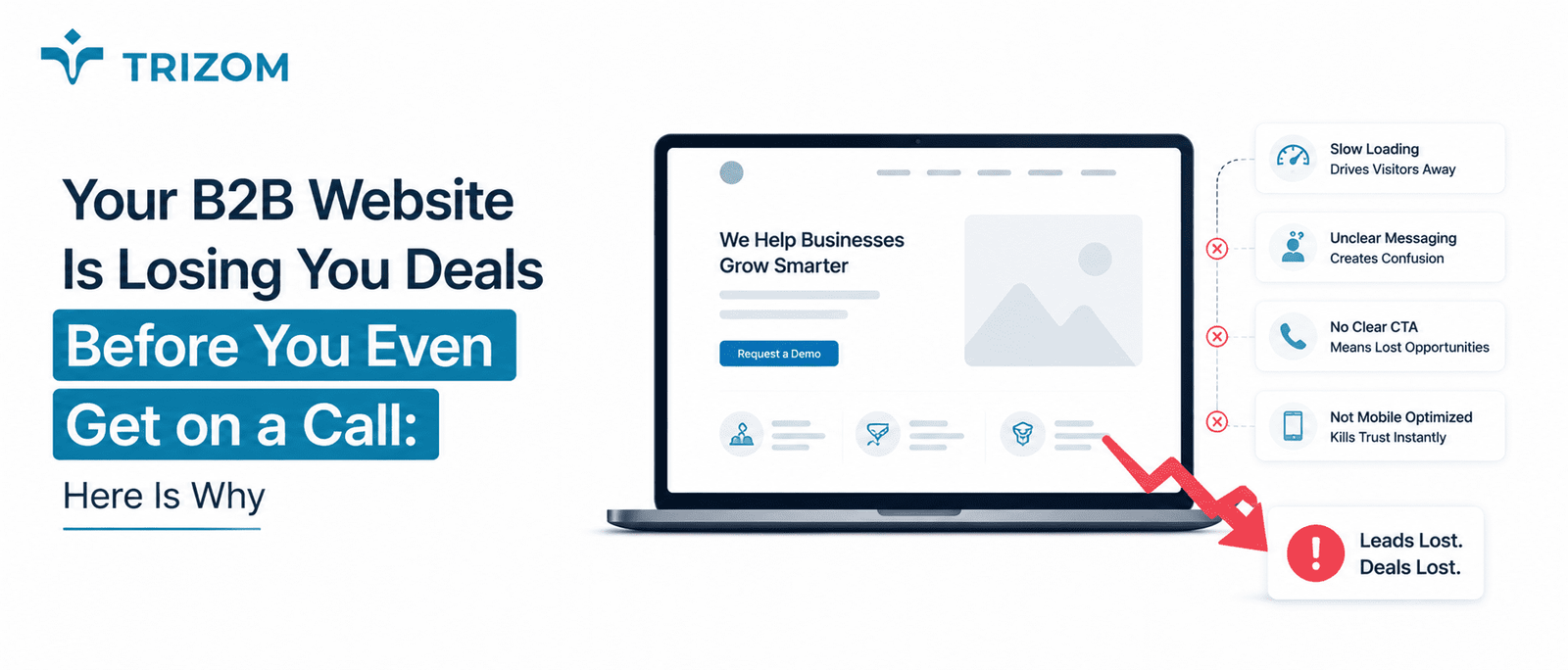
Your B2B Website Is Losing You Deals Before You Even Get on a Call: Here Is Why

B2B website design in India has a serious credibility problem, and most founders do not realise it until a prospect tells them directly. Your conversion-optimised website is not a nice-to-have in 2026. It is the first sales meeting your business ever has.

And right now, most B2B websites in India are failing that meeting before the prospect scrolls past the hero section.

The Silent Deal Killer Sitting on Your Domain

Your website is open in a tab right now on a prospect’s browser. They found you through a referral, a LinkedIn post, or a Google search. They are evaluating whether you are worth a conversation.

You have approximately 7 seconds to convince them you are.

Here is what is going wrong in those 7 seconds, and why it is costing Indian B2B companies real pipeline every single day.

Problem 1: Your Above the Fold Design Communicates Nothing

Above the fold design is the first thing a visitor sees without scrolling. It is your most valuable piece of digital real estate.

Most Indian B2B websites waste it completely.

Generic headlines like “Welcome to Our Website” or “We Deliver Excellence” communicate nothing to a decision maker evaluating vendors. Your above-the-fold section must answer three questions instantly: what you do, who you do it for, and why you are the right choice.

If a visitor cannot answer all three within 5 seconds, they leave. They do not come back.

Problem 2: Your Website Load Time Is Destroying First Impressions

Website load time in India is a critical conversion variable that most B2B founders completely underestimate.

A page that takes more than 3 seconds to load loses over 50% of its visitors before they see a single word of your content. For a B2B website in India where each lost visitor could represent a high-value contract, this is an extraordinarily expensive problem.

Website speed optimisation in India is not a technical luxury. It is a sales priority.

Slow websites signal to decision makers that your operations are outdated. Fast websites signal that you take performance seriously. That perception forms before they read your headline.

Problem 3: No Clear CTA Placement on Key Pages

Your visitor is interested. They have scrolled through your service page, and they want to take the next step.

Then they cannot find how.

CTA placement on your website is one of the most consistently broken elements of Indian B2B websites. Calls to action buried in footers, hidden behind walls of text, or written in generic language like “Submit” or “Click Here” do not convert motivated visitors.

Every service page, case study page, and blog post needs a clear, specific, benefit-led CTA that tells the visitor exactly what happens next. “Book a 30-Minute Strategy Call” converts better than “Contact Us” every single time.

Problem 4: Your Website Has No Trust Signals

A B2B decision maker is about to recommend your company to their leadership team. They need ammunition to justify that recommendation.

Your website is not giving it to them.

Trust signals on a B2B website include client logos, case studies with specific outcomes, team credentials, certifications, testimonials from named individuals at real companies, and press mentions. Without these elements, your website looks identical to every other vendor they are evaluating.

UI UX design for B2B must deliberately place trust signals at the exact moments in the browsing experience where doubt is most likely to arise. Typically this is just before a CTA, just after a pricing section, and on any page where a visitor is being asked to commit.

Problem 5: Your Website Is Not Mobile First

Over 60% of B2B website traffic in India now comes from mobile devices. Yet most B2B website designs in India were built primarily for desktop and adapted for mobile as an afterthought.

A mobile-first website in India is not about shrinking your desktop design to fit a smaller screen. It is about designing the entire experience around how a decision maker actually browses on their phone during a commute, between meetings, or at an airport.

If your mobile experience has tiny text, broken layouts, or buttons that are difficult to tap, you are communicating carelessness. That perception transfers directly to how the prospect thinks about your attention to detail as a service provider.

Problem 6: Your Landing Page Design Does Not Match Your Ads

You are running Google Ads or LinkedIn campaigns. Someone clicks your ad and lands on your homepage.

Your homepage talks about everything your company does. The visitor came looking for one specific thing.

They leave.

Landing page design for B2B must match the exact promise made in the ad or content piece that brought the visitor there. Message match between your ad and your landing page is one of the most powerful conversion levers available, and one of the most ignored in Indian B2B marketing.

A dedicated landing page design for each B2B service you promote through paid channels consistently outperforms a generic homepage by a significant margin on both conversion rate and lead quality.

Problem 7: Your Bounce Rate Is High, and Nobody Is Investigating Why

A high bounce rate on your B2B website in India is your analytics dashboard telling you something is seriously wrong.

Most teams see the number, feel uncomfortable, and move on.

Bounce rate on a B2B website is a symptom of misalignment between what brought the visitor to the page and what they found when they arrived. It could be a keyword intent mismatch, a slow load time, a confusing above-the-fold layout, missing trust signals, or a combination of all of the above.

The fix requires diagnosis before prescription. And diagnosis requires someone who knows what to look for in the data.

What a Professionally Built B2B Website Actually Does

A professional website for a B2B company in India does not just look good. It works around the clock as your most consistent, scalable sales asset.

It qualifies visitors through clear positioning. It builds credibility through deliberate trust signals. It converts interest into action through strategic CTA placement. It loads fast enough to hold attention. It works flawlessly on every device. And it is built on a technically sound foundation like WordPress development for B2B that makes ongoing updates, SEO improvements, and content additions straightforward without months of developer dependency.

A business website redesign in India done correctly pays for itself in pipeline generated within the first quarter of going live.

How Trizom Fixes B2B Websites That Are Losing Deals

At Trizom, our B2B website design process in India starts with a conversion audit of your existing site. We identify every element that is costing you pipeline, from above-the-fold messaging and CTA placement to mobile experience, load time, and trust signal gaps.

We then rebuild or redesign your website as a conversion-optimised website that reflects the quality of your services, earns the trust of your target buyer, and gives your sales team a digital asset they can be proud to send a prospect to.

Your website should win deals before your sales team gets on the call. Right now, it is probably losing them.

Conclusion

Your B2B website design in India is either building your pipeline or quietly draining it. Slow load times, weak above-the-fold design, missing trust signals, poor CTA placement, and a broken mobile experience collectively ensure that qualified prospects leave your website without ever becoming leads. A conversion-optimised website in India built around your buyer’s decision journey fixes each of these failure points systematically. In 2026, your website is not your digital brochure. It is your highest-traffic salesperson, and it needs to perform like one.

Is your website winning deals or losing them?
Get a Free Website Audit from TRIZOM

Frequently Asked Questions

Loader image

The cost of professional website design for a B2B company in India varies significantly based on scope, complexity, and the development approach. A basic WordPress development for B2B with 8 to 12 pages, conversion optimised design, mobile first build, and SEO-ready architecture typically ranges from ₹50,000 to ₹1,50,000. A more complex business website redesign in India with custom functionality, CRM integration, multiple landing pages, and advanced UI UX design for B2B can range from ₹1,50,000 to ₹5,00,000 or more. The more relevant question is not what the website costs but what losing deals to a poorly performing website is costing you every month.

A conversion optimised website in India for B2B companies combines several elements that work together to move a decision maker from curious visitor to qualified enquiry. Clear above the fold design that communicates your value proposition instantly, deliberate trust signals on your B2B website including client logos and specific case study outcomes, strategic CTA placement at every key decision point, fast website speed optimisation, a mobile first website experience that works flawlessly on every device, and landing page design for B2B that matches the specific intent of the visitor are all essential components of a website that consistently generates leads.

Extremely important and consistently underestimated. Over 60% of B2B website traffic in India now originates from mobile devices, meaning the majority of your prospects are forming their first impression of your business on a phone screen. A mobile first website in India is designed from the ground up for the mobile browsing experience, not adapted from a desktop layout as an afterthought. Poor mobile UI UX design for B2B including small text, difficult navigation, and slow load times on mobile signals to decision makers that your company does not pay attention to detail, which is exactly the wrong impression to create before a sales conversation.

A standard business website redesign in India for a B2B company with 8 to 15 pages typically takes between 4 and 8 weeks from kickoff to launch. This includes discovery and strategy, wireframing and UI UX design for B2B, content development with landing page design for key service pages, WordPress development, speed optimisation, mobile testing, and pre-launch SEO setup. More complex projects involving custom functionality, CRM integration, or e-commerce capabilities may take 10 to 14 weeks. The timeline is directly influenced by how quickly the client can provide feedback, approvals, and content inputs during the process.

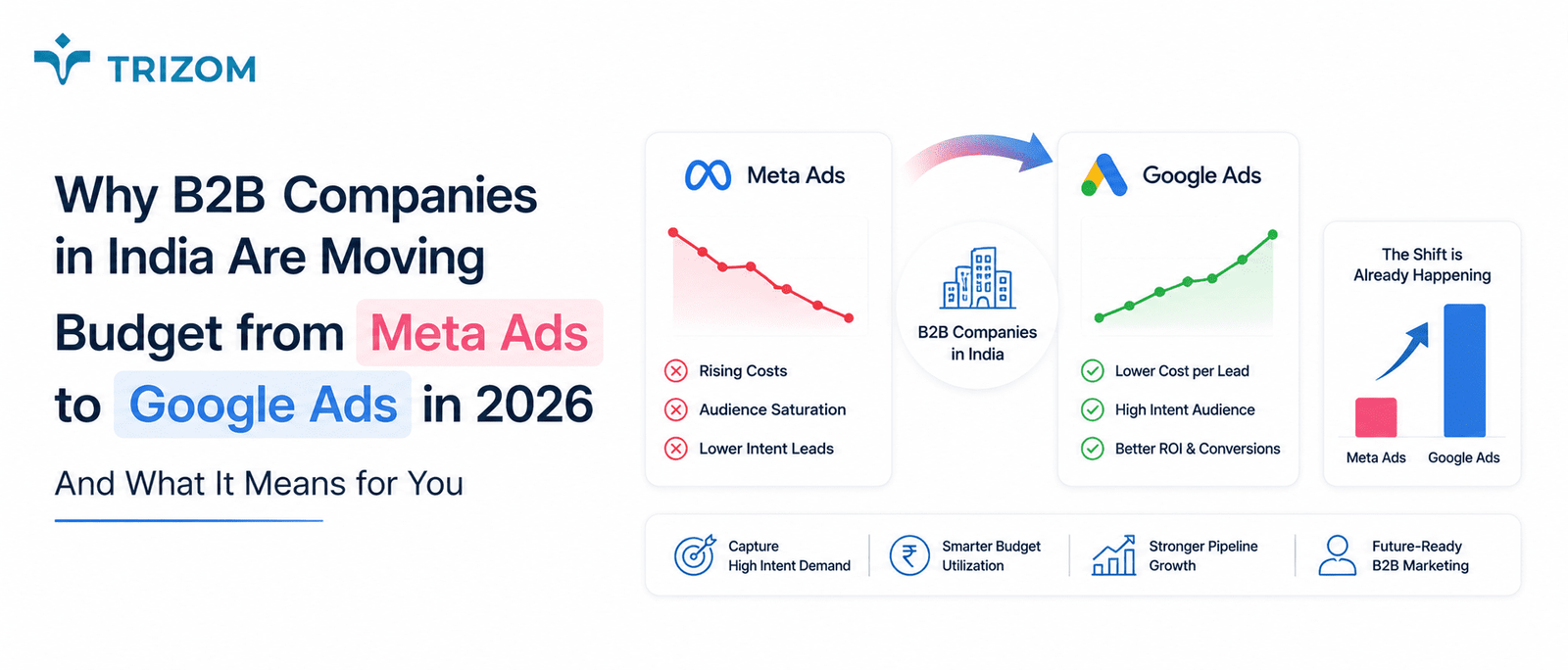
Why B2B Companies in India Are Moving Budget from Meta Ads to Google Ads in 2026 And What It Means for You

Meta Ads vs Google Ads for B2B in India is no longer a theoretical debate happening in marketing forums. It is a live budget reallocation decision being made by CMOs and performance marketing managers across Indian B2B companies right now, and the direction of that shift is becoming increasingly clear.

The question is not which platform is better in absolute terms. The question is which platform is better for your specific buyer, your specific sales cycle, and your specific revenue goal in 2026. And the answer to that question has changed significantly over the last eighteen months.

Here is what is driving the shift and what it means for how you allocate your paid advertising strategy for B2B in India going forward.

The Fundamental Problem with Meta Ads for B2B in India

Meta Ads, encompassing Facebook and Instagram, were built for consumer behaviour. The platform architecture, the algorithm, and the ad formats are all optimised for impulse-driven decisions made by individuals scrolling through personal content feeds.

Facebook Ads for B2B in India ask you to interrupt a decision maker who is looking at their cousin’s wedding photos and convince them in three seconds to care about your enterprise software, logistics solution, or professional service.

That is not impossible. But it is inefficient, and in 2026 the inefficiency is showing up clearly in Google Ads vs Meta Ads ROI comparisons across B2B accounts in India.

The core issue is intent. Meta captures passive audiences. Google captures active intent. And in B2B purchasing, intent is everything.

Why Google Ads Is Winning the B2B Budget Conversation in India

High Intent at the Moment That Matters Most

When a procurement manager in Mumbai types “cloud infrastructure management company India” into Google, they are not browsing. They are evaluating. That search represents a buyer who has already identified a problem, decided they need an external solution, and is now comparing vendors.

Lead generation ads in India in 2026 that appear at this moment of active intent convert at a fundamentally different rate than ads that interrupt passive scrolling behaviour on Meta.

For B2B companies with high-value contracts and long sales cycles, capturing a buyer at peak intent is worth far more than reaching ten times as many passive scrollers on Facebook.

Campaign Structure Built for B2B Buying Committees

A critical advantage of Google Ads for B2B is the ability to build campaign structure for B2B buying behaviour, where multiple stakeholders search for different aspects of the same solution at different stages of the evaluation process.

A technical director searches for implementation complexity. A CFO searches for pricing and ROI benchmarks. A CEO searches for vendor reputation and case studies. A well-structured Google Ads campaign can reach each of these decision-makers with a relevant message at their specific point of research, something B2B paid social advertising on India’s Meta platforms struggles to replicate with the same precision.

Where Meta Ads Still Earn Their Place in a B2B Paid Media Strategy

Before you reallocate your entire budget to Google, understand where B2B paid social advertising in India through Meta still delivers genuine value.

Top of Funnel Awareness at Scale

Meta Ads for B2B in India remain one of the most cost-effective ways to build broad brand awareness among a defined professional demographic. If your target audience includes startup founders, SME owners, or younger business decision-makers who spend significant time on Instagram and Facebook, Meta can introduce your brand at a lower CPM than almost any other digital channel.

The key is not to expect Meta to close deals. Expect it to start conversations and build familiarity.

Retargeting Campaigns That Recapture Intent

Retargeting for B2B in India is where Meta genuinely earns its allocation in a mature paid media strategy. Once a prospect has visited your website through a Google search or organic channel, Meta retargeting keeps your brand visible as they continue their evaluation process across their personal social feeds.

ROAS optimisation in India for B2B campaigns consistently shows that retargeting audiences on Meta convert at significantly higher rates than cold audiences, because the intent signal has already been established through another channel.

This is the correct role for Meta in a B2B paid media strategy in 2026. Not primary acquisition. Persistent re-engagement.

The Smarter Paid Advertising Strategy for B2B India in 2026

The B2B companies generating the strongest pipeline from paid media in India right now are not choosing between Google and Meta. They are sequencing them intelligently.

Google Ads captures high-intent buyers at the moment of active search. It fills the top of your qualified pipeline with prospects who are already in evaluation mode.

Meta Ads retarget those same prospects across their social feeds, reinforcing your brand message, sharing proof points, and keeping you front of mind during the weeks or months between their initial search and their final vendor decision.

This sequenced paid media strategy in India requires tight conversion tracking in India across both platforms, clear audience targeting segmentation between cold and warm audiences, and disciplined ad creative strategy for B2B that serves different messages at different stages of the buyer journey.

ROAS Optimisation Across Both Platforms

ROAS optimisation in India for B2B paid campaigns requires a unified view of the customer journey rather than optimising each platform in isolation. A prospect who clicked a Google Ad, visited your pricing page, saw three Meta retargeting ads, and then converted through a direct website visit should not be attributed to the last touchpoint alone.

Multi-touch attribution, even at a basic level, reveals that the cost per acquisition for B2B is almost always lower when Google and Meta work together as a sequenced strategy than when either platform operates in isolation.

How Trizom Builds Paid Media Strategies That Convert B2B Buyers

At Trizom, our paid advertising strategy for B2B in India is built around one principle: budget should follow buyer intent, not platform familiarity.

We audit your current Google and Meta Ads performance, identify where budget is being allocated versus where it is actually generating qualified pipeline, and rebuild your campaign architecture around a sequenced strategy that uses each platform for what it does best.

From campaign structure for B2B buying committees to ROAS optimisation across platforms and full conversion tracking setup in India, we manage every layer of your paid media ecosystem so your budget generates pipeline rather than just impressions.

Conclusion

Meta Ads vs Google Ads for B2B in India is not a winner-takes-all decision in 2026. It is a sequencing and allocation decision. Google Ads wins on intent capture and direct lead generation for high-value B2B buyers. Meta Ads wins on brand awareness and retargeting for prospects already in your funnel. The Indian B2B companies generating the strongest returns from their paid advertising strategy are the ones running both platforms with clear roles, tight conversion tracking, and a unified view of the buyer journey from first search to signed contract. The shift happening in 2026 is not away from Meta entirely. It is toward smarter allocation that respects how B2B buyers actually make decisions.

Is your paid media budget allocated where your buyers actually convert?
Get a Free Paid Media Audit from Trizom

Frequently Asked Questions

Loader image

Facebook Ads for B2B in India underperform Google Ads on direct lead generation because Meta is a passive discovery platform where users are not actively searching for business solutions. B2B buying decisions involve multiple stakeholders, long evaluation cycles, and high purchase values, all of which require intent-based targeting that Google's search network delivers far more effectively. B2B paid social advertising in India through Meta works best as a retargeting and brand awareness tool rather than a primary lead generation channel, which is why the Google Ads vs Meta Ads ROI comparison consistently favours Google for direct B2B pipeline impact.

The most effective paid media strategy for B2B India in 2026 combines Google Search Ads for high-intent acquisition with Meta retargeting for prospect re-engagement, supported by strong conversion tracking in India that gives you a unified view of the buyer journey across both platforms. Within Google, a well-structured campaign structure for B2B targets different buyer roles and search intents at different stages of the evaluation process. Within Meta, retargeting for B2B in India focuses exclusively on warm audiences who have already engaged with your brand through search or organic channels, significantly improving cost per acquisition for B2B across your overall paid investment.

Retargeting for B2B in India involves showing paid ads specifically to people who have previously visited your website, engaged with your content, or interacted with your brand through another channel. On Meta, retargeting uses the Facebook Pixel to identify website visitors and serve them relevant ads across Facebook and Instagram feeds during their ongoing evaluation period. On Google, retargeting through Display and YouTube reaches the same prospects across millions of websites. For B2B companies, retargeting consistently delivers the lowest cost per acquisition in the paid media mix because you are re-engaging buyers who have already demonstrated intent rather than trying to generate interest from a cold audience.

Measuring ROAS optimisation in India for B2B campaigns requires a different approach than B2C because B2B conversions are rarely immediate transactions. Effective ROAS measurement for B2B paid advertising tracks lead quality metrics alongside volume metrics, assigns pipeline value to each lead source based on historical close rates and average deal sizes, and uses multi-touch attribution to distribute revenue credit across Google Ads, Meta retargeting, and other paid touchpoints that contributed to a conversion. Proper conversion tracking in India across both Google and Meta platforms, integrated with your CRM, is the foundation of meaningful ROAS optimisation for any B2B paid social advertising strategy in India.

LinkedIn vs Instagram for B2B Lead Generation in India: Which Platform Actually Converts in 2026

LinkedIn marketing for B2B India and Instagram are both fighting for the same slice of your social media budget in 2026, but only one of them is consistently filling pipelines for Indian B2B companies. The question is not which platform has more users. It is which platform puts your brand in front of the person who actually signs the purchase order.

If you are a founder or marketing head sitting with a limited content budget and a very specific buyer in mind, this is the decision that determines whether your social media effort compounds into revenue or evaporates into engagement metrics that impress no one in your boardroom.

Let us settle it properly.

The Core Difference Nobody Talks About

Before comparing features and formats, you need to understand one fundamental distinction between these two platforms.

Instagram is a discovery platform. People open it to be entertained, inspired, and distracted. The intent is passive.

LinkedIn is a professional intent platform. People open it to learn, to network, to evaluate vendors, and to stay visible in their industry. The intent is active.

For B2B social media strategy in India, this distinction is everything. You are not selling a product someone buys on impulse. You are selling a solution that a committee of three to seven people will evaluate over several weeks or months. The platform where that evaluation happens matters more than the platform where your reel gets the most views.

The Case for LinkedIn Marketing for B2B in India

Decision Maker Targeting That Actually Works

Decision maker targeting on LinkedIn is unmatched by any other social platform available to Indian B2B marketers in 2026.

You can filter your content and paid reach by job title, seniority level, company size, industry, and geography. This means a manufacturing automation company in Pune can put its content directly in front of production heads and plant managers at mid-size factories across Maharashtra, without a single rupee being spent reaching someone who has no buying authority.

LinkedIn company page optimisation combined with consistent thought leadership content from the founders and senior team creates a compounding credibility effect. Decision makers research vendors on LinkedIn before they ever fill out a contact form. If your company page looks inactive and your leadership team has no presence, you have already lost the shortlist consideration before the conversation started.

Thought Leadership Converts Longer Sales Cycles

Thought leadership on LinkedIn India is particularly powerful for B2B companies with long sales cycles because it keeps your brand visible throughout the evaluation period without requiring a hard sell at every touchpoint.

A well-structured B2B content calendar for LinkedIn that mixes industry insights, problem-focused posts, behind-the-scenes credibility content, and client outcome narratives builds the kind of sustained familiarity that shortens the time between first contact and signed contract.

LinkedIn lead generation in India in 2026 is not just about direct messages and connection requests. It is about being the brand a decision maker has already seen twelve times before your sales team ever picks up the phone.

LinkedIn Sales Navigator for Precision Outreach

For B2B companies with a defined ICP, LinkedIn Sales Navigator in India remains one of the highest ROI prospecting tools available. The ability to build targeted account lists, track buyer signals, and engage warm prospects before a formal outreach sequence gives your sales team an edge that no Instagram strategy can replicate.

The Case for Instagram for B2B Companies in India

Brand Humanisation and Top of Funnel Awareness

Instagram for B2B companies is not useless. It is just misunderstood.

Instagram works exceptionally well for B2B brands that need to build human connection and cultural credibility before a decision-maker is ready to engage on a professional level. If your buyers are younger founders, startup operators, or growth-stage business leaders who spend more time on Instagram than LinkedIn, dismissing the platform entirely is a strategic mistake.

Organic social media growth in India on Instagram is particularly strong for B2B companies in creative industries, technology, design, and professional services where the visual demonstration of work quality builds trust faster than a written case study.

Social Media ROI for B2B on Instagram

The challenge with measuring social media ROI for B2B on Instagram is attribution. The path from an Instagram Reel to a signed service agreement is longer and harder to track than a LinkedIn post that generates a direct message from a procurement manager.

This does not mean Instagram has no ROI for B2B. It means the ROI is brand equity, not immediate pipeline, and that distinction should determine how much of your B2B content strategy budget it receives.

So Which Platform Should Indian B2B Companies Prioritise in 2026?

The honest answer is that the right platform depends on three variables: who your buyer is, what stage of the funnel you are trying to influence, and what your content team can execute consistently.

However, if you are choosing between the two for primary pipeline impact, LinkedIn marketing for B2B in India wins decisively for the following reasons:

Your buyer is on LinkedIn with professional intent; they are not scrolling LinkedIn to be entertained. They are there to stay informed and evaluate options in their industry. That is the exact mindset you want to reach.

Social media marketing for manufacturers in India, IT services companies, logistics firms, consulting practices, and SaaS businesses all show stronger direct lead attribution from LinkedIn than from Instagram, precisely because the platform context matches the buying context.

Engagement rate on B2B social matters less than engagement quality. One comment from a CFO on a LinkedIn post is worth more to your pipeline than 400 likes on an Instagram carousel from an audience of mixed intent.

LinkedIn company page optimisation combined with personal brand content from founders is currently the most underutilised and highest returning organic social strategy available to Indian B2B companies.

Use Instagram to build brand familiarity and human connection. Use LinkedIn to build pipeline.

How Trizom Builds Social Media Strategies That Generate B2B Leads

At Trizom, our B2B social media strategy in India is built around one principle: every piece of content must serve a stage in your buyer journey, not just an algorithm.

We build platform-specific content calendars for LinkedIn and Instagram, optimise your company page for social media lead generation in India, develop thought leadership frameworks for your founding team, and track engagement quality metrics that actually correlate with pipeline rather than vanity numbers.

If your social media effort is generating impressions but no conversations, we need to talk.

Conclusion

LinkedIn marketing for B2B India is the clear frontrunner for direct pipeline impact in 2026, while Instagram plays a valuable supporting role in brand building and top-of-funnel awareness. For Indian B2B companies with limited budgets and specific buyers, investing in a disciplined LinkedIn strategy with strong thought leadership content, optimised company presence, and targeted social media lead generation in India will consistently outperform a scattered approach across both platforms. Choose your primary platform based on where your buyer makes professional decisions, not where they spend the most leisure time.

Want a social media strategy that actually fills your B2B pipeline?
Talk to Trizom Today

Frequently Asked Questions

Loader image

Effective LinkedIn lead generation in India combines four elements: a fully optimised LinkedIn company page that clearly communicates your value proposition, consistent thought leadership content from founders and senior team members that addresses your buyer's pain points, a structured B2B content calendar that maps content to different stages of the buyer journey, and proactive outreach through connection requests, direct messages, and LinkedIn Sales Navigator for precision prospecting. Consistency over 90 days on LinkedIn produces measurably better pipeline results than sporadic posting.

The highest performing content formats for B2B social media strategy in India on LinkedIn include founder-led opinion posts addressing industry pain points, client outcome narratives that demonstrate results without being overtly promotional, educational carousel posts that break down complex problems, and behind-the-scenes content that builds human credibility. On Instagram, short-form video content, team culture posts, and visual case study carousels perform best for organic social media growth in India. Both platforms reward consistency and specificity over production value.

LinkedIn marketing for B2B India can be pursued organically at near-zero cost through consistent content publishing and engagement, making it one of the highest ROI channels available to Indian B2B companies with limited budgets. LinkedIn paid advertising, including Sponsored Content and Message Ads, typically costs between ₹400 and ₹900 per click in India depending on audience targeting parameters. LinkedIn Sales Navigator subscriptions start at approximately ₹5,000 to ₹7,000 per month per user. For most B2B companies starting, an organic-first approach combined with selective paid amplification of high-performing posts delivers the strongest social media ROI for B2B in the early stages.

Most B2B companies in India begin seeing meaningful social media lead generation results from LinkedIn within 60 to 90 days of consistent, strategic content publishing. The first 30 days are typically focused on building an audience, optimising the company page, and establishing a content rhythm. Days 30 to 60 see growing engagement rate on B2B social content as the algorithm begins distributing posts to relevant professional audiences. By day 90, companies with a clear ICP, strong thought leadership content, and active founder presence typically begin receiving inbound connection requests, direct message enquiries, and profile visits from target buyers. Sustained pipeline impact compounds significantly beyond the six-month mark.

How Indian B2B Companies Are Wasting 60% of Their Google Ads Budget Without Knowing It

According to WordStream, the average Google Ads conversion rate across B2B industries sits at just 3.75%. Yet most Indian B2B companies running paid search campaigns are converting at well below that, while continuing to increase their monthly budgets, hoping the numbers will eventually improve.

They will not. Not without fixing what is actually broken.

If you are a marketing manager or business owner running Google Ads for B2B in India and your cost per lead keeps climbing while your pipeline stays flat, the problem is almost certainly not your budget. It is where that budget is going.

The Uncomfortable Truth About B2B Google Ads in India

Most B2B companies in India set up their PPC campaigns once, let them run, and optimise only when the numbers become impossible to ignore.

By that point, months of ad spend have already been wasted on the wrong audiences, the wrong keywords, and the wrong bidding strategies. A PPC campaign audit in India conducted on a typical B2B account will almost always reveal the same pattern: significant budget leakage happening across multiple layers simultaneously.

Here is exactly where it is happening in your account.

Where Your Google Ads Budget Is Leaking

  1. No Negative Keyword List

This is the single biggest source of wasted ad spend in B2B Google Ads accounts across India.

Without a properly maintained negative keyword list, your ads show up for searches that have nothing to do with your buyers. A software company targeting procurement managers ends up paying for clicks from students searching for internships. A logistics firm targeting supply chain heads pays for clicks from job seekers searching for driver positions.

Every irrelevant click costs you money. Over a month, those clicks add up to a significant portion of your Google Ads budget optimisation problem, and the fix costs nothing except attention.

  1. Ignoring the Search Term Report

The search term report is one of the most powerful tools inside Google Ads and one of the least visited by B2B marketing teams in India.

This report shows you the exact queries that triggered your ads. Not the keywords you targeted. The actual searches people typed before clicking your ad and spending your budget.

In a typical PPC campaign audit in India, the search term report reveals dozens of irrelevant, low-intent, or completely unrelated queries eating into the monthly budget. Mining this report weekly and converting wasted terms into negatives is one of the fastest ways to reduce cost per lead in India without touching your budget ceiling.

  1. Poor Quality Score Management

Quality score improvement is directly tied to how much you pay per click. Google rewards ads that are relevant to the search query and the landing page experience. Low quality scores mean you pay more for the same placement than a competitor with a better-structured campaign.

Most B2B Google Ads accounts in India have quality scores sitting between 3 and 5 on core keywords, which means they are paying a premium for every click. Improving ad relevance, tightening keyword-to-ad copy alignment, and fixing landing page relevance can improve quality scores significantly and directly reduce your cost per click without reducing your visibility.

  1. Weak Conversion Tracking Setup

This is where PPC management in India gets particularly costly.

If your conversion tracking setup in India is incomplete, misconfigured, or not tracking the right actions, you are essentially flying blind. Google’s smart bidding algorithms optimise toward the conversion signals you give them. If those signals are wrong, the algorithm optimises toward the wrong outcomes and spends your budget accordingly.

A proper conversion tracking setup tracks form submissions, phone calls, WhatsApp initiations, and demo bookings separately, giving Google the data it needs to find more of the right buyers and fewer of the wrong ones.

  1. No Ad Schedule Optimisation

Ad schedule optimisation is consistently overlooked in B2B campaigns, yet it can recover a meaningful percentage of wasted spend almost immediately.

B2B buyers in India typically research and engage during business hours, Monday through Friday. Running your pay-per-click advertising in India at full budget on Sunday evenings or late nights when decision-makers are not at their desks means you are paying for impressions and clicks that will never convert into a sales conversation.

Analysing your conversion data by hour and day, then adjusting your bid modifiers and scheduling accordingly, is a fundamental part of any serious B2B lead generation Google Ads strategy.

  1. Weak Bid Strategy for B2B

Most B2B companies in India default to Maximise Clicks as their bidding strategy without understanding that this tells Google to get you the most clicks possible, not the most relevant or highest-intent clicks.

A proper bid strategy for B2B depends on your campaign maturity, conversion data volume, and cost per acquisition targets. Moving to Target CPA or Target ROAS bidding once you have sufficient conversion data allows Google’s algorithm to focus your budget on searches most likely to result in an actual lead, dramatically improving your Google Ads budget optimisation over time.

Why B2B Lead Generation on Google Ads Requires a Different Approach

B2B lead generation on Google Ads is fundamentally different from B2C. The keywords are lower volume, the clicks are more expensive, the sales cycles are longer, and the decision-makers are far more difficult to reach.

Every rupee of wasted ad spend in B2B campaigns carries a higher opportunity cost than in consumer-facing campaigns, because the pool of high-intent buyers is smaller and the value of each converted lead is significantly higher.

This is why a PPC campaign audit in India for a B2B company is not a quarterly exercise. It is an ongoing discipline that separates campaigns that compound in performance over time from those that drain budget month after month with nothing to show for it.

How Trizom Stops the Bleed

At Trizom, our PPC management process for B2B companies begins with a forensic audit of your existing Google Ads account. We identify every source of budget leakage, from missing negative keyword lists and ignored search term reports to broken conversion tracking and misaligned bid strategies.

We then rebuild your campaign architecture around your actual buyers, optimise for lead quality over click volume, and set up the conversion tracking infrastructure that gives Google’s algorithm the right signals to work with.

The result is not just a lower cost per lead. It is a pipeline that grows in proportion to the budget you are already spending.

Conclusion

Indian B2B companies running Google Ads are consistently losing a significant portion of their monthly budget to preventable, fixable problems. Missing negative keyword lists, unreviewed search term reports, poor quality scores, broken conversion tracking, unoptimised ad schedules, and weak bid strategies are collectively responsible for the gap between what you spend and what you generate. A structured PPC campaign audit in India is the fastest way to stop the bleed, improve your cost per lead, and turn your Google Ads investment into a predictable source of qualified B2B leads. The budget you need is likely already in your account. It just needs to be pointed in the right direction.

Is your Google Ads account leaking budget every day?
Request a Free PPC Audit from Trizom

Frequently Asked Questions

Loader image

A PPC campaign audit in India reviews every layer of your Google Ads account, including your search term report, negative keyword list, quality scores, bid strategy, ad schedule optimisation, and conversion tracking setup. For B2B companies, this audit almost always uncovers significant wasted ad spend flowing toward irrelevant searches, low-intent audiences, and poorly structured campaigns. Fixing these issues systematically is the most direct way to reduce cost per lead in India without increasing your monthly budget.

A negative keyword list is a set of search terms you explicitly tell Google not to show your ads for. Without one, your pay per click advertising in India budget gets spent on searches that have nothing to do with your buyers, including job seekers, students, competitors, and completely unrelated queries. For B2B companies in India where each click can cost between ₹80 and ₹300, allowing irrelevant searches to trigger your ads is one of the fastest ways to drain your Google Ads budget without generating a single qualified lead. Building and maintaining a negative keyword list is a non-negotiable part of effective PPC management in India.

Quality score improvement directly reduces what you pay per click because Google rewards advertisers whose ads are highly relevant to the search query and whose landing pages deliver a strong user experience. A B2B company with a quality score of 7 or above on core keywords pays significantly less per click than a competitor with a score of 3 or 4 for the same keyword. Improving landing page relevance, tightening the alignment between your keywords and ad copy, and ensuring your destination pages load fast are the primary levers for quality score improvement and are central to any serious Google Ads budget optimisation strategy for B2B companies in India.

The best bid strategy for B2B lead generation on Google Ads in India depends on the maturity of your campaign and the volume of conversion data available. New campaigns with limited data typically perform better on Manual CPC or Maximise Conversions with a target CPA ceiling. Once your conversion tracking setup in India has recorded at least 30 to 50 conversions per month, moving to Target CPA or Target ROAS bidding allows Google's algorithm to optimise toward your actual cost per lead goal. The critical mistake most B2B companies in India make is running pay-per-click advertising on Maximise Clicks indefinitely, which prioritises traffic volume over lead quality and consistently produces high spend with low pipeline returns.

Why Your B2B Website Gets Traffic but Zero Leads: The Technical SEO Gaps No One Is Fixing

According to a study by BrightEdge, 53% of all website traffic comes from organic search, yet most B2B companies in India convert less than 2% of that traffic into actual leads. If you are a founder, marketing head, or growth manager staring at Google Analytics wondering why your numbers look great, but your pipeline feels empty, you are not alone, and you are not imagining it.

The problem is rarely the traffic itself.

It is what happens, or more accurately what fails to happen, the moment that traffic lands on your website.

The Illusion of Growth: Traffic Without Conversion

Indian B2B companies are investing more in digital presence than ever before. Websites are being built, blogs are being published, and yet the enquiry forms stay silent.

The disconnect sits inside a layer most marketing teams never examine closely enough: technical SEO.

Most businesses treat SEO as a content game. Publish more blogs. Add more keywords. Build more backlinks. But if the technical foundation of your website is broken, no amount of content will fix your organic lead generation in India. You are essentially pouring water into a bucket full of holes.

Here is what the data actually shows about B2B websites not generating leads despite decent traffic volumes.

The Technical SEO Gaps That Are Silently Killing Your Conversions

  1. Keyword Intent Mismatch

This is the single most overlooked issue in SEO for B2B companies in India.

Your website might be ranking for keywords that attract the wrong audience entirely. If you sell enterprise software to procurement managers but your blog is optimised for how-to queries written for students or junior executives, you are driving traffic that was never going to convert.

A proper technical SEO audit in India starts with intent mapping, matching every page on your website to the exact intent of your target buyer at a specific stage of their decision journey.

Ranking for the right keyword at the wrong intent stage is just as damaging as not ranking at all.

  1. Crawl Errors Blocking Your Best Pages

Crawl errors are one of the most common findings in a technical SEO audit and one of the least talked about in B2B marketing circles.

When Googlebot cannot crawl and index your service pages, case study pages, or contact pages correctly, those pages simply do not appear in search results. You may have brilliant content sitting on pages that Google has never properly seen.

Google Search Console in India is often set up but rarely actioned. Most teams check it, see the red flags, and move on because they do not know how to prioritise the fixes.

  1. Core Web Vitals and Page Speed

Google has made it clear that Core Web Vitals are a ranking signal, and Indian business websites are consistently underperforming on this metric.

Slow loading pages, layout shifts, and poor interactivity scores do not just hurt your rankings. They destroy user experience. A B2B decision maker arriving on a page that takes 6 seconds to load will leave before reading a single word.

Page speed optimisation is not a nice-to-have for B2B websites competing in 2026. It is a baseline requirement.

  1. On-Page SEO Misalignment

Poor heading structure, missing or duplicate meta descriptions, unoptimised title tags, and thin page content are standard findings on most B2B websites we audit. These are classic on-page SEO failures that suppress search visibility and push qualified visitors toward competitors who have done the basics properly.

Your service pages especially need to be structured around the search terms your actual buyers use, not the internal jargon your team prefers.

  1. High Bounce Rate with No Diagnostic Action

A high bounce rate on a B2B website is a symptom, not a cause. It tells you that visitors are arriving, deciding your page does not answer their question, and leaving immediately.

The bounce rate fix is rarely just a design change. It requires aligning the search intent of the keyword that brought the visitor to the content and the experience they find when they land. When intent, content, and page experience are aligned, bounce rates fall and time-on-page increases, which are both signals Google uses to evaluate your search visibility for B2B in India.

Why a Strong B2B SEO Strategy in 2026 Starts With a Technical Audit

The businesses generating consistent inbound leads from organic search in India are not necessarily publishing the most content. They are the ones who have invested in fixing the invisible problems first.

A B2B SEO strategy in 2026 that skips the technical foundation is like building a sales team without a CRM. The effort goes in, but the output leaks out before it can be measured or compounded.

Website traffic with no conversions is not a content volume problem. It is a systems problem. And systems problems require a structured, diagnostic approach before any creative solution is layered on top.

The SEO fixes for business websites that move the needle are rarely glamorous. They are technical audits, crawl error resolution, Core Web Vitals improvements, structured data implementation, internal linking corrections, and intent-driven page restructuring. None of these show up in a content calendar, but all of them show up in your lead numbers.

How Trizom Fixes What Others Miss

At Trizom, our technical SEO audit process begins where most SEO companies stop. We go beyond surface-level keyword rankings and into the structural layer of your website, identifying every crawl error, intent mismatch, speed bottleneck, and on-page gap that is preventing your organic traffic from converting into pipeline.

We then build a prioritised roadmap of SEO fixes for your business website, aligned with your buyer journey and commercial goals, so every change we make is tied to improving your organic lead generation in India, not just your ranking position.

If your website is getting traffic but your enquiry form is silent, the answer is not more content. It is a smarter technical SEO strategy built on a foundation that actually works.

Conclusion

B2B websites in India are losing leads every day to problems unrelated to content volume or ad spend. Crawl errors, keyword intent mismatches, poor Core Web Vitals, weak on-page SEO, and undiagnosed bounce rate issues are quietly suppressing your search visibility and costing you pipeline. A proper technical SEO audit in India is the first and most important step toward turning your website from a digital brochure into a lead generation engine. Fix the foundation first, and the traffic you already have will start working as hard as the business you are building.

Ready to find out exactly what is holding your B2B website back?
Request a Free Technical SEO Audit from TRIZOM

Frequently Asked Questions

Loader image

A technical SEO audit is a structured diagnostic review of your website's technical foundation, covering crawl errors, page speed, Core Web Vitals, on-page SEO alignment, internal linking, structured data, and mobile performance. If your B2B website in India is receiving organic traffic but generating little to no enquiries, experiencing a high bounce rate, or ranking for keywords that do not bring in qualified buyers, a technical SEO audit is not optional. It is the starting point for any B2B SEO strategy in 2026 that is serious about organic lead generation.

Crawl errors prevent Google from properly indexing your most important pages, including service pages, case study pages, and contact pages. When Googlebot cannot access these pages, they do not appear in search results, which means qualified buyers searching for your services never find you. Regular monitoring through Google Search Console in India and fixing crawl errors as part of your ongoing SEO for B2B companies in India is essential to maintaining and improving your search visibility and organic lead flow.

Core Web Vitals measure three critical aspects of your website's user experience: loading speed, visual stability, and interactivity. Google uses these as a direct ranking signal, meaning a website with poor Core Web Vitals scores ranks lower than competitors with better scores, even if the content quality is comparable. For B2B websites in India, poor page speed optimisation means decision makers, who have very little tolerance for slow digital experiences, leave before reading your offer. Improving Core Web Vitals directly improves both your search visibility for B2B in India and your on-page conversion rate.

The most impactful SEO fixes for B2B business websites in India include resolving crawl errors through Google Search Console, fixing keyword intent mismatches by aligning page content with buyer-stage search queries, improving page speed optimisation and Core Web Vitals scores, restructuring on-page SEO elements including title tags, headings, and meta descriptions, and reducing bounce rate by matching landing page content to the exact intent of the search term that brought the visitor. Together these fixes address the root causes of website traffic with no conversions and are the foundation of effective organic lead generation in India.