
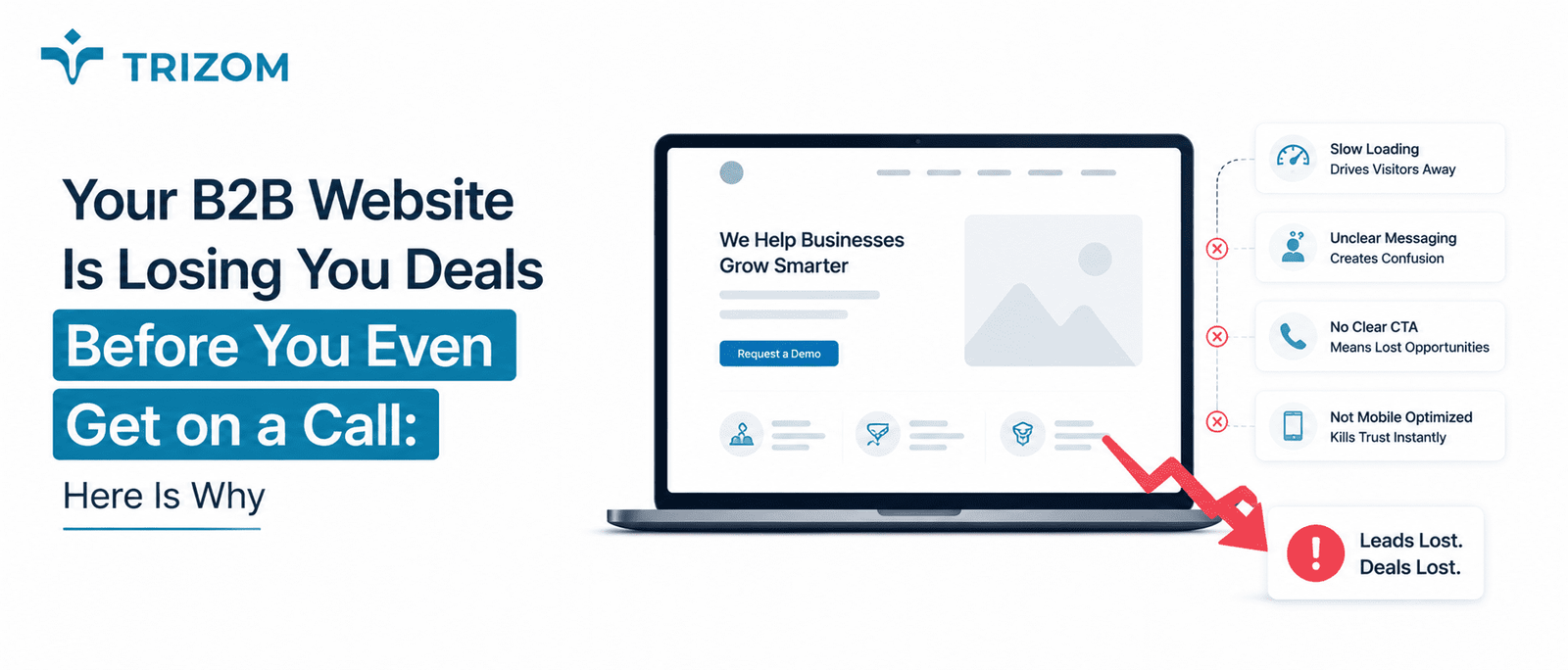
B2B website design in India has a serious credibility problem, and most founders do not realise it until a prospect tells them directly. Your conversion-optimised website is not a nice-to-have in 2026. It is the first sales meeting your business ever has.
And right now, most B2B websites in India are failing that meeting before the prospect scrolls past the hero section.
The Silent Deal Killer Sitting on Your Domain
Your website is open in a tab right now on a prospect’s browser. They found you through a referral, a LinkedIn post, or a Google search. They are evaluating whether you are worth a conversation.
You have approximately 7 seconds to convince them you are.
Here is what is going wrong in those 7 seconds, and why it is costing Indian B2B companies real pipeline every single day.
Problem 1: Your Above the Fold Design Communicates Nothing
Above the fold design is the first thing a visitor sees without scrolling. It is your most valuable piece of digital real estate.
Most Indian B2B websites waste it completely.
Generic headlines like “Welcome to Our Website” or “We Deliver Excellence” communicate nothing to a decision maker evaluating vendors. Your above-the-fold section must answer three questions instantly: what you do, who you do it for, and why you are the right choice.
If a visitor cannot answer all three within 5 seconds, they leave. They do not come back.
Problem 2: Your Website Load Time Is Destroying First Impressions
Website load time in India is a critical conversion variable that most B2B founders completely underestimate.
A page that takes more than 3 seconds to load loses over 50% of its visitors before they see a single word of your content. For a B2B website in India where each lost visitor could represent a high-value contract, this is an extraordinarily expensive problem.
Website speed optimisation in India is not a technical luxury. It is a sales priority.
Slow websites signal to decision makers that your operations are outdated. Fast websites signal that you take performance seriously. That perception forms before they read your headline.
Problem 3: No Clear CTA Placement on Key Pages
Your visitor is interested. They have scrolled through your service page, and they want to take the next step.
Then they cannot find how.
CTA placement on your website is one of the most consistently broken elements of Indian B2B websites. Calls to action buried in footers, hidden behind walls of text, or written in generic language like “Submit” or “Click Here” do not convert motivated visitors.
Every service page, case study page, and blog post needs a clear, specific, benefit-led CTA that tells the visitor exactly what happens next. “Book a 30-Minute Strategy Call” converts better than “Contact Us” every single time.
Problem 4: Your Website Has No Trust Signals
A B2B decision maker is about to recommend your company to their leadership team. They need ammunition to justify that recommendation.
Your website is not giving it to them.
Trust signals on a B2B website include client logos, case studies with specific outcomes, team credentials, certifications, testimonials from named individuals at real companies, and press mentions. Without these elements, your website looks identical to every other vendor they are evaluating.
UI UX design for B2B must deliberately place trust signals at the exact moments in the browsing experience where doubt is most likely to arise. Typically this is just before a CTA, just after a pricing section, and on any page where a visitor is being asked to commit.
Problem 5: Your Website Is Not Mobile First
Over 60% of B2B website traffic in India now comes from mobile devices. Yet most B2B website designs in India were built primarily for desktop and adapted for mobile as an afterthought.
A mobile-first website in India is not about shrinking your desktop design to fit a smaller screen. It is about designing the entire experience around how a decision maker actually browses on their phone during a commute, between meetings, or at an airport.
If your mobile experience has tiny text, broken layouts, or buttons that are difficult to tap, you are communicating carelessness. That perception transfers directly to how the prospect thinks about your attention to detail as a service provider.
Problem 6: Your Landing Page Design Does Not Match Your Ads
You are running Google Ads or LinkedIn campaigns. Someone clicks your ad and lands on your homepage.
Your homepage talks about everything your company does. The visitor came looking for one specific thing.
They leave.
Landing page design for B2B must match the exact promise made in the ad or content piece that brought the visitor there. Message match between your ad and your landing page is one of the most powerful conversion levers available, and one of the most ignored in Indian B2B marketing.
A dedicated landing page design for each B2B service you promote through paid channels consistently outperforms a generic homepage by a significant margin on both conversion rate and lead quality.
Problem 7: Your Bounce Rate Is High, and Nobody Is Investigating Why
A high bounce rate on your B2B website in India is your analytics dashboard telling you something is seriously wrong.
Most teams see the number, feel uncomfortable, and move on.
Bounce rate on a B2B website is a symptom of misalignment between what brought the visitor to the page and what they found when they arrived. It could be a keyword intent mismatch, a slow load time, a confusing above-the-fold layout, missing trust signals, or a combination of all of the above.
The fix requires diagnosis before prescription. And diagnosis requires someone who knows what to look for in the data.
What a Professionally Built B2B Website Actually Does
A professional website for a B2B company in India does not just look good. It works around the clock as your most consistent, scalable sales asset.
It qualifies visitors through clear positioning. It builds credibility through deliberate trust signals. It converts interest into action through strategic CTA placement. It loads fast enough to hold attention. It works flawlessly on every device. And it is built on a technically sound foundation like WordPress development for B2B that makes ongoing updates, SEO improvements, and content additions straightforward without months of developer dependency.
A business website redesign in India done correctly pays for itself in pipeline generated within the first quarter of going live.
How Trizom Fixes B2B Websites That Are Losing Deals
At Trizom, our B2B website design process in India starts with a conversion audit of your existing site. We identify every element that is costing you pipeline, from above-the-fold messaging and CTA placement to mobile experience, load time, and trust signal gaps.
We then rebuild or redesign your website as a conversion-optimised website that reflects the quality of your services, earns the trust of your target buyer, and gives your sales team a digital asset they can be proud to send a prospect to.
Your website should win deals before your sales team gets on the call. Right now, it is probably losing them.
Conclusion
Your B2B website design in India is either building your pipeline or quietly draining it. Slow load times, weak above-the-fold design, missing trust signals, poor CTA placement, and a broken mobile experience collectively ensure that qualified prospects leave your website without ever becoming leads. A conversion-optimised website in India built around your buyer’s decision journey fixes each of these failure points systematically. In 2026, your website is not your digital brochure. It is your highest-traffic salesperson, and it needs to perform like one.
Is your website winning deals or losing them?
Get a Free Website Audit from TRIZOM
Frequently Asked Questions

How much does a professional B2B website design in India cost?
The cost of professional website design for a B2B company in India varies significantly based on scope, complexity, and the development approach. A basic WordPress development for B2B with 8 to 12 pages, conversion optimised design, mobile first build, and SEO-ready architecture typically ranges from ₹50,000 to ₹1,50,000. A more complex business website redesign in India with custom functionality, CRM integration, multiple landing pages, and advanced UI UX design for B2B can range from ₹1,50,000 to ₹5,00,000 or more. The more relevant question is not what the website costs but what losing deals to a poorly performing website is costing you every month.
What makes a B2B website design convert visitors into leads in India?
A conversion optimised website in India for B2B companies combines several elements that work together to move a decision maker from curious visitor to qualified enquiry. Clear above the fold design that communicates your value proposition instantly, deliberate trust signals on your B2B website including client logos and specific case study outcomes, strategic CTA placement at every key decision point, fast website speed optimisation, a mobile first website experience that works flawlessly on every device, and landing page design for B2B that matches the specific intent of the visitor are all essential components of a website that consistently generates leads.
How important is mobile first website design for B2B companies in India?
Extremely important and consistently underestimated. Over 60% of B2B website traffic in India now originates from mobile devices, meaning the majority of your prospects are forming their first impression of your business on a phone screen. A mobile first website in India is designed from the ground up for the mobile browsing experience, not adapted from a desktop layout as an afterthought. Poor mobile UI UX design for B2B including small text, difficult navigation, and slow load times on mobile signals to decision makers that your company does not pay attention to detail, which is exactly the wrong impression to create before a sales conversation.
How long does a B2B website redesign take in India?
A standard business website redesign in India for a B2B company with 8 to 15 pages typically takes between 4 and 8 weeks from kickoff to launch. This includes discovery and strategy, wireframing and UI UX design for B2B, content development with landing page design for key service pages, WordPress development, speed optimisation, mobile testing, and pre-launch SEO setup. More complex projects involving custom functionality, CRM integration, or e-commerce capabilities may take 10 to 14 weeks. The timeline is directly influenced by how quickly the client can provide feedback, approvals, and content inputs during the process.