
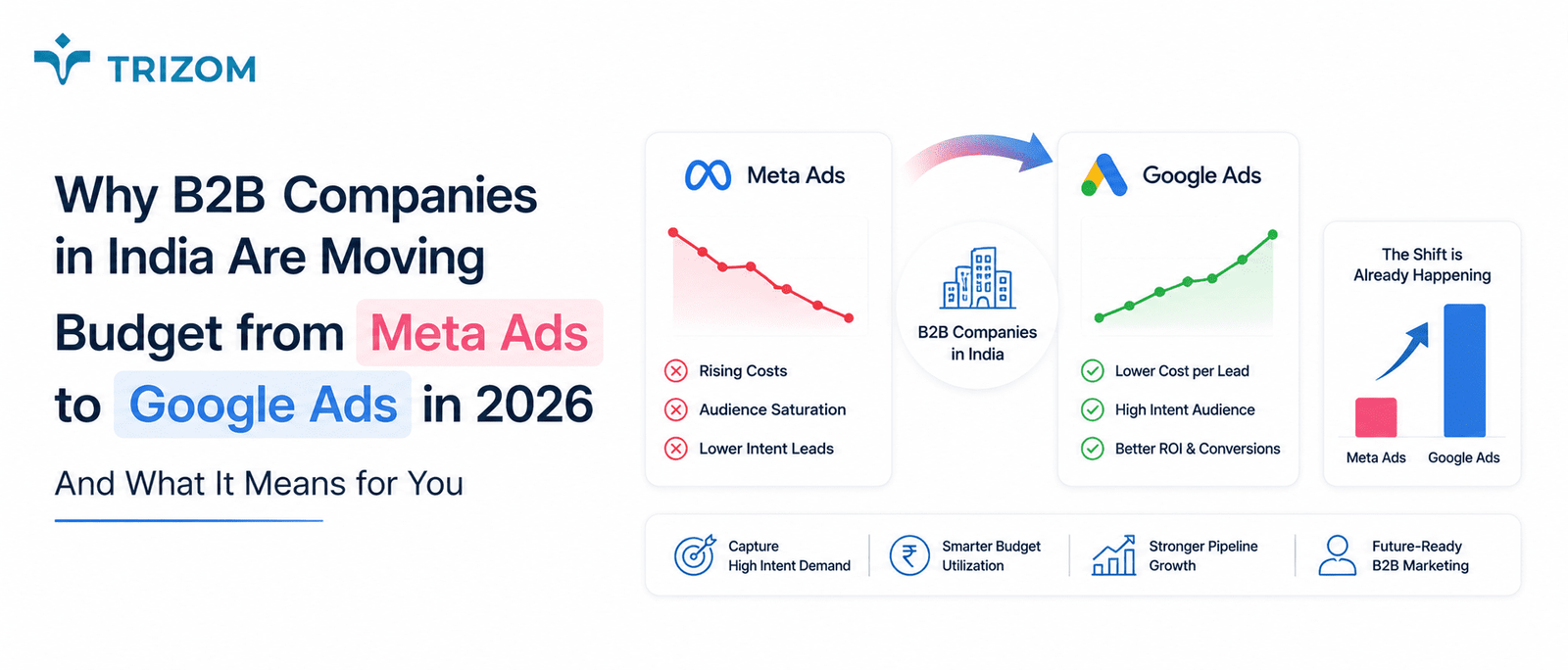
Meta Ads vs Google Ads for B2B in India is no longer a theoretical debate happening in marketing forums. It is a live budget reallocation decision being made by CMOs and performance marketing managers across Indian B2B companies right now, and the direction of that shift is becoming increasingly clear.
The question is not which platform is better in absolute terms. The question is which platform is better for your specific buyer, your specific sales cycle, and your specific revenue goal in 2026. And the answer to that question has changed significantly over the last eighteen months.
Here is what is driving the shift and what it means for how you allocate your paid advertising strategy for B2B in India going forward.
The Fundamental Problem with Meta Ads for B2B in India
Meta Ads, encompassing Facebook and Instagram, were built for consumer behaviour. The platform architecture, the algorithm, and the ad formats are all optimised for impulse-driven decisions made by individuals scrolling through personal content feeds.
Facebook Ads for B2B in India ask you to interrupt a decision maker who is looking at their cousin’s wedding photos and convince them in three seconds to care about your enterprise software, logistics solution, or professional service.
That is not impossible. But it is inefficient, and in 2026 the inefficiency is showing up clearly in Google Ads vs Meta Ads ROI comparisons across B2B accounts in India.
The core issue is intent. Meta captures passive audiences. Google captures active intent. And in B2B purchasing, intent is everything.
Why Google Ads Is Winning the B2B Budget Conversation in India
High Intent at the Moment That Matters Most
When a procurement manager in Mumbai types “cloud infrastructure management company India” into Google, they are not browsing. They are evaluating. That search represents a buyer who has already identified a problem, decided they need an external solution, and is now comparing vendors.
Lead generation ads in India in 2026 that appear at this moment of active intent convert at a fundamentally different rate than ads that interrupt passive scrolling behaviour on Meta.
For B2B companies with high-value contracts and long sales cycles, capturing a buyer at peak intent is worth far more than reaching ten times as many passive scrollers on Facebook.
Campaign Structure Built for B2B Buying Committees
A critical advantage of Google Ads for B2B is the ability to build campaign structure for B2B buying behaviour, where multiple stakeholders search for different aspects of the same solution at different stages of the evaluation process.
A technical director searches for implementation complexity. A CFO searches for pricing and ROI benchmarks. A CEO searches for vendor reputation and case studies. A well-structured Google Ads campaign can reach each of these decision-makers with a relevant message at their specific point of research, something B2B paid social advertising on India’s Meta platforms struggles to replicate with the same precision.
Where Meta Ads Still Earn Their Place in a B2B Paid Media Strategy
Before you reallocate your entire budget to Google, understand where B2B paid social advertising in India through Meta still delivers genuine value.
Top of Funnel Awareness at Scale
Meta Ads for B2B in India remain one of the most cost-effective ways to build broad brand awareness among a defined professional demographic. If your target audience includes startup founders, SME owners, or younger business decision-makers who spend significant time on Instagram and Facebook, Meta can introduce your brand at a lower CPM than almost any other digital channel.
The key is not to expect Meta to close deals. Expect it to start conversations and build familiarity.
Retargeting Campaigns That Recapture Intent
Retargeting for B2B in India is where Meta genuinely earns its allocation in a mature paid media strategy. Once a prospect has visited your website through a Google search or organic channel, Meta retargeting keeps your brand visible as they continue their evaluation process across their personal social feeds.
ROAS optimisation in India for B2B campaigns consistently shows that retargeting audiences on Meta convert at significantly higher rates than cold audiences, because the intent signal has already been established through another channel.
This is the correct role for Meta in a B2B paid media strategy in 2026. Not primary acquisition. Persistent re-engagement.
The Smarter Paid Advertising Strategy for B2B India in 2026
The B2B companies generating the strongest pipeline from paid media in India right now are not choosing between Google and Meta. They are sequencing them intelligently.
Google Ads captures high-intent buyers at the moment of active search. It fills the top of your qualified pipeline with prospects who are already in evaluation mode.
Meta Ads retarget those same prospects across their social feeds, reinforcing your brand message, sharing proof points, and keeping you front of mind during the weeks or months between their initial search and their final vendor decision.
This sequenced paid media strategy in India requires tight conversion tracking in India across both platforms, clear audience targeting segmentation between cold and warm audiences, and disciplined ad creative strategy for B2B that serves different messages at different stages of the buyer journey.
ROAS Optimisation Across Both Platforms
ROAS optimisation in India for B2B paid campaigns requires a unified view of the customer journey rather than optimising each platform in isolation. A prospect who clicked a Google Ad, visited your pricing page, saw three Meta retargeting ads, and then converted through a direct website visit should not be attributed to the last touchpoint alone.
Multi-touch attribution, even at a basic level, reveals that the cost per acquisition for B2B is almost always lower when Google and Meta work together as a sequenced strategy than when either platform operates in isolation.
How Trizom Builds Paid Media Strategies That Convert B2B Buyers
At Trizom, our paid advertising strategy for B2B in India is built around one principle: budget should follow buyer intent, not platform familiarity.
We audit your current Google and Meta Ads performance, identify where budget is being allocated versus where it is actually generating qualified pipeline, and rebuild your campaign architecture around a sequenced strategy that uses each platform for what it does best.
From campaign structure for B2B buying committees to ROAS optimisation across platforms and full conversion tracking setup in India, we manage every layer of your paid media ecosystem so your budget generates pipeline rather than just impressions.
Conclusion
Meta Ads vs Google Ads for B2B in India is not a winner-takes-all decision in 2026. It is a sequencing and allocation decision. Google Ads wins on intent capture and direct lead generation for high-value B2B buyers. Meta Ads wins on brand awareness and retargeting for prospects already in your funnel. The Indian B2B companies generating the strongest returns from their paid advertising strategy are the ones running both platforms with clear roles, tight conversion tracking, and a unified view of the buyer journey from first search to signed contract. The shift happening in 2026 is not away from Meta entirely. It is toward smarter allocation that respects how B2B buyers actually make decisions.
Is your paid media budget allocated where your buyers actually convert?
Get a Free Paid Media Audit from Trizom
Frequently Asked Questions

Why are Meta Ads less effective for B2B lead generation in India compared to Google Ads?
Facebook Ads for B2B in India underperform Google Ads on direct lead generation because Meta is a passive discovery platform where users are not actively searching for business solutions. B2B buying decisions involve multiple stakeholders, long evaluation cycles, and high purchase values, all of which require intent-based targeting that Google's search network delivers far more effectively. B2B paid social advertising in India through Meta works best as a retargeting and brand awareness tool rather than a primary lead generation channel, which is why the Google Ads vs Meta Ads ROI comparison consistently favours Google for direct B2B pipeline impact.
What is the best paid media strategy for B2B companies in India in 2026?
The most effective paid media strategy for B2B India in 2026 combines Google Search Ads for high-intent acquisition with Meta retargeting for prospect re-engagement, supported by strong conversion tracking in India that gives you a unified view of the buyer journey across both platforms. Within Google, a well-structured campaign structure for B2B targets different buyer roles and search intents at different stages of the evaluation process. Within Meta, retargeting for B2B in India focuses exclusively on warm audiences who have already engaged with your brand through search or organic channels, significantly improving cost per acquisition for B2B across your overall paid investment.
How does retargeting work for B2B companies running paid ads in India?
Retargeting for B2B in India involves showing paid ads specifically to people who have previously visited your website, engaged with your content, or interacted with your brand through another channel. On Meta, retargeting uses the Facebook Pixel to identify website visitors and serve them relevant ads across Facebook and Instagram feeds during their ongoing evaluation period. On Google, retargeting through Display and YouTube reaches the same prospects across millions of websites. For B2B companies, retargeting consistently delivers the lowest cost per acquisition in the paid media mix because you are re-engaging buyers who have already demonstrated intent rather than trying to generate interest from a cold audience.
How do you measure ROAS for B2B paid advertising campaigns in India?
Measuring ROAS optimisation in India for B2B campaigns requires a different approach than B2C because B2B conversions are rarely immediate transactions. Effective ROAS measurement for B2B paid advertising tracks lead quality metrics alongside volume metrics, assigns pipeline value to each lead source based on historical close rates and average deal sizes, and uses multi-touch attribution to distribute revenue credit across Google Ads, Meta retargeting, and other paid touchpoints that contributed to a conversion. Proper conversion tracking in India across both Google and Meta platforms, integrated with your CRM, is the foundation of meaningful ROAS optimisation for any B2B paid social advertising strategy in India.