
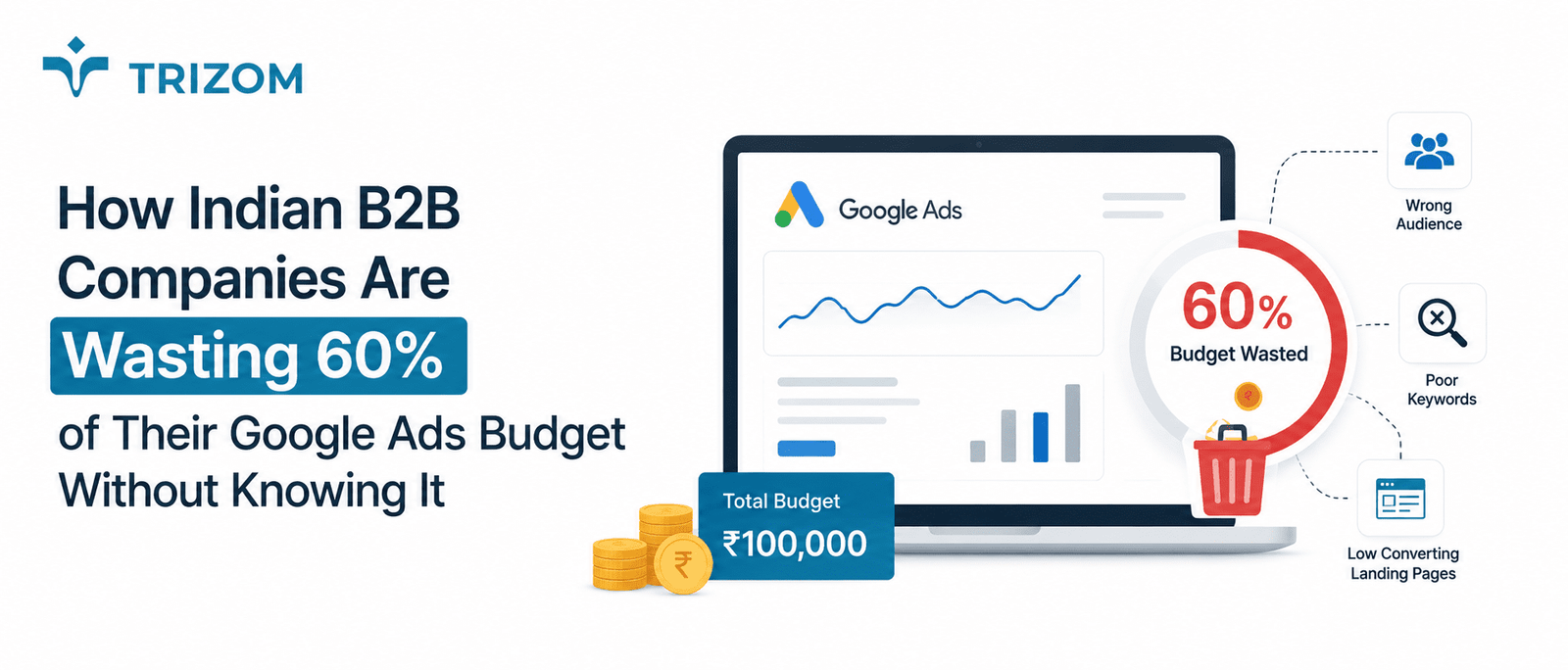
According to WordStream, the average Google Ads conversion rate across B2B industries sits at just 3.75%. Yet most Indian B2B companies running paid search campaigns are converting at well below that, while continuing to increase their monthly budgets, hoping the numbers will eventually improve.
They will not. Not without fixing what is actually broken.
If you are a marketing manager or business owner running Google Ads for B2B in India and your cost per lead keeps climbing while your pipeline stays flat, the problem is almost certainly not your budget. It is where that budget is going.
The Uncomfortable Truth About B2B Google Ads in India
Most B2B companies in India set up their PPC campaigns once, let them run, and optimise only when the numbers become impossible to ignore.
By that point, months of ad spend have already been wasted on the wrong audiences, the wrong keywords, and the wrong bidding strategies. A PPC campaign audit in India conducted on a typical B2B account will almost always reveal the same pattern: significant budget leakage happening across multiple layers simultaneously.
Here is exactly where it is happening in your account.
Where Your Google Ads Budget Is Leaking
-
No Negative Keyword List
This is the single biggest source of wasted ad spend in B2B Google Ads accounts across India.
Without a properly maintained negative keyword list, your ads show up for searches that have nothing to do with your buyers. A software company targeting procurement managers ends up paying for clicks from students searching for internships. A logistics firm targeting supply chain heads pays for clicks from job seekers searching for driver positions.
Every irrelevant click costs you money. Over a month, those clicks add up to a significant portion of your Google Ads budget optimisation problem, and the fix costs nothing except attention.
-
Ignoring the Search Term Report
The search term report is one of the most powerful tools inside Google Ads and one of the least visited by B2B marketing teams in India.
This report shows you the exact queries that triggered your ads. Not the keywords you targeted. The actual searches people typed before clicking your ad and spending your budget.
In a typical PPC campaign audit in India, the search term report reveals dozens of irrelevant, low-intent, or completely unrelated queries eating into the monthly budget. Mining this report weekly and converting wasted terms into negatives is one of the fastest ways to reduce cost per lead in India without touching your budget ceiling.
-
Poor Quality Score Management
Quality score improvement is directly tied to how much you pay per click. Google rewards ads that are relevant to the search query and the landing page experience. Low quality scores mean you pay more for the same placement than a competitor with a better-structured campaign.
Most B2B Google Ads accounts in India have quality scores sitting between 3 and 5 on core keywords, which means they are paying a premium for every click. Improving ad relevance, tightening keyword-to-ad copy alignment, and fixing landing page relevance can improve quality scores significantly and directly reduce your cost per click without reducing your visibility.
-
Weak Conversion Tracking Setup
This is where PPC management in India gets particularly costly.
If your conversion tracking setup in India is incomplete, misconfigured, or not tracking the right actions, you are essentially flying blind. Google’s smart bidding algorithms optimise toward the conversion signals you give them. If those signals are wrong, the algorithm optimises toward the wrong outcomes and spends your budget accordingly.
A proper conversion tracking setup tracks form submissions, phone calls, WhatsApp initiations, and demo bookings separately, giving Google the data it needs to find more of the right buyers and fewer of the wrong ones.
-
No Ad Schedule Optimisation
Ad schedule optimisation is consistently overlooked in B2B campaigns, yet it can recover a meaningful percentage of wasted spend almost immediately.
B2B buyers in India typically research and engage during business hours, Monday through Friday. Running your pay-per-click advertising in India at full budget on Sunday evenings or late nights when decision-makers are not at their desks means you are paying for impressions and clicks that will never convert into a sales conversation.
Analysing your conversion data by hour and day, then adjusting your bid modifiers and scheduling accordingly, is a fundamental part of any serious B2B lead generation Google Ads strategy.
-
Weak Bid Strategy for B2B
Most B2B companies in India default to Maximise Clicks as their bidding strategy without understanding that this tells Google to get you the most clicks possible, not the most relevant or highest-intent clicks.
A proper bid strategy for B2B depends on your campaign maturity, conversion data volume, and cost per acquisition targets. Moving to Target CPA or Target ROAS bidding once you have sufficient conversion data allows Google’s algorithm to focus your budget on searches most likely to result in an actual lead, dramatically improving your Google Ads budget optimisation over time.
Why B2B Lead Generation on Google Ads Requires a Different Approach
B2B lead generation on Google Ads is fundamentally different from B2C. The keywords are lower volume, the clicks are more expensive, the sales cycles are longer, and the decision-makers are far more difficult to reach.
Every rupee of wasted ad spend in B2B campaigns carries a higher opportunity cost than in consumer-facing campaigns, because the pool of high-intent buyers is smaller and the value of each converted lead is significantly higher.
This is why a PPC campaign audit in India for a B2B company is not a quarterly exercise. It is an ongoing discipline that separates campaigns that compound in performance over time from those that drain budget month after month with nothing to show for it.
How Trizom Stops the Bleed
At Trizom, our PPC management process for B2B companies begins with a forensic audit of your existing Google Ads account. We identify every source of budget leakage, from missing negative keyword lists and ignored search term reports to broken conversion tracking and misaligned bid strategies.
We then rebuild your campaign architecture around your actual buyers, optimise for lead quality over click volume, and set up the conversion tracking infrastructure that gives Google’s algorithm the right signals to work with.
The result is not just a lower cost per lead. It is a pipeline that grows in proportion to the budget you are already spending.
Conclusion
Indian B2B companies running Google Ads are consistently losing a significant portion of their monthly budget to preventable, fixable problems. Missing negative keyword lists, unreviewed search term reports, poor quality scores, broken conversion tracking, unoptimised ad schedules, and weak bid strategies are collectively responsible for the gap between what you spend and what you generate. A structured PPC campaign audit in India is the fastest way to stop the bleed, improve your cost per lead, and turn your Google Ads investment into a predictable source of qualified B2B leads. The budget you need is likely already in your account. It just needs to be pointed in the right direction.
Is your Google Ads account leaking budget every day?
Request a Free PPC Audit from Trizom
Frequently Asked Questions

How does a PPC campaign audit in India help reduce wasted ad spend for B2B companies?
A PPC campaign audit in India reviews every layer of your Google Ads account, including your search term report, negative keyword list, quality scores, bid strategy, ad schedule optimisation, and conversion tracking setup. For B2B companies, this audit almost always uncovers significant wasted ad spend flowing toward irrelevant searches, low-intent audiences, and poorly structured campaigns. Fixing these issues systematically is the most direct way to reduce cost per lead in India without increasing your monthly budget.
What is a negative keyword list and why does every B2B Google Ads account in India need one?
A negative keyword list is a set of search terms you explicitly tell Google not to show your ads for. Without one, your pay per click advertising in India budget gets spent on searches that have nothing to do with your buyers, including job seekers, students, competitors, and completely unrelated queries. For B2B companies in India where each click can cost between ₹80 and ₹300, allowing irrelevant searches to trigger your ads is one of the fastest ways to drain your Google Ads budget without generating a single qualified lead. Building and maintaining a negative keyword list is a non-negotiable part of effective PPC management in India.
How does quality score improvement lower the cost per lead for B2B Google Ads campaigns in India?
Quality score improvement directly reduces what you pay per click because Google rewards advertisers whose ads are highly relevant to the search query and whose landing pages deliver a strong user experience. A B2B company with a quality score of 7 or above on core keywords pays significantly less per click than a competitor with a score of 3 or 4 for the same keyword. Improving landing page relevance, tightening the alignment between your keywords and ad copy, and ensuring your destination pages load fast are the primary levers for quality score improvement and are central to any serious Google Ads budget optimisation strategy for B2B companies in India.
What bid strategy works best for B2B lead generation on Google Ads in India?
The best bid strategy for B2B lead generation on Google Ads in India depends on the maturity of your campaign and the volume of conversion data available. New campaigns with limited data typically perform better on Manual CPC or Maximise Conversions with a target CPA ceiling. Once your conversion tracking setup in India has recorded at least 30 to 50 conversions per month, moving to Target CPA or Target ROAS bidding allows Google's algorithm to optimise toward your actual cost per lead goal. The critical mistake most B2B companies in India make is running pay-per-click advertising on Maximise Clicks indefinitely, which prioritises traffic volume over lead quality and consistently produces high spend with low pipeline returns.